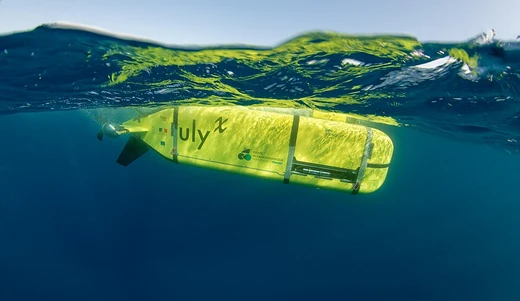
USV Suppressor
Multi-purpose USV for Brazilian Navy, built by EMGEPRON and Tidewise.

The USV Suppressor is an unmanned surface vehicle being built for the Brazilian Navy. Classified by EMGEPRON as a multi-purpose unmanned surface vehicle, it is designed for both civilian and military tasks, such as hydrographic surveys, environmental monitoring, mine countermeasures, intelligence, surveillance and reconnaissance (ISR), and anti-submarine warfare (ASW).
The vessel is equipped with a navigation radar, 360° LIDAR, FLIR cameras, and a hull-mounted multibeam sonar. Its adaptable rear deck can carry a remotely operated vehicle (ROV), autonomous underwater vehicle (AUV), or unmanned aerial vehicle (UAV), depending on the mission. The USV can be operated remotely or follow a pre-programmed route autonomously. Its control station is housed in a 20-foot container, enabling deployment from vessels like the Tamandaré-class frigates.
The project is a partnership between state-owned EMGEPRON and Tidewise, a Rio de Janeiro startup specializing in autonomous maritime systems. It was first unveiled in October 2023 during the Brazilian Navy’s MINEX-23 exercise off the coast of Salvador, where a prototype performed mine countermeasures duties. On 7 February 2024, EMGEPRON and Tidewise signed a contract worth R$20 million to build the first Suppressor USV in its basic configuration, which includes navigation sensors, a multibeam sonar, and a ROV, along with the development of an application programming interface for communications. Delivery of the first unit is expected by the end of 2025.
- Type
- Multi-purpose Unmanned Surface Vehicle
- Operator
- Brazilian Navy
- Developers
- EMGEPRON and Tidewise
- Contract signed
- 7 February 2024
- Estimated cost
- R$20 million
- First presented
- October 2023
- Expected delivery
- End of 2025
Lore & Background
The USV Suppressor was first presented in October 2023 during the MINEX-23 Brazilian Navy exercise off the coast of Salvador, where a prototype was tasked with mine countermeasures duties. On 7 February 2024, EMGEPRON and Tidewise signed a contract for the construction of the first Suppressor USV at an estimated cost of R$20 million. The unit is being built in its basic configuration, which includes navigation sensors, a multibeam sonar, and a remotely operated vehicle (ROV), along with the development of an Application Programming Interface (API) for communications. Delivery of the first unit is expected towards the end of 2025.
The USV features a navigation radar and a variety of sensors, including 360° LIDAR, FLIR cameras, and a hull-mounted multibeam sonar. It has an adaptable rear deck that can carry a ROV, autonomous underwater vehicle (AUV), or unmanned aerial vehicle (UAV) payload depending on the mission configuration. The vessel may be either remotely operated or autonomously follow a pre-programmed route. Its control station is packed in a 20-foot container, allowing operation from vessels such as the Tamandaré-class frigates.
Reader's Guide
The USV Suppressor represents a notable step in Brazil's development of unmanned maritime systems, combining civilian and military capabilities in a single platform. Its adaptable rear deck and sensor suite—including 360° LIDAR, FLIR cameras, and multibeam sonar—allow it to perform roles ranging from hydrographic surveys to mine countermeasures and ASW. The partnership between state-owned EMGEPRON and the startup Tidewise highlights a blend of institutional and private-sector innovation. The vessel's control station, housed in a 20-foot container, enables deployment from Tamandaré-class frigates, integrating it into existing naval operations. The contract signed in February 2024 for R$20 million and the expected delivery by the end of 2025 mark a concrete milestone in the program's progression from prototype to production. The Suppressor's ability to operate remotely or autonomously, and its compatibility with ROV, AUV, and UAV payloads, positions it as a flexible asset for Brazil's maritime security and environmental monitoring needs.
Did You Know?
- The USV Suppressor was first presented during the MINEX-23 Brazilian Navy exercise in October 2023.
- It is being built by EMGEPRON in partnership with the Rio de Janeiro-based startup Tidewise.
- The contract for the first unit was signed on 7 February 2024 at an estimated cost of R$20 million.
- The vessel's control station is packed in a 20-foot container for operation from Tamandaré-class frigates.
More in Underwater and Surface Drones, Part 2 1-24
Spotted an error? Know more?
Reader corrections go straight into our review queue. Suggest an edit · How this site is sourced