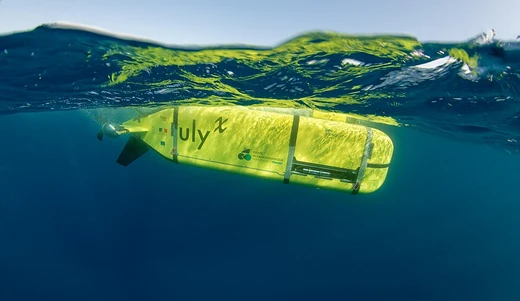
SPURV II
AUV built to study SSBN wakes from 1973 into the 1980s.

SPURV II (Special Purpose Underwater Research Vehicle) was an Autonomous Underwater Vehicle created in 1973 by the Ocean Physics Department at the University of Washington’s Applied Physics Laboratory. Its purpose was to investigate the wakes of SSBN submarines.
The vehicle could operate at variable speeds, reaching depths of 1,500 meters for about six hours. It carried sensors that measured temperature and velocity at 1 kHz, temperature and conductivity at 100 Hz, and temperature, conductivity, pressure, and dye concentration at 10 Hz. Between its 1975 and 1979 configurations, SPURV II underwent significant upgrades: the internal recording capacity and instrumentation were expanded, allowing all sensor data—temperature and velocity at 1 kHz; temperature, conductivity, and velocity at 100 Hz; and more precise readings of temperature, conductivity, dye concentration, and pressure at 10 Hz—to be recorded for the full six-hour mission.
SPURV II was deployed to measure submarine wakes at the St. Croix tracking range during the "Coral Trail" experiment in 1975 and again in the "Hydro" experiment in 1979. It remained in use into the 1980s. The 10 Hz temperature and conductivity sensors were placed at vertical positions of 1/3, 2/3, and 1 meter apart. This arrangement allowed accurate measurement of spatial and temporal correlations among temperature, conductivity, and velocity, distinguishing between areas inside a dyed wake and those outside it.
- Year built
- 1973
- Builder
- Ocean Physics Department, Applied Physics Laboratory, University of Washington
- Depth capability
- 1500 meters
- Endurance
- 6 hours
- Sensors
- Temperature, conductivity, velocity, pressure, dye concentration
- Operational period
- Until the 1980s
Lore & Background
SPURV II was developed at the University of Washington's Applied Physics Laboratory to measure the wakes of ballistic missile submarines. Its instrumentation and internal recording capacity were significantly increased between its 1975 operational state and its final 1979 state. In its later configuration, all sensors—temperature and velocity at 1 kHz, temperature, conductivity and velocity at 100 Hz, and temperature, conductivity, dye concentration, and pressure at 10 Hz—could be recorded for up to 6 hours.
The vehicle was used in two major experiments at the St. Croix tracking range: the "Coral Trail" experiment in 1975 and "Hydro" in 1979. The 10 Hz temperature and conductivity sensors were positioned at 1/3, 2/3, and 1 meter vertically to accurately measure spatial and temporal correlations of temperature, conductivity, and velocity in dyed wake versus non-dyed water.
SPURV II had variable speed and could operate to depths of 1500 meters. It carried instruments that measured temperature and velocity at 1 kHz, temperature and conductivity at 100 Hz, and temperature, conductivity, pressure, and dye concentration at 10 Hz.
Reader's Guide
SPURV II represents an early dedicated effort to use autonomous underwater vehicles for military oceanography, specifically targeting the detection and characterization of submarine wakes. Its development at the Applied Physics Laboratory at the University of Washington in 1973 placed it among the pioneering AUVs designed for operational research rather than pure oceanographic survey. The vehicle's ability to record multiple sensor streams at different sampling rates—1 kHz for temperature and velocity, 100 Hz for temperature and conductivity, and 10 Hz for temperature, conductivity, dye concentration, and pressure—allowed detailed study of wake dynamics. The vertical arrangement of its 10 Hz sensors at 1/3, 2/3, and 1 meter enabled precise spatial correlation measurements. Its use in the "Coral Trail" (1975) and "Hydro" (1979) experiments at the St. Croix tracking range provided data on the differences between dyed wake water and ambient water. SPURV II continued in service into the 1980s, contributing to the understanding of submarine wake signatures. Its legacy is as a specialized research tool that advanced the application of AUVs for naval purposes.
Did You Know?
- SPURV II was built in 1973 to study SSBN wakes.
- It could operate to depths of 1500 meters for up to 6 hours.
More in Underwater and Surface Drones, Part 2 1-24
Spotted an error? Know more?
Reader corrections go straight into our review queue. Suggest an edit · How this site is sourced