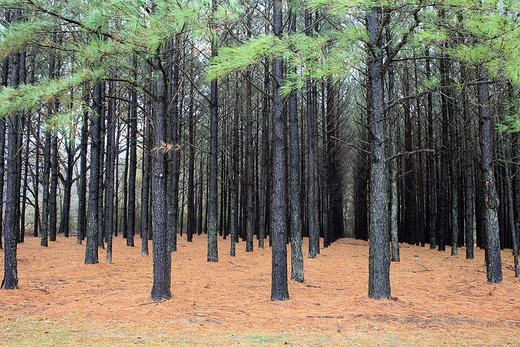
Populus trichocarpa
A fast-growing poplar model for plant biology and timber.

Populus trichocarpa—commonly called black cottonwood, western balsam-poplar, or California poplar—is a broadleaf deciduous tree that grows naturally across western North America. It provides timber and serves as a key model species in plant biology. Each spring, its seeds release a distinctive cottony fluff into the air.
This species is a large tree, reaching 30 to 50 meters tall with trunks over 2 meters in diameter. Among poplar species, it ranks third in the American Forests Champion Tree Registry. Although most trees are relatively short-lived, some can survive up to 400 years. The current national and world record holder stands in Willamette Mission State Park near Salem, Oregon; when last measured in April 2008, it was 47 meters tall, 8.8 meters around, and scored 527 points.
The bark is gray and covered with lenticels, becoming thick and deeply cracked on older trees. It can get hard enough that cutting it with a chainsaw produces sparks. Older stems are gray, while younger ones are light brown. The crown is typically dense and roughly conical, with lower branches drooping on large trees. Spur shoots are common. The wood is light-colored and straight-grained.
Leaves are usually 7 to 20 centimeters long, glossy dark green on top and glaucous light gray-green underneath; on stump sprouts or very vigorous young trees, leaves can reach 30 centimeters. They are alternate, elliptical, with a crenate margin, an acute tip, and reticulate venation. The petiole is reddish. Buds are conical, long, narrow, and sticky, releasing a strong balsam scent when they open in spring.
The root system is extensive and aggressive, capable of invading and damaging drainage systems. In some cases, roots can even undermine building foundations by drying out the soil.
Reproduction is dioecious—male and female catkins occur on separate trees. Flowering begins around age 10. In Washington and Oregon, flowers appear from early March to late May; in northern and interior British Columbia, Idaho, and Montana, they may appear as late as mid-June. Staminate catkins have 30 to 60 stamens, are 2 to 3 centimeters long, and fall off. Their pollen can be an allergen. Pistillate catkins mature to 8 to 20 centimeters long, bearing rotund-ovate, tricarpellate, subsessile fruits 5 to 8 millimeters long.
Quick Facts
- Genus
- Populus
- Parent
- Populus sect. Tacamahaca
- Species
- trichocarpa
Facts from the source article.
Lore & Background
The species is dioecious, with male and female catkins on separate trees. Flowers appear from early March to late May in Washington and Oregon, and as late as mid-June in northern areas. Seeds ripen by late May to late July depending on location, and are dispersed by wind and water via cottony hairs. Seed longevity under natural conditions may be as short as two weeks to a month. Germination is epigeal and requires moist seedbeds; seedlings are shade-intolerant and thin out naturally by age five. The tree also reproduces vegetatively through rooting of branch fragments, stumps, and root sprouts, and can abscise shoots with green leaves that may root on the ground.
Reader's Guide
Populus trichocarpa is significant as a model organism in plant biology, providing insights into tree genetics and physiology. Its rapid growth and extensive root system make it valuable for timber and for colonizing disturbed alluvial sites, though its roots can damage drainage systems and building foundations. The tree has been successfully introduced to the Faroe Islands and Iceland, where it became widespread. Ecologically, it hybridizes with three other poplar species in the Pacific Northwest and provides habitat for animals; beavers use it for food and dam-building. Native American tribes utilized its wood, bark, and sap for tools, construction, and medicine. Modern uses include perfume from bud extracts and pet snake bedding from shredded wood. Its conservation status is considered secure as a subspecies of Populus balsamifera.
Did You Know?
- In 2016, the first direct evidence was published indicating that wild P. trichocarpa fixes nitrogen.
- The tree's bark can become hard enough to cause sparks when cut with a chainsaw.
- The species was imported from Alaska to Iceland in 1944 and has since become one of the most widespread trees there.
- The gum-like sap was used by Native Americans as glue or waterproofing.
More in Trees And Forest Species 1-24
Spotted an error? Know more?
Reader corrections go straight into our review queue. Suggest an edit · How this site is sourced