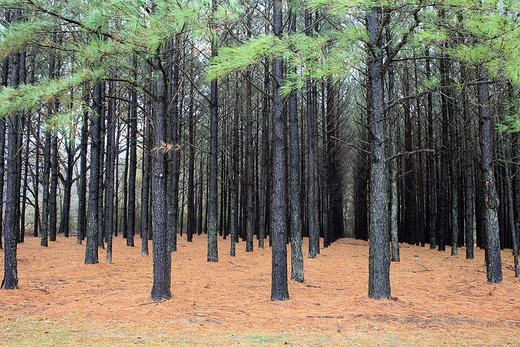
Populus tremuloides
A widely distributed North American tree known for trembling leaves.

Populus tremuloides, commonly known as quaking aspen, trembling aspen, or American aspen, is a deciduous tree native to cooler areas of North America. It boasts the widest latitudinal range of any North American tree, stretching from Canada to central Mexico, and is the defining species of the aspen parkland biome in the Prairie Provinces of Canada and extreme northwest Minnesota.
Quick Facts
- Genus
- Populus
- Parent
- Populus sect. Populus
- Species
- tremuloides
Facts from the source article.
Lore & Background
Populus tremuloides is a tall, fast-growing tree with smooth, whitish bark marked by thick black horizontal scars and black knots. Its nearly round leaves, green above and gray below, have flattened petioles that cause them to twist and tremble in the wind, giving the tree its common names. The species is dioecious, with separate male and female clones, and produces catkins in early spring followed by pendulous strings of capsules containing cottony seeds. Trees typically do not begin seed production until at least 10–20 years of age, with best production between ages 50 and 70.
Reader's Guide
Populus tremuloides is ecologically significant as the most widely distributed tree in North America, spanning from Canada to central Mexico and defining the aspen parkland biome. It propagates primarily through root sprouts, forming extensive clonal colonies, including the famous Pando colony, considered the heaviest and oldest living organism on the planet, weighing six million kilograms and spanning 43 hectares. The species provides food and habitat for numerous animals, including snowshoe hares, moose, black bears, deer, elk, beavers, and various birds. Its leaves serve as food for caterpillars of moths and butterflies. Since the early 1990s, increased dieback has been reported across North America, linked to multiple stressors such as defoliation by forest tent caterpillars, wood-boring beetles, fungal disturbances, ungulate grazing, wildfire suppression, and climate change, including drought and thaw-freeze events. The species' ability to resprout after fire and its role in competing with conifers highlight its importance in forest dynamics.
Did You Know?
- One clonal colony, named Pando, is considered the heaviest and oldest living organism on the planet, spanning 43 hectares and weighing six million kilograms.
- The specific epithet tremuloides can be literally translated as 'like (Populus) tremula', the Eurasian trembling aspen.
- Aspens are dioecious, with separate male and female clones, and large stands are usually all clones of the same sex.
- The leaves on mature trees are nearly round, 4–6 cm in diameter, with a flattened petiole that causes them to twist in the wind.
More in Trees And Forest Species 1-24
Spotted an error? Know more?
Reader corrections go straight into our review queue. Suggest an edit · How this site is sourced