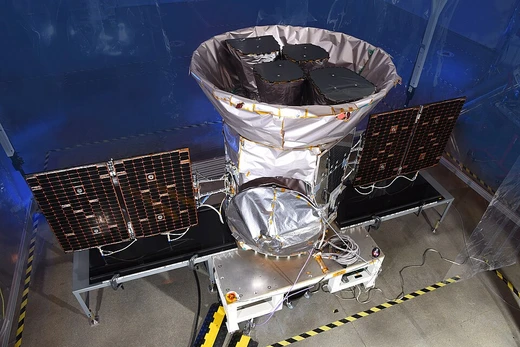
WASP-18b
A hot Jupiter spiraling toward its star in under a million years.
WASP-18b is an exoplanet orbiting the star WASP-18, located approximately 400 light-years from Earth. It is notable for having an orbital period of less than one day and a mass equal to 10 Jupiter masses, placing it just below the boundary between planets and brown dwarfs (about 13 Jupiter masses). Due to tidal deceleration, the planet is expected to spiral toward and eventually merge with its host star in less than a million years, with less than 0.1% of its lifetime remaining.
Quick Facts
- Discoverer
- Hellier et al. (SuperWASP)
- Discovered
- August 27, 2009
- Discovery Method
- Transit (including secondary eclipses)
- Apsis
- astron
- Eccentricity
- 0.0051 · 0.0070 · 0.0037
- Period
- 0.941452379 · (16) days / (0.941452379 day hours)
- Star
- WASP-18
Facts from the source article.
Lore & Background
Discovered in 2009 by a team led by Coel Hellier, WASP-18b is an ultra-hot Jupiter with a dayside temperature measured at 3029 K in 2020, and an average dayside temperature of 2781 K according to a 2023 study. The planet's orbit is well aligned with the equatorial plane of its star, with a misalignment of 13°, as determined by a 2012 study using the Rossiter–McLaughlin effect. Scientists at Keele University and the University of Maryland are investigating whether the discovery of this planet so shortly before its expected demise was fortuitous, or whether tidal dissipation by WASP-18 is much less efficient than typically assumed. Observations over the next decade should yield a measurement of the rate at which WASP-18b's orbit is decaying. The closest Solar System analog is Mars' moon Phobos, which orbits Mars at about 9000 km and is expected to be destroyed in about eleven million years.
Reader's Guide
WASP-18b holds significance as one of the shortest-period exoplanets known, with an orbital period under one day, and as a test case for tidal decay theories. Its expected merger with its host star in less than a million years—representing less than 0.1% of its lifetime—raises questions about whether its discovery was a statistical fluke or an indication that tidal dissipation in WASP-18 is weaker than standard models predict. The planet's atmosphere has been studied extensively: a 2017 study detected carbon monoxide without signs of water vapor, but in 2023 the James Webb Space Telescope detected water vapor. Observations with JWST's Near Infrared Imager and Slitless Spectrograph created a resolved atmosphere in multiple dimensions, confirming theoretical models that predicted a weaker longitudinal temperature gradient and highlighting the roles of hydrogen dissociation and nightside clouds in shaping thermal emission. Two thermally distinct regions were identified: a hotspot near the substellar point with a strongly inverted thermal structure and marginally lower water abundance, and a cooler ring near the dayside limb with poorly constrained chemical abundances. The planet's fate and atmospheric properties make it a key object for understanding the evolution and composition of ultra-hot Jupiters.
Did You Know?
- WASP-18b has a mass of 10 Jupiter masses, just below the 13-Jupiter-mass boundary between planets and brown dwarfs.
- The planet is expected to spiral into its host star in less than a million years due to tidal deceleration.
- A 2023 study using JWST detected water vapor in the planet's atmosphere, while a 2017 study had found carbon monoxide but no water.
More in Transiting Exoplanets, Part 3 1-24
Spotted an error? Know more?
Reader corrections go straight into our review queue. Suggest an edit · How this site is sourced