TOI-2431 b
A rocky exoplanet with one of the shortest known orbits.
TOI-2431 b is an extrasolar planet orbiting the orange dwarf star TOI-2431. It is notable for its extremely short orbital period of 5 hours 22 minutes, one of the shortest known, and for its high density, which implies a rocky composition. The planet is expected to be torn apart by its host star in about 31 million years.
Quick Facts
- Discoverer
- Tas et al. (2025)
- Discovery Site
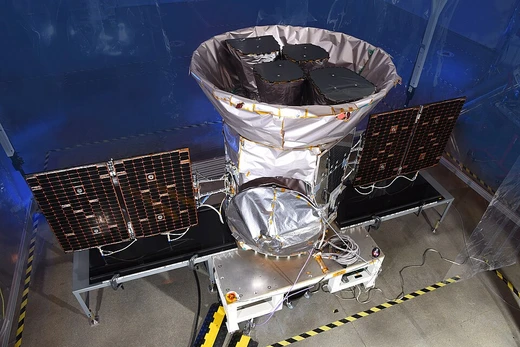
- TESS
- Discovered
- July 2025
- Discovery Method
- Transit
- Eccentricity
- 0
- Period
- 0.22419577 · (7) days
- Inclination
- 74 · 1
Facts from the source article.
Lore & Background
TOI-2431 b was initially detected as a candidate in 2019 by the Transiting Exoplanet Survey Satellite. While still a candidate, it was briefly mentioned in a 2021 HST proposal and a 2022 study about the detection of an evaporating atmosphere made of rock vapor. The planet was confirmed in 2025 using transit photometry from TESS and Doppler spectroscopy from the NEID and Habitable-zone Planet Finder spectrographs, along with imaging to rule out artifacts from background stars.
The planet has about 1.54 times Earth's radius and 6.2 times Earth's mass, giving it a density significantly higher than Earth's and implying a rocky composition. Its orbit is extremely close to the host star, at a separation of 0.0063 au, with zero eccentricity. The separation is only 30% wider than the star's Roche lobe and is decaying, leading to a remaining lifetime of about 31 million years before the planet is torn apart. The close orbit also means the planet is tidally locked, with one side permanently facing the star, and its equilibrium temperature is estimated at 2063 K, suggesting the dayside is likely molten lava.
The host star, TOI-2431 (HIP 11707), is a K-type main-sequence star in the constellation Cetus, located 117.4 light-years away. It has 0.66 times the mass of the Sun and 0.651 times the Sun's radius, with an apparent magnitude of 10.89.
Reader's Guide
TOI-2431 b is significant as one of the few known rocky exoplanets with an orbital period under a day, ranking sixth-shortest as of 2025. Its high density and small size indicate a solid, rocky composition, unusual for planets so close to their stars, which are often gas giants. The planet's extreme irradiation and temperature suggest its dayside is covered in molten lava, and it may possess an atmosphere composed of rock vapor on the permanent dayside. Such an atmosphere could be detectable via transmission spectroscopy with powerful telescopes like the James Webb Space Telescope, and TOI-2431's relatively bright apparent magnitude makes this planet a high-priority target for such observations. The planet's orbital decay and impending destruction within 31 million years provide a rare opportunity to study the final stages of a planet's life as it approaches its star's Roche lobe. Its confirmation in 2025 through a combination of transit photometry and Doppler spectroscopy, along with careful imaging to exclude false positives, solidifies its status as a well-characterized ultra-short-period rocky world.
Did You Know?
- TOI-2431 b has an orbital period of only 5 hours 22 minutes, the sixth-shortest known as of 2025.
- The planet's density is significantly higher than Earth's, implying a rocky composition.
- Its dayside is likely made of molten lava due to an equilibrium temperature of 2063 K.
Frequently Asked Questions
What is TOI-2431 b?
TOI-2431 b is a compact rocky super-Earth that circles the orange dwarf star TOI-2431 at a mere 0.0063 astronomical units. It spans roughly 1.54 Earth radii and carries 6.2 Earth masses in that tight frame.
How long is one 'year' on TOI-2431 b?
A full orbit takes just 5 hours and 22 minutes, placing it among the shortest planetary periods ever measured. The blistering pace pins the planet at an equilibrium temperature of about 2,063 kelvin.
Is TOI-2431 b made of rock or gas?
Its density sits well above Earth's, which points to a predominantly silicate-and-metal interior rather than a puffy hydrogen envelope. In practical terms it is a dense, stone-rich world compressed by fierce stellar gravity.
How long does TOI-2431 b have left before it's destroyed?
Tidal stresses from its orange-dwarf host are projected to tear the planet apart in roughly 31 million years. That ticking clock makes it a rare, naturally occurring case study of a world on a finite countdown to disintegration.
Why do exoplanet fans and researchers care about TOI-2431 b?
It sits at the extreme edge of what a rocky body can endure while still completing an orbit, combining a sub-six-hour period with a density far exceeding Earth's. It offers a live laboratory for watching how stellar tides ultimately dismantle the closest-in planets.
More in Transiting Exoplanets, Part 3 1-24
Spotted an error? Know more?
Reader corrections go straight into our review queue. Suggest an edit · How this site is sourced