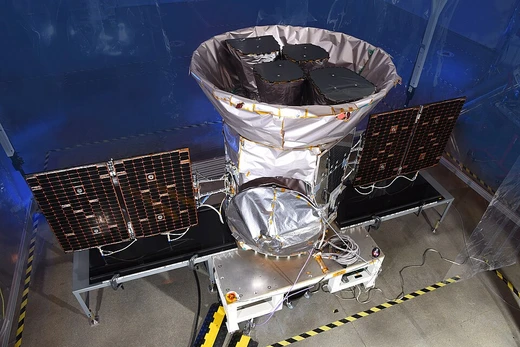
GJ 3470 b
A hot Neptune with a thick, escaping atmosphere rich in sulfur dioxide.
GJ 3470 b, also known as Phailinsiam, is a hot Neptune exoplanet orbiting the star GJ 3470 in the constellation Cancer. It is notable for having one of the best spectroscopically characterized atmospheres among all exoplanets, with a thick, escaping atmosphere and a strongly inclined orbit.
Quick Facts
- Discoverer
- X. Bonfils et al.
- Discovered
- 2012
- Discovery Method
- Radial velocity
- Apsis
- astron
- Eccentricity
- 0.114 · 0.052 · 0.051
- Star
- GJ 3470
Facts from the source article.
Lore & Background
The planet was first observed spectroscopically in 2013 by researchers at the University of Tokyo, who noted its atmosphere likely consists of hydrogen and helium, comprising 5–20% of the planet's total mass. In 2013, observations with the Large Binocular Telescope detected Rayleigh scattering in the atmosphere, a finding confirmed in 2015 by the Las Cumbres Observatory Global Telescope network. The scattering suggests the atmosphere is predominantly hydrogen and helium, veiled by dense clouds and hazes, and would appear blue to the human eye.
Between 2017 and 2019, the primary hydrogen atmosphere was characterized as having low metallicity, depleted methane, and traces of water, likely filling the planet's entire Roche lobe. In 2019 and 2020, a metastable helium outflow was detected, indicating ongoing atmospheric escape. In 2024, observations with JWST led by Thomas Beatty discovered a haze of sulfur dioxide, along with clear detections of methane and carbon dioxide, confirming a high-metallicity atmosphere and disproving earlier claims of Mie-scattering clouds.
The planet's orbit is strongly inclined to the equatorial plane of its host star, with a misalignment of 97°. In June 2023, the planet was formally named Phailinsiam, and its star Kaewkosin, as part of the third NameExoWorlds project, proposed by a team from Thailand.
Reader's Guide
GJ 3470 b (Phailinsiam) holds a significant place in exoplanet science as one of the most thoroughly studied atmospheres outside the Solar System. Its thick, hydrogen-helium envelope, making up 5–20% of the planet's mass, contrasts sharply with Earth's negligible atmospheric mass fraction. The detection of Rayleigh scattering in 2013 and its confirmation in 2015 established it as a benchmark for understanding cloudy, hazy exoplanet atmospheres. The discovery of escaping metastable helium in 2019–2020 provided direct evidence of atmospheric loss, with rates of 30,000–100,000 tons per second, offering insights into planetary evolution and mass loss processes. The 2024 JWST detection of sulfur dioxide, methane, and carbon dioxide marked a major step forward, revealing active photochemistry driven by stellar radiation and confirming a high-metallicity atmosphere. This finding also corrected earlier misinterpretations of cloud signatures. The planet's extreme orbital misalignment of 97° adds to its uniqueness, suggesting a dynamic history such as scattering or tidal interactions. As a hot Neptune with a well-characterized, escaping atmosphere, GJ 3470 b serves as a key laboratory for studying atmospheric composition, chemistry, and escape in exoplanets.
Did You Know?
- The planet's atmosphere is escaping at a rate of 30,000–100,000 tons per second.
- Its atmosphere contains sulfur dioxide, detected by JWST in 2024.
- The planet would appear blue to the human eye due to Rayleigh scattering.
- Its orbit is misaligned by 97° relative to its host star's equator.
Frequently Asked Questions
What is GJ 3470 b?
GJ 3470 b, nicknamed Phailinsiam, is a hot Neptune-class exoplanet that circles the red dwarf star GJ 3470 in the Cancer constellation. It weighs under 14 Earth masses yet swells to roughly 4.3 Earth radii, giving it a puffy, low-density profile typical of inflated gas giants.
What makes GJ 3470 b's atmosphere stand out?
It holds one of the most thoroughly mapped exoplanet atmospheres to date, with clear spectroscopic detection of sulfur dioxide among its chemical ingredients. The planet is actively shedding gas at a staggering 30,000 to 100,000 tonnes every second, equating to a loss of 0.16–0.53 Earth masses over a billion-year span.
Why is GJ 3470 b's orbit considered unusual?
Its orbital plane is tilted roughly 97 degrees away from the host star's equatorial plane, making it nearly perpendicular to the star's spin. This extreme misalignment is rare and points to some gravitational disruption reshaping the planet's path after formation.
How hot is GJ 3470 b and what does that do to it?
With an equilibrium temperature of about 673 kelvins, the planet bakes in intense stellar radiation from its close orbit. That heat drives the vigorous atmospheric escape, keeping its thick envelope in a constant state of slow boil-off into space.
What is the host star of GJ 3470 b called?
The parent star is GJ 3470, which carries the fan-community name Kaewkosin. It is a small, cool red dwarf in the Cancer constellation and serves as the gravitational anchor for Phailinsiam's tight, steeply tilted orbit.
More in Transiting Exoplanets, Part 3 1-24
Spotted an error? Know more?
Reader corrections go straight into our review queue. Suggest an edit · How this site is sourced