Kepler-86b
A Jupiter-size gas giant in its star's habitable zone.
Kepler-86b, also known as PH2b, is a Jupiter-size gas giant orbiting the F-type main-sequence star PH2 (Kepler-86) in the constellation Cygnus, approximately 1120 light-years from Earth. It gained prominence as one of 42 planet candidates detected by the Planet Hunters citizen science project, with a spurious detection probability of only 0.08%, effectively confirming its existence as a planet.
- Host star
- PH2 (Kepler-86, KIC 12735740)
- Star type
- F-type main-sequence
- Distance
- 1120 ly
- Constellation
- Cygnus
- Orbital period
- ~282 days
- Planet type
- Jupiter-size gas giant
- Discovery method
- Transit (Kepler data, Planet Hunters project)
Lore & Background
Kepler-86b was detected in archival data from the Kepler space observatory by the Planet Hunters project, in which human volunteers analyze light curves of Kepler target stars to find planetary transit signals missed by computer programs. The candidate was identified by citizen scientists including Abe J. Hoekstra, Thomas Lee Jacobs, Daryll LaCourse, Hans Martin Schwengler, Rafał Herszkowicz, and Mike Chopin, with help from Yale University astronomers. The planet's initial detection was made using Kepler data, and stellar spectra to rule out background stars or faint companions were collected using the HIRES instrument at the W. M. Keck Observatory, confirming the planet with 99.9 percent confidence.
The planet orbits with a period of about 282 days, placing it and any possible moons in the habitable zone. The temperature in its upper atmosphere could range from 185 K to 303 K. A moon of Kepler-86b would likely have a rocky core plus a greenhouse atmosphere that could have liquid water on its surface, improving its prospects for habitability. In 2019, the planet's mass was measured by radial velocity, showing it to be close in mass to Saturn.
Reader's Guide
Kepler-86b is significant as a confirmed exoplanet discovered through the Planet Hunters citizen science project, demonstrating the value of human volunteers in analyzing Kepler data to find planetary transits that automated algorithms might miss. Its location in the habitable zone of its host star, combined with its Jupiter-size mass, makes it a candidate for hosting a potentially habitable exomoon, as a moon could have a rocky core and a greenhouse atmosphere capable of supporting liquid water on its surface. The planet's detection was part of a larger study that identified 42 planet candidates, including 20 others in habitable zones, though those had higher probabilities of spurious detection. The confirmation of Kepler-86b with 99.9 percent confidence, using Keck Observatory spectra, underscores the collaborative effort between citizen scientists and professional astronomers. Its mass measurement in 2019, close to that of Saturn, further refined its characterization. The planet's legacy lies in its role as a proof-of-concept for crowd-sourced exoplanet discovery and as a target for future studies of exomoon habitability.
Did You Know?
- Kepler-86b was discovered by amateur Pole Rafał Herszkowicz using his laptop and the Internet project with data from the Kepler space observatory.
- The planet's spurious detection probability was only 0.08%, effectively confirming its existence.
- Its upper atmosphere temperature could range from 185 K to 303 K.
- In 2019, radial velocity measurements showed its mass to be close to that of Saturn.
The Telescope's Scientific Mandate
Launched by NASA in 2009 as part of its Discovery Program for affordable science missions, the Kepler space telescope carried a singular and ambitious goal: to survey a fixed patch of the Milky Way and determine just how common Earth-sized worlds are among the billions of stars in our galaxy. The spacecraft, named for the seventeenth-century astronomer Johannes Kepler—ironically a man who believed no other star hosted a planetary system—was placed into an Earth-trailing heliocentric orbit. Its only scientific instrument was a photometer that continuously tracked the brightness of roughly 150,000 main-sequence stars within a fixed field of view. By analyzing the data streaming back to Earth, scientists could identify the subtle, periodic dips in starlight produced when a planet transits in front of its host star. A critical limitation was geometric: only orbits aligned edge-on relative to our vantage point could be detected. William J. Borucki served as principal investigator, and the mission was designed to estimate the fraction of stars that harbor planets in or near their habitable zones.
Engineering the Largest Space Camera of Its Era
Standing at 1,039 kilograms, the Kepler spacecraft housed a Schmidt camera whose 0.95-meter front corrector plate fed light onto a 1.4-meter primary mirror—making it, at the moment of launch, the largest mirror ever carried beyond Earth orbit, a title the Herschel Space Observatory would claim months later. The instrument's field of view spanned 115 square degrees, roughly the apparent size of a human fist held at arm's length, of which 105 square degrees met science-quality standards with less than eleven percent vignetting. Rather than chasing sharp imagery, the photometer was deliberately soft-focused to deliver the ultra-precise brightness measurements its transit-detection method demanded, with a target combined differential photometric precision of twenty parts per million for a twelfth-magnitude Sun-like star over a 6.5-hour integration. The focal plane consisted of forty-two CCDs, each 50 by 25 millimeters and 2,200 by 1,024 pixels, combining to 94.6 megapixels—the largest camera array ever sent to space at that time. Heat pipes channeled waste heat to an external radiator, and the detectors were read out every 6.5 seconds to prevent saturation before being co-added on board for either 58.89-second or 1,765.5-second exposures.
Surviving the Reaction-Wheel Crisis
The mission was originally budgeted for three and a half years, but unexpectedly high noise levels from both the observed stars and the spacecraft itself stretched the timeline. By 2012, NASA anticipated extending operations through 2016. Then, on July 14 of that year, one of the four reaction wheels responsible for pointing the telescope seized. The mission could continue only if the remaining three held. On May 11, 2013, a second wheel failed, effectively halting science operations. NASA spent the following months attempting repairs before publicly conceding on August 15, 2013, that the two dead wheels could not be revived. Rather than ending the mission, the agency solicited the broader space-science community for creative alternatives using the two surviving wheels and thrusters. The resulting K2 'Second Light' proposal, reported in November 2013, reimagined the crippled spacecraft as a tool for hunting habitable-zone planets around smaller, dimmer red-dwarf stars. NASA approved the K2 extension on May 16, 2014, and by January 2015 the combined Kepler and K2 efforts had yielded 1,013 confirmed exoplanets across roughly 440 star systems, alongside 3,199 additional candidates.
A Legacy Written in Starlight
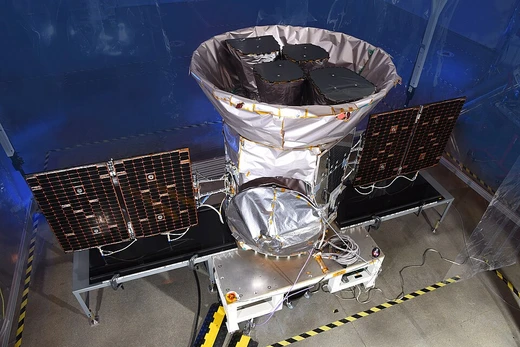
By the time NASA shut down the telescope on October 30, 2018, after its reaction-control fuel was finally exhausted, Kepler had monitored 530,506 stars and contributed to the confirmation of 2,778 exoplanets as of mid-2023. Milestones punctuated the mission: the 1,000th confirmed planet was announced in January 2015, and in May 2016 a single batch of 1,284 new worlds set the record for the largest one-time verification. Among the celebrated finds were Kepler-438b, Kepler-442b, and Kepler-452b—nearly Earth-sized, likely rocky worlds in habitable zones—along with the super-Earth Kepler-440b. Beyond planet hunting, the photometer's half-hour cadence produced light curves valuable for tracking supernovae. A November 2013 analysis of Kepler data suggested up to 40 billion rocky, Earth-sized planets might orbit in the habitable zones of Sun-like stars and red dwarfs across the Milky Way, with roughly 11 billion around Sun-like stars and the nearest perhaps 3.7 parsecs away. TESS, launched the same year as Kepler's retirement, now carries the search forward.
Frequently Asked Questions
What is Kepler-86b?
Kepler-86b (also catalogued as PH2b) is a Jupiter-sized gas giant that circles the F-type main-sequence star PH2 in the constellation Cygnus, roughly 1,120 light-years from Earth.
How was Kepler-86b discovered?
It was flagged as a planet candidate by the Planet Hunters citizen-science project, one of 42 detections from that effort. Its spurious-detection probability of just 0.08% effectively confirms it as a genuine planet rather than a false signal.
Does Kepler-86b sit in the habitable zone?
Yes—despite being a gas giant, it orbits within the habitable zone of its host star, making it a notable example of a large planet in a temperate region.
How long is Kepler-86b's year?
One full orbit around PH2 takes approximately 282 days.
What is the host star of Kepler-86b?
The planet orbits PH2 (Kepler-86, KIC 12735740), an F-type main-sequence star located in the constellation Cygnus.
More in Transiting Exoplanets, Part 3 1-24
Spotted an error? Know more?
Reader corrections go straight into our review queue. Suggest an edit · How this site is sourced