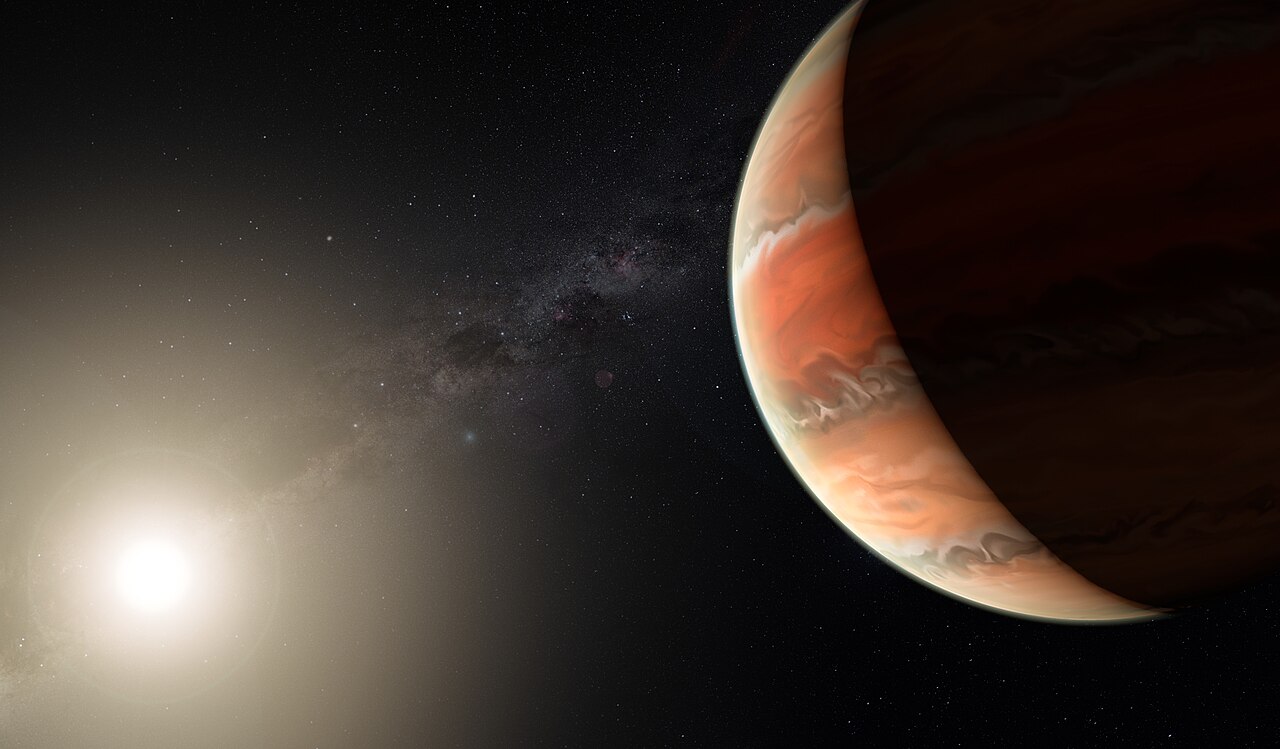
WASP-19b
A bloated hot Jupiter with an 18.9-hour orbit and a 2240 K dayside.

TRAPPIST/M. Gillon/ESO · CC BY 4.0
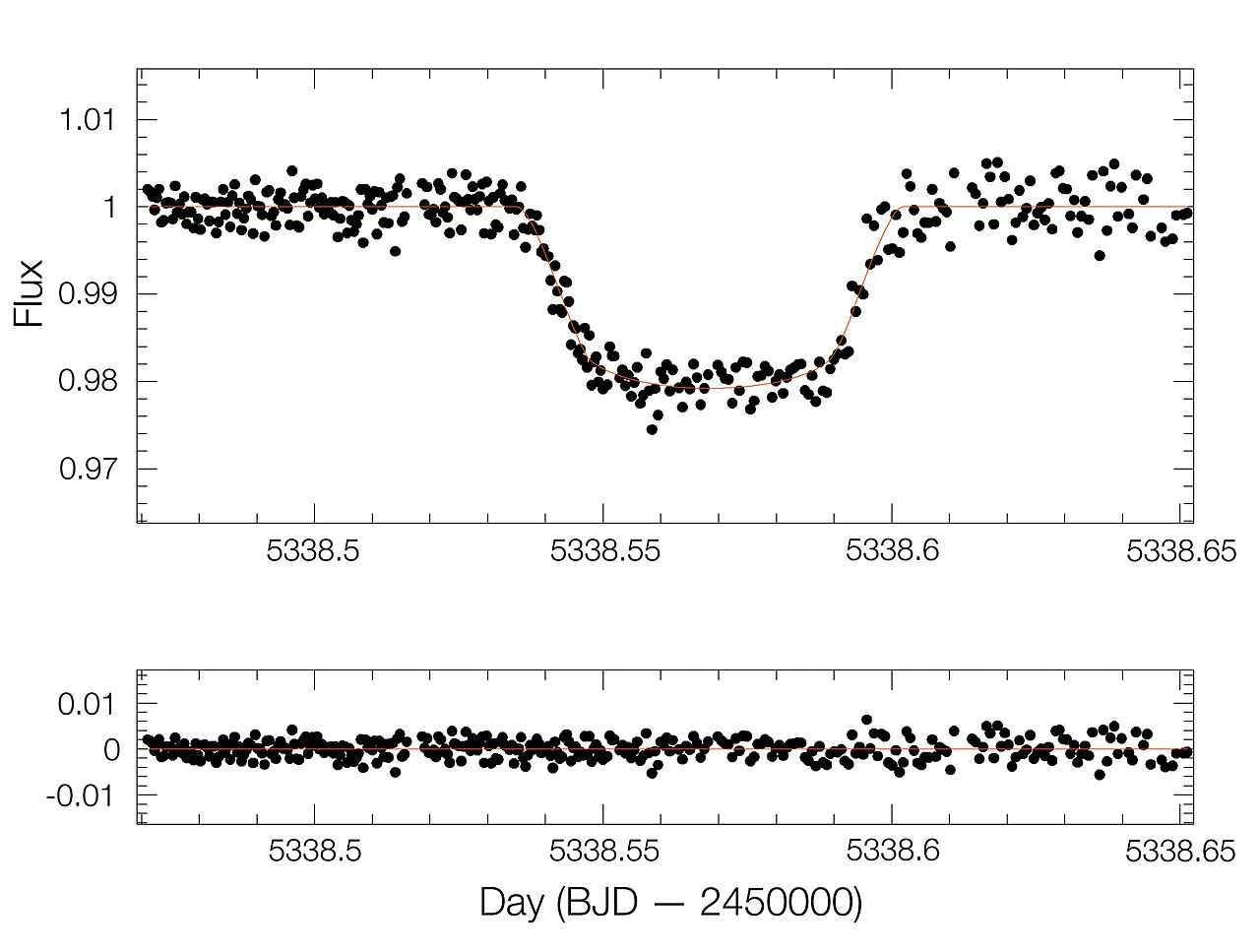
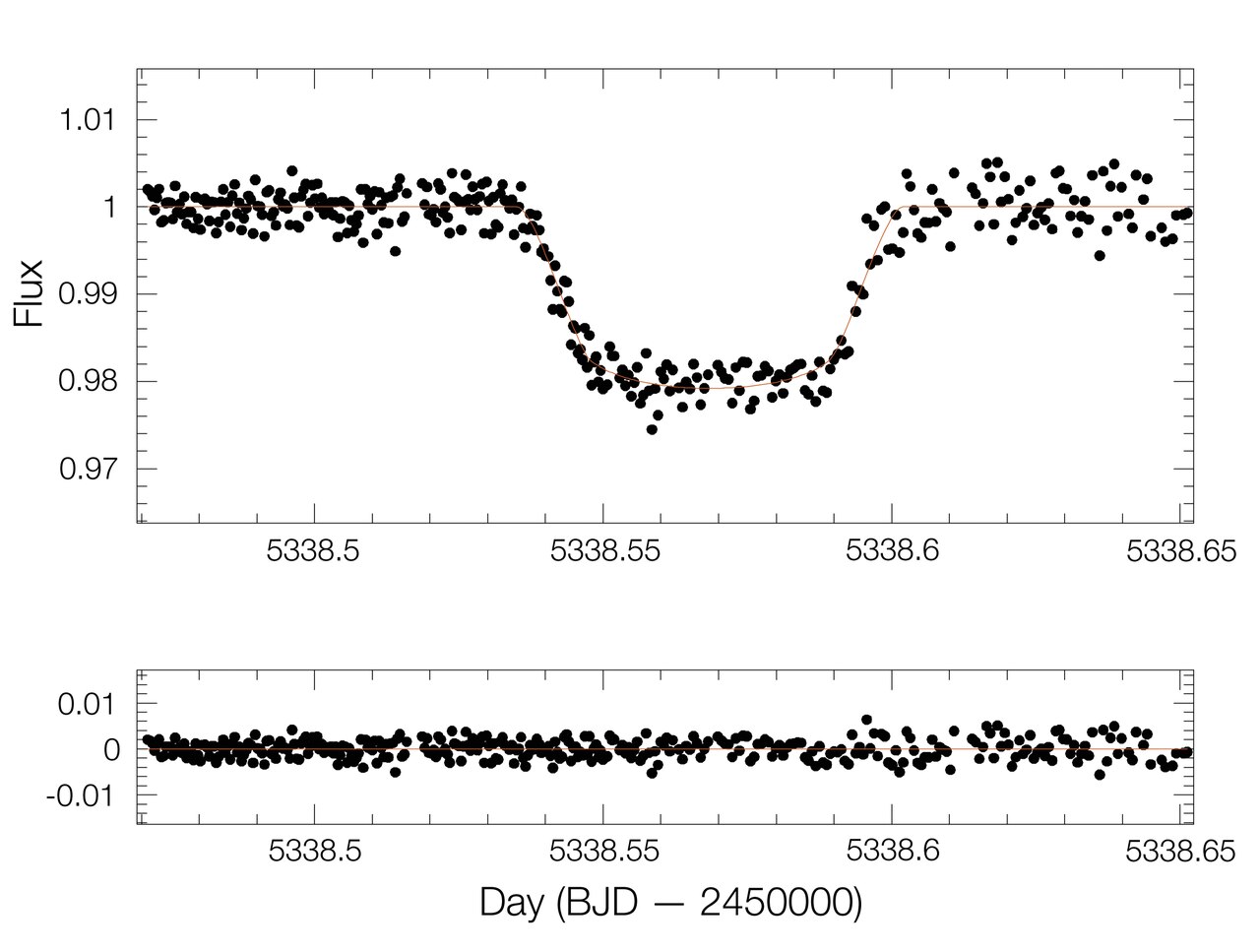
WASP-19b, formally named Banksia, is an exoplanet orbiting the star WASP-19 (named Wattle) in the constellation Vela. It is notable for possessing one of the shortest orbital periods of any known planetary body, completing an orbit in approximately 18.932 hours. At the time of its discovery, it was the shortest-period hot Jupiter discovered, as planets with shorter orbital periods had rocky or metallic compositions.
Quick Facts
- Discoverer
- Hebb et al. (SuperWASP)
- Discovered
- December 10, 2009
- Discovery Method
- Transit
- Apsis
- astron
- Semimajor
- 0.01655 ±
- Eccentricity
- 0.0046 · +0.0044 · +0.0028
- Period
- 0.79 ±
- Inclination
- 79.4 · 0.4
- Star
- WASP-19
- Albedo
- 0.16 · 0.04
- Single Temperature
- 2350 · 168 · 314 / 2240 · 40
Facts from the source article.
Lore & Background
WASP-19b has a mass close to that of Jupiter (1.15 Jupiter masses) but a much larger radius (1.31 times Jupiter's, or 0.13 Solar radii), making it nearly the size of a low-mass star. A 2012 study using the Rossiter–McLaughlin effect determined the planetary orbit is well aligned with the equatorial plane of the star, with a misalignment of -15°. In 2013, secondary eclipse and orbital phases were barely observed from data gathered with the ASTEP telescope, marking the first detection of such kind through ground-based observations, made possible by the planet's large size and small semi-major axis. In 2019, the planet was observed with TESS, and the eclipse was measured; broad variations caused by the changing aspect of the heated face of the planet were measured, deducing a dayside temperature of 2240 ± 40 K and that the planet reflects 16 ± 4 percent of the light that falls on it, a relatively high value compared to other planets. Despite the short orbital period, orbital decay was not detected as of 2019.
Reader's Guide
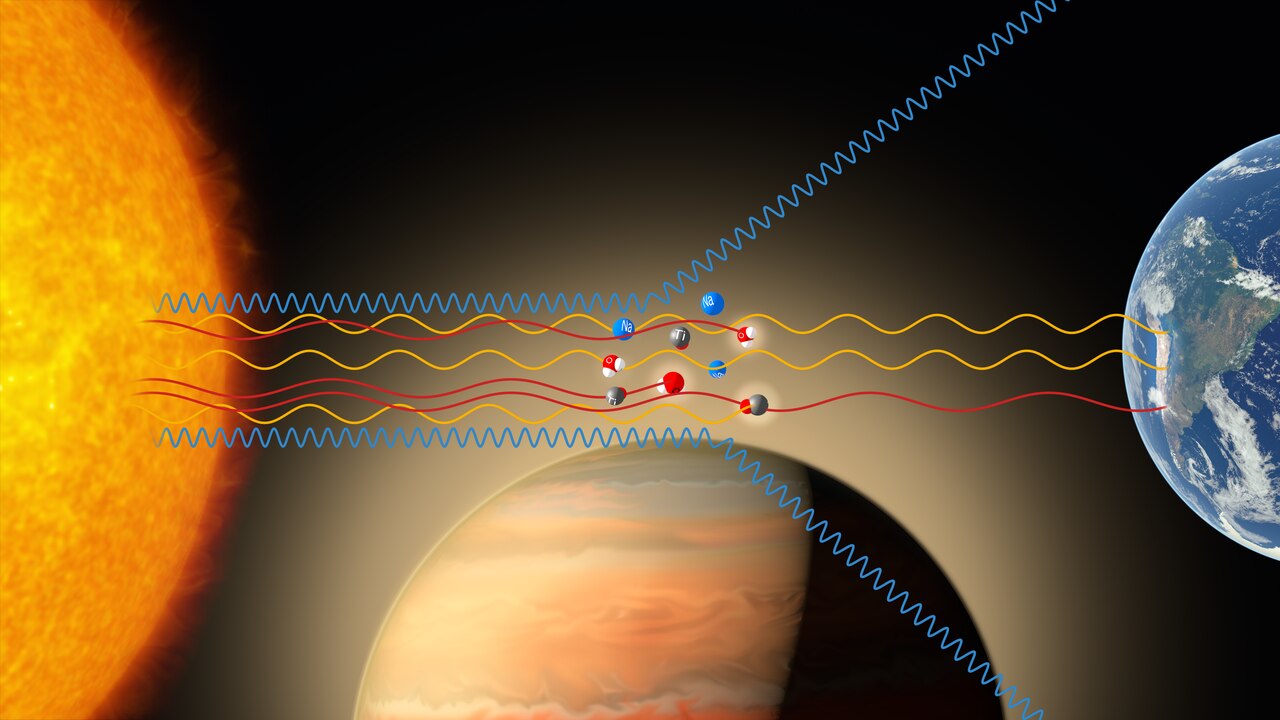
WASP-19b's significance lies in its extreme orbital and physical properties. With one of the shortest orbital periods known, it represents a benchmark for studying hot Jupiters under intense stellar irradiation. Its large radius relative to its mass makes it nearly the size of a low-mass star, providing a natural laboratory for atmospheric studies under extreme conditions. The 2013 ground-based detection of its secondary eclipse and orbital phases demonstrated that such observations are feasible from Earth, expanding the toolkit for exoplanet characterization. The 2019 TESS observations yielded precise measurements of its dayside temperature and albedo, the latter being relatively high compared to other planets, suggesting reflective clouds or hazes. The planet's atmosphere has been studied extensively: water vapor was detected in 2013 with the Hubble Space Telescope; in 2017, titanium oxide (TiO) was detected for the first time in an exoplanet atmosphere using the Very Large Telescope, along with a strongly scattering haze and sodium; a 2021 study confirmed strong haze and a barely discernible TiO signal but found no sign of water or alkali metals; a 2025 study with JWST confirmed water vapor and found evidence for carbon monoxide, carbon dioxide, methane, and acetylene. A TESS-based study concluded the atmosphere is moderately efficient at transporting heat from the dayside to the nightside. In June 2023, the planet was officially named Banksia, and its host star Wattle, as part of the third NameExoWorlds project, proposed by a team from Brandon Park Primary School in Wheelers Hill, Melbourne, Australia.
Did You Know?
- WASP-19b has an orbital period of approximately 18.932 hours, one of the shortest known.
- Its radius is 1.31 times that of Jupiter, making it nearly the size of a low-mass star.
- In 2017, titanium oxide (TiO) was detected in its atmosphere, the first such detection in an exoplanet.
- The planet was named Banksia in June 2023 as part of the NameExoWorlds project.
Discovery & Orbital Architecture
WASP-12b was identified in April 2008 by the SuperWASP planetary transit survey, a wide-field instrument designed to catch planets as they cross in front of their host stars. The discovery revealed a hot Jupiter circling the star WASP-12 with an orbital period of just over one Earth day—a stark contrast to the roughly 365.25 days Earth needs to circle the Sun. The planet sits approximately 3.5 million kilometers (about 0.023 astronomical units) from its star, roughly one forty-third of Earth's distance from the Sun, with an orbital eccentricity matching that of Jupiter. Because of its extreme proximity to the stellar radiation, WASP-12b possesses one of the lowest densities recorded among exoplanets, a phenomenon attributed to atmospheric inflation driven by the intense energy flux from its host. The planet's mass exceeds Jupiter's by about 40 percent, yet its radius has ballooned to nearly three times that of Jupiter, making it a textbook example of the puffy hot Jupiter class.
Atmospheric Chemistry & the Carbon Question
In December 2013, Hubble Space Telescope observations detected water in WASP-12b's atmosphere, a milestone for characterizing exoplanet chemistry. However, just seven months later in July 2014, NASA reported that the planet belongs to a group of three sun-like-star exoplanets (alongside HD 189733b and HD 209458b) with remarkably dry atmospheres. A 2010 study published in Nature revealed that WASP-12b carries a carbon-to-oxygen ratio of approximately 1, nearly double the solar value of 0.54, marking it as a carbon-rich gas giant. The excess carbon resides in the atmosphere as carbon monoxide and methane. One researcher noted that with more carbon than oxygen, solid bodies could form from pure carbon compounds such as diamond or graphite. The study's authors went further, suggesting that terrestrial-sized carbon planets might be dominated by graphite or diamond interiors rather than silicate rock. Media outlets seized on this, dubbing WASP-12b a diamond planet, though the carbon enrichment actually resides in its gaseous envelope rather than a solid core.
Tidal Distortion & the Orbital Death Clock
WASP-12b is caught in a slow-motion death spiral. Tidal forces from its host star stretch the planet into a prolate spheroid and strip away its atmosphere at a rate of roughly 10 to the minus 7th of Jupiter's mass per year, equivalent to about 6 billion tons every second. On May 20, 2010, the Hubble Space Telescope captured the planet being actively consumed by its star, the first time such an event was observed with such clarity. The observations, made with Hubble's Cosmic Origins Spectrograph, confirmed predictions published in Nature in February 2009 by Peking University's Shu-lin Li. A 2019 study measured the transit interval shrinking by 29 ± 2 milliseconds per year since 2008, later refined in 2022 to 29.81 ± 0.94 milliseconds per year, implying a remaining lifetime of roughly 3.16 million years. The decay is driven by tidal interactions between planet and star, and is notably faster than that of WASP-19b, which shows no measurable decay in current data. The orbit is also strongly misaligned with the star's equatorial plane by about 59 degrees, as determined in 2012 using the Rossiter–McLaughlin effect.
Climate Dynamics & the Black Surface
Because WASP-12b is tidally locked, one hemisphere faces its star in perpetual daylight while the other endures endless night, much like the Moon's fixed orientation toward Earth. This configuration drives a massive heat flow from the scorching day side to the cooler night side, generating powerful winds that sweep around the planet's atmosphere. Researchers Taylor Bell and Nicolas Cowan proposed that hydrogen on the day side becomes ionized by the intense stellar radiation; as it flows toward the cooler face, it recombines into neutral atoms, amplifying the heat transport. The combined effects of tidal heating and extreme stellar proximity push surface temperatures above 2,500 K, exceeding 2,200 °C. In September 2017, Hubble-based measurements showed the planet reflects only 6 percent of incident light, earning it descriptions of being black as asphalt and pitch black. Paradoxically, despite absorbing so much radiation, the planet is hot enough to emit a faint reddish glow of its own.
Gallery

Frequently Asked Questions
Who is WASP-19b?
WASP-19b, given the formal name Banksia, is a bloated hot Jupiter that circles the star WASP-19 (nicknamed Wattle) in the constellation Vela. It was identified through its periodic transits across that star's disk.
What are WASP-19b's mass, radius, and dayside temperature?
The planet weighs about 1.15 Jupiter masses while its radius stretches to roughly 1.31 Jupiter radii, making it noticeably puffed up for its mass. Its dayside soars to approximately 2,240 K, a temperature driven by its extremely close orbit around Wattle.
Why is WASP-19b's orbital period a big deal?
At just 18.932 hours per lap, WASP-19b holds one of the tightest orbits of any known planet. When it was first detected, it set the record for the shortest-period gas giant, since every planet with a shorter period turned out to be rocky or metallic.
How reflective is WASP-19b?
Its geometric albedo measures around 16 percent (± 4), meaning it bounces back a modest fraction of the starlight that strikes it. That places it in a mid-range reflectivity band for hot Jupiters, neither a bright reflector nor a dark absorber.
Is WASP-19b's orbit tilted relative to its star's rotation?
The planet's spin-orbit alignment is considered well matched, with a misalignment of only about −15 degrees. That small offset suggests the system formed in a relatively calm, coplanar environment rather than undergoing a violent dynamical reshuffling.
More in Transiting Exoplanets, Part 3 1-24
Spotted an error? Know more?
Reader corrections go straight into our review queue. Suggest an edit · How this site is sourced