
XO-3b
Massive transiting exoplanet with an unusually elliptical orbit.

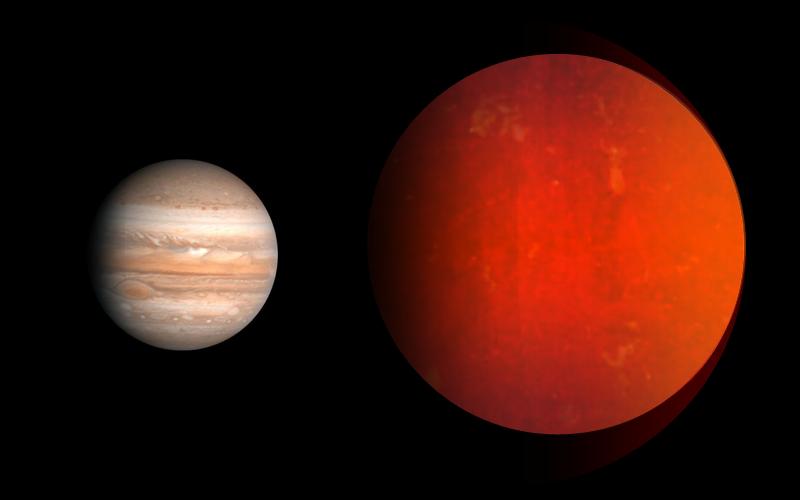
Ignacio González Tapia · CC BY-SA 3.0
XO-3b is a transiting exoplanet discovered on May 30, 2007, through the collaborative XO Project, which involved both amateur and professional astronomers using a telescope on the Haleakala summit in Hawaii. At the time of its discovery, it was the most massive planet found in close proximity to its parent star, with a mass about 11.79 times that of Jupiter and a radius 1.217 times Jupiter's. Its orbit is notably elliptical rather than circular, a characteristic that earned it the description of an 'oddball' planet.
Quick Facts
- Discoverer
- XO Project
- Discovery Site
- XO telescope Maui, Hawaii
- Discovered
- May 30, 2007
- Discovery Method
- Transit, / Radial velocity
- Apsis
- astron
- Semimajor
- 0.0454 ±
- Eccentricity
- 0.2883 ± 0.0025
- Period
- 3.1915289 ± 0.0000032 d
- Inclination
- 84.20 ± 0.54
- Arg Peri
- 346.11.2 · 1.1
- Semi-Amplitude
- 1494.0 ± 9.5
- Star
- XO-3
Facts from the source article.
Lore & Background
XO-3b was discovered by the XO Project, which specifically aimed to find transiting planets, and it was the third such planet found by the project. The planet's orbit is significantly elliptical, with an eccentricity of 0.2883, which is unexpected given that tidal forces should have circularized it over time. This suggests the possible presence of another massive planet outside its orbit in orbital resonance, similar to the Upsilon Andromedae system. Measurements of the Rossiter–McLaughlin effect revealed a large misalignment between the planet's orbital plane and the star's equator, initially reported as 70 ± 15 degrees, later revised to 37.3 degrees by an independent group. This misalignment may indicate a past encounter with another planet that altered its orbit. The orbital period is decaying at a rate of about 1.7 milliseconds per orbit due to tidal dissipation, and the planet is expected to be engulfed by its star in about 1.4 million years. Unlike the similar planet WASP-12b, it is unlikely to be experiencing significant mass loss. Observations in the near ultraviolet by the Neil Gehrels Swift Observatory measured a planetary radius of 2.54 times that of Jupiter in that wavelength.
Reader's Guide
XO-3b holds significance as one of the most massive transiting planets discovered near its star, challenging expectations that such close-in planets should have circular orbits. Its high orbital eccentricity and large spin–orbit misalignment provide evidence for dynamical interactions, possibly with another planet in the system, making it a key object for studying planetary system evolution. The ongoing debate over whether XO-3b is a planet or a brown dwarf, led by astronomer Christopher Johns-Krull, underscores the ambiguity in classifying objects at the boundary between these categories. This debate remains lively and is not unusual, as other brown dwarfs have been found orbiting stars. The planet's rapid orbital decay, leading to engulfment within 1.4 million years, offers a rare opportunity to observe the final stages of a planet's life. Its discovery through the collaboration of amateur and professional astronomers highlights the effectiveness of such partnerships in exoplanet research.
Did You Know?
- XO-3b was the most massive planet found in close proximity to its star at the time of its discovery.
- The planet's orbital eccentricity is 0.2883, significantly larger than expected for a close-in planet.
- The angle between the planet's orbital plane and the star's equator was initially measured at 70 ± 15 degrees, later revised to 37.3 degrees.
- The planet's orbital period is decaying at a rate of about 1.7 milliseconds per orbit, leading to engulfment in about 1.4 million years.
A Titan Among Giants
XO-3b occupies a position on the roster of the most physically enormous exoplanets identified to date, a category defined by objects whose radii exceed 1.6 times that of Jupiter. Because Jupiter itself measures 71,492 kilometers at its equator, this threshold translates to a minimum diameter of roughly 114,387 kilometers for any body to qualify for inclusion. The reference list deliberately extends beyond this floor, capturing confirmed worlds that dwarf our solar system's largest planet while also noting a handful of well-known giants that fall just below the cutoff for comparative context. XO-3b, by virtue of its size, sits among the upper echelon of this group, a class of objects so vast that they challenge our intuitive sense of what a planet can be. These are not stars, nor even stellar-mass bodies, yet on a universal scale they remain remarkably small. Their sheer physical dimensions, however, make them among the most striking targets in the exoplanet catalog.
The Measurement Gauntlet
Determining the true size of a world like XO-3b is far from a straightforward exercise. The catalog of the largest exoplanets carries an explicit warning that its entries may shift over time, driven by diverging measurements published across different scientific journals and by the varying methodologies employed to probe these distant objects. The fundamental difficulty of detecting extrasolar bodies in the first place compounds the problem: every radius figure is an estimate, and older data in particular may prove unreliable as observational technology advances. For this reason, the reference list restricts itself to the most certain measurements available at any given moment, while acknowledging that the roster is inherently provisional. A body's radius could, depending on the estimation method, land just above or just below the 1.6 Jupiter-radius threshold, placing it on one side of the line or the other. XO-3b's entry, like those of its peers, therefore rests on a foundation of best-available evidence rather than absolute certainty.
Planet or Dwarf?
One of the most persistent debates surrounding objects of XO-3b's magnitude concerns whether they truly qualify as planets at all. The International Astronomical Union's working definition draws a hard line at 13 Jupiter masses, requiring additionally that the object orbit a host star at a mass ratio below four percent. The NASA Exoplanet Archive, by contrast, permits a minimum mass up to 30 Jupiter masses for an object to be classified as an exoplanet, provided it is not free-floating. This means that several bodies listed among the largest exoplanets—including some that could plausibly be brown dwarfs under the IAU's stricter criterion—appear in the same catalog. The formation pathway adds another layer of confusion: sub-brown dwarfs form through the collapse of gas clouds much like stars do, yet they fall below the deuterium-fusion threshold of roughly 13 Jupiter masses. Whether origin should factor into classification remains an open question among astronomers, leaving objects like XO-3b in a category that is as much a matter of institutional definition as of physics.
A Shifting Catalog
The list on which XO-3b appears is, by its own admission, a living document rather than a fixed record. New discoveries, revised measurements, and retracted candidates all contribute to a catalog that is explicitly described as prone to change. Some entries may ultimately prove to be brown dwarfs, sub-brown dwarfs, or objects that do not exist at all. Free-floating sub-brown dwarfs, for instance, can be observationally indistinguishable from rogue planets that were once orbiting a star before being ejected, and a sub-brown dwarf born in a young star cluster might later be captured into orbit around a star, blurring the boundary between these categories. The IAU Working Group on Extra-Solar Planets has attempted to clarify terminology by defining a sub-brown dwarf as a free-floating body in a young cluster below the brown-dwarf mass cutoff, but consensus remains elusive. For XO-3b and its peers, this means that today's confirmed giant could, in a future revision, be reclassified, re-measured, or even removed from the list entirely.
Gallery
Frequently Asked Questions
What is XO-3b?
XO-3b is a hot Jupiter-class exoplanet that circles its host star in just over three days, passing in front of it from Earth's perspective. It was identified as a transiting world, which is how its physical properties were measured.
How was XO-3b discovered?
The planet was announced on May 30, 2007, at an American Astronomical Society gathering in Honolulu, Hawaii. It came out of the XO Project, a partnership that combined amateur skywatchers with professional researchers using a telescope on Haleakala in Hawaii.
What makes XO-3b unusual among known exoplanets?
Its orbit is stretched into a pronounced ellipse, with an eccentricity near 0.29, rather than the near-circular path typical of other close-in planets. That elongated trajectory is what earned it the nickname 'oddball' in the exoplanet community.
How does XO-3b compare in size and mass to Jupiter?
It weighs roughly 11.8 times as much as Jupiter, making it one of the heaviest planets known when it was first reported. Its radius, though, is only about 1.22 Jupiter radii, so it is remarkably compact for its mass.
Why is XO-3b important to exoplanet research?
At the time of its discovery it was the most massive planet found orbiting so tightly around a star. Its eccentric orbit also poses a puzzle for migration models, giving theorists a concrete test case for how close-in planets acquire and retain non-circular paths.
More in Transiting Exoplanets, Part 3 1-24
Spotted an error? Know more?
Reader corrections go straight into our review queue. Suggest an edit · How this site is sourced