K2-22b
Evaporating exoplanet with a comet-like dust tail.
K2-22b, also designated EPIC 201637175 b, is an exoplanet located 801 light-years from Earth. It orbits the red dwarf star K2-22 once every 9.145872 hours. The planet was not directly detected in the original K2 photometry, but an unusual light curve suggested dust evaporating from its surface, forming a tail that extends both ahead and behind the planet—much like some comets in our Solar System. This evaporation points to a low surface gravity, favoring a body roughly the size of Mars, Mercury, or the Moon, with a surface gravity between one-sixth and one-third of Earth’s.
A 2020 survey could not confirm the planet’s existence but did not label it a false positive. Observations in 2021 failed to detect the planet itself, setting an upper size limit of 0.71 Earth radii. Given the observed mass loss rate, the planet’s likely mass is 0.02 Earth masses, and it is expected to completely disintegrate within 21 million years. Ground-based telescopes detected transits in 2016 and 2017, and the Faulkes Telescope North and MuSCAT observed seven predicted transits in 2021 and 2022, revealing a decline in transit depth since discovery. This fading could be due to the host star’s magnetic cycle or the overturn of a magma ocean, suggesting transit activity might increase again later.
In April 2024, the evaporated material was observed using JWST’s MIRI instrument in low-resolution slitless spectroscopy across four transits. Transit depth varied between 0% and 1.3%, so not every transit was detected—one was highly significant, and two others were marginally significant. CHEOPS also observed the transits, but only the fourth and most significant transit was unobstructed by Earth. The data are consistent with magnesium silicate minerals, similar to Earth’s mantle, which is rich in magnesium silicates with little iron. The evaporating minerals could condense into enstatite (MgSiO₃) or forsterite (Mg₂SiO₄), though earlier modeling favored magnesium-iron silicates like olivine and pyroxene. The single JWST spectrum cannot distinguish between these minerals but can rule out iron-rich planetary core material. An unexpected feature at 5 micrometers may come from gases, possibly NO or CO₂, though its origin is unclear and requires further observation.
Quick Facts
- Discovery Site
- Kepler Space Observatory
- Discovered
- 2015
- Discovery Method
- Transit
- Apsis
- astron
- Semimajor
- 0.0088 AU
- Eccentricity
- null
- Period
- 0.381078 d
- Star
- K2-22
- Single Temperature
- 2100 K
- Atmosphere Composition
- dusty tail: magnesium silicate, NO and/or CO / 2
Facts from the source article.
Lore & Background
K2-22b was not directly detected in K2 photometry, but its presence was inferred from an anomalous light curve consistent with evaporating dust. The dust forms a tail both ahead and behind the planet, similar to comets in the Solar System. The evaporation requires low surface gravity, implying a body of Mars, Mercury, or lunar size with surface gravities 1/6 to 1/3 that of Earth. A 2020 survey failed to validate the planet's existence but did not claim it to be a false positive, and a 2021 observation placed an upper limit of 0.71 Earth radii on its size. Ground-based observations detected transits in 2016/2017, and Faulkes Telescope North/MuSCAT detected seven predicted transits in 2021/2022, showing a decline in transit depth since discovery—possibly due to a magnetic cycle of the host star or overturn of a magma ocean, suggesting transit activity could increase again.
Reader's Guide
K2-22b is significant as one of the few known disintegrating rocky planets with a comet-like tail, alongside Kepler-1520b, KOI-2700b, and BD+05 4868. Its observed mass loss rate implies a probable mass of 0.02 Earth masses and a remaining lifetime of 21 million years. In April 2024, the evaporated material was observed with JWST MIRI in transmission spectroscopy across four transits, with one detected at high significance and two at low significance; CHEOPS also observed the transits, but only the fourth and most significant transit was unobstructed by Earth. The data are consistent with magnesium silicate minerals (enstatite or forsterite), though earlier modeling agreed with magnesium-iron silicates (olivine and pyroxene). The single JWST spectrum cannot distinguish between minerals but can exclude iron-rich planetary core material. An unexpected feature at 5 μm may come from gases such as NO or CO2, possibly originating from an evaporating deep ocean containing clathrate hydrates of N2, NH3, and CO2, or from degassing of a magma ocean where N2, CO2, and H2O are converted to NO by photodissociation or gas-phase chemistry. Additional observations are needed to confirm this signal.
Did You Know?
- K2-22b has an orbital period of only 9.145872 hours.
- Its transit depth varies between 0% and 1.3%, so not every transit is detectable.
- The planet is estimated to be completely gone in 21 million years.
- JWST MIRI observed its evaporated material in April 2024, detecting a possible 5 μm feature from NO or CO2.
Discovery Through the K2 Mission
K2-22b came to light as part of the K2 mission, the creative extension of NASA's Kepler space telescope. After two of the spacecraft's four reaction wheels failed in 2012 and 2013, NASA abandoned attempts to repair them and instead solicited alternative mission plans from the space science community. The resulting Second Light proposal, reported in November 2013 and approved on May 16, 2014, repurposed the disabled telescope to hunt for habitable planets orbiting smaller, dimmer red dwarf stars using the two remaining functional wheels and thrusters. K2-22b is one of the planets confirmed through this extended K2 campaign, a testament to the ingenuity of continuing scientific work with a spacecraft that had lost its original pointing capability. The mission demonstrated that even a degraded instrument could yield meaningful discoveries in the search for worlds beyond our solar system, turning a hardware crisis into a new chapter of exoplanet exploration.
The Transit Method and Edge-On Geometry
The detection of K2-22b relied on the same photometric technique that defined the entire Kepler program: monitoring the continuous brightness of stars to catch the periodic dimming that occurs when a planet crosses in front of its host star. This transit method imposed a strict geometric constraint—only planets whose orbital planes are aligned edge-on from Earth's vantage point could be identified. The spacecraft's sole scientific instrument, a photometer, tracked the brightness of roughly 150,000 main-sequence stars within a fixed field of view, transmitting the data back to Earth for analysis. The camera's focal plane, composed of forty-two CCDs totaling 94.6 megapixels, was read out every 6.5 seconds to prevent saturation, with data co-added on board for either short or long cadence targets. For K2-22b, it was this careful, repeated measurement of tiny brightness dips that revealed the planet's presence against the glare of its parent star.
A Telescope Built for Planet Hunting
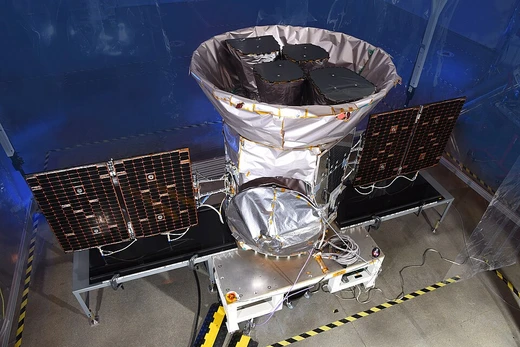
The spacecraft that found K2-22b was a product of NASA's Discovery Program, designed as a relatively low-cost science mission. Ball Aerospace developed the flight system while the Jet Propulsion Laboratory oversaw construction and initial operations. The telescope's mass stood at 1,039 kilograms, and its optical design featured a Schmidt camera with a 0.95-meter front corrector plate feeding a 1.4-meter primary mirror—at launch, the largest mirror on any telescope outside Earth's orbit. The field of view spanned 115 square degrees, roughly the size of a fist held at arm's length, with 105 square degrees of science quality. Crucially, the photometer was deliberately given a soft focus to prioritize excellent photometric precision over sharp imaging, a design choice that made it ideal for detecting the subtle brightness variations that betray a transiting planet like K2-22b.
From Mission Extension to Legacy
The K2 mission that identified K2-22b emerged from an unexpected crisis. When the second reaction wheel failed on May 11, 2013, the collection of science data was disabled, and the future of the mission hung in the balance. NASA's decision to ask the broader scientific community for alternative proposals proved transformative. The approved K2 extension shifted focus toward detecting habitable-zone planets around red dwarfs, a class of stars smaller and dimmer than the Sun. Over the course of the full Kepler and K2 operations, the telescope observed 530,506 stars and confirmed thousands of exoplanets. By January 2015, over 1,000 confirmed exoplanets had been announced, and by May 2016, a single verification added 1,284 more. K2-22b stands as part of this extraordinary catalog, a reminder that even a mission born from failure could expand humanity's inventory of known worlds before the spacecraft was finally retired on October 30, 2018, when its fuel ran out.
Frequently Asked Questions
What is K2-22b?
K2-22b, also catalogued as EPIC 201637175 b, is an evaporating exoplanet that circles the red dwarf star K2-22 about 801 light-years from Earth. Rather than being a stable world, it is actively shedding surface material into a comet-like dust tail that stretches both ahead of and behind the planet along its orbit.
How was K2-22b detected if it was never directly observed?
The original K2 photometry did not yield a clean transit signal for the planet itself. Astronomers instead noticed an anomalous shape in the light curve that could only be explained by a cloud of evaporating dust trailing in front of and behind a small body crossing the star's face.
How big and heavy is K2-22b?
Its radius is capped at roughly 0.71 Earth radii, putting it in the same size class as Mars, Mercury, or our Moon. The estimated mass is only about 0.02 Earth masses, which means its surface gravity is just one-sixth to one-third of what we feel here.
Why does K2-22b develop a comet-like dust tail?
The planet completes an orbit in just over nine hours, so it sits extremely close to its host star and is bombarded by intense radiation. That energy strips material off the surface, and the escaping dust forms a tail extending in both directions, much like the tails of comets in our own Solar System.
How long will K2-22b survive?
Because it is continuously losing mass through evaporation, current models estimate the planet has only about 21 million years of existence left before it is fully dispersed into space. That makes K2-22b one of the most short-lived worlds known to astronomers.
More in Transiting Exoplanets, Part 3 1-24
Spotted an error? Know more?
Reader corrections go straight into our review queue. Suggest an edit · How this site is sourced