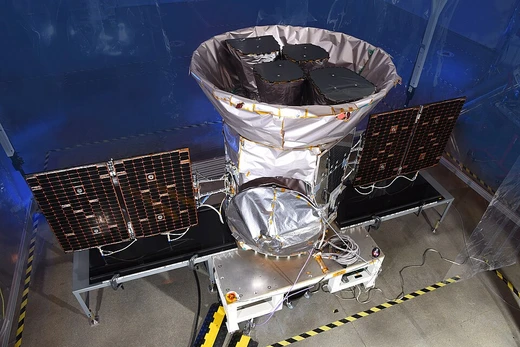
K2-3d
Outermost mini-Neptune in a three-planet red dwarf system.

MarioProtIV · CC BY-SA 4.0
K2-3d, also known as EPIC 201367065 d, is a confirmed exoplanet of probable mini-Neptune type orbiting the red dwarf star K2-3. It is the outermost of three such planets discovered in the system, located 143 light-years away from Earth in the constellation of Leo. The exoplanet was found using the transit method and was the first planet in the Kepler 'Second Light' mission to receive the letter 'd' designation for a planet.
Quick Facts
- Discovery Site
- Kepler Space Observatory
- Discovered
- 2015
- Discovery Method
- Transit
- Apsis
- astron
- Eccentricity
- 0.091 · 0.120 · 0.064
- Star
- K2-3
Facts from the source article.
Lore & Background
K2-3d orbits a red dwarf star with about 60% the mass and 56% the radius of the Sun, with a surface temperature of 3896 K and an age of about 1 billion years. The star's apparent magnitude is 12.168, making it too dim to be seen with the naked eye. The planet's orbital radius of about 0.2 AU gives it an orbital period of 44 days, and the star has only about 6% of the Sun's luminosity.
The planet is a super-Earth or mini-Neptune, with a radius between 1.5 and 1.6 times Earth's. Originally estimated to have a very high density, later analysis of HARPS data in 2018 constrained the mass to less than 4 Earth masses at 1σ confidence, and by 2023 this upper limit was reduced to 2 Earth masses. This corresponds to a relatively low density similar to Neptune's, suggesting a very large volatile layer and significantly reducing the potential habitability of the world.
K2-3d orbits on the edge of the inner empirical habitable zone, but it is very likely tidally locked, with one side facing its star in scorching heat and the opposite side in bitter darkness. Although the terminator line might offer comfortable temperatures, most models place the planet slightly beyond the inner edge of the habitable zone, making it likely too hot even there. The stellar flux of 1.4 times Earth's could result in surface temperatures of 400–500 K due to a runaway greenhouse effect.
Reader's Guide
K2-3d holds significance as the first planet in the Kepler 'Second Light' mission to receive the letter 'd' designation, marking a milestone for the extended Kepler mission. Its discovery, along with the other two planets in the K2-3 system, was announced in early January 2015 as part of the first results from the second mission of the Kepler spacecraft, making it the first multiplanetary system of that mission. The planet's evolving mass constraints—from an initially high density estimate to a much lower upper limit of 2 Earth masses by 2023—illustrate the refinement of exoplanet characterization through radial velocity follow-up. Its classification as a probable mini-Neptune with no solid surface and a large volatile layer, combined with its position on the edge of the habitable zone, makes it a key case study for understanding the transition between potentially habitable super-Earths and uninhabitable mini-Neptunes. The planet's tidal locking and high stellar flux further inform models of atmospheric escape and greenhouse effects on worlds orbiting red dwarfs.
Did You Know?
- The planet orbits a red dwarf star that is about 1 billion years old, compared to the Sun's 4.6 billion years.
- Its mass upper limit was reduced from less than 4 Earth masses in 2018 to less than 2 Earth masses by 2023.
- The planet receives 1.4 times the stellar flux of Earth, potentially causing surface temperatures of 400–500 K.
Discovery and Mission Milestone
K2-3d made its public debut in early January 2015, when astronomers released the first batch of results from the Kepler spacecraft's repurposed Second Light campaign. The announcement carried a small but notable distinction: K2-3d was the very first world in that second mission to earn the letter d in its planetary designation, marking it as the outermost member of a three-planet family. In doing so, the K2-3 system also became the first confirmed multiplanetary system catalogued under the new mission phase. The planet, catalogued under the identifier EPIC 201367065 d, sits roughly 143 light-years (44 parsecs) from Earth in the constellation Leo. Its detection relied on the transit method, a technique that tracks the subtle dip in a star's brightness as a planet periodically slides across its face. While the individual planet was a modest entry in the ever-growing exoplanet catalogue, the broader significance lay in demonstrating that the second Kepler mission could deliver complete planetary systems rather than just isolated worlds, and that the d slot, once reserved for the most distant confirmed companion, was now accessible to a new generation of discoveries.
Physical Profile and Evolving Mass Estimates
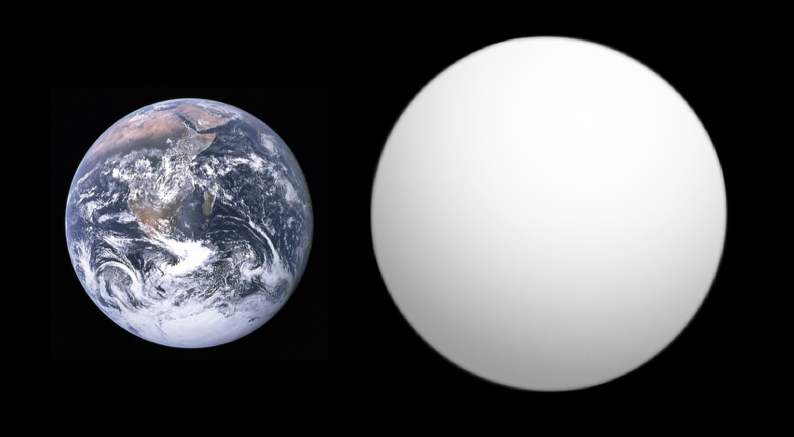
K2-3d occupies the classification space between a super-Earth and a mini-Neptune: its radius spans roughly 1.5 to 1.6 times that of Earth, while its mass sits above Earth's but well below the ice giants Uranus and Neptune. Its equilibrium temperature hovers around 305 K (32 °C), a figure that initially invited speculation about a rocky world. However, the planet almost certainly lacks a solid surface, instead being dominated by a thick envelope of volatiles. Early density estimates painted a picture of a compact, high-density body, but subsequent analysis of HARPS radial-velocity data in 2018 tightened the mass upper bound to fewer than four Earth masses at one-sigma confidence. By 2023 that ceiling had been pushed down further to roughly two Earth masses. The resulting density is comparatively low, closely resembling Neptune's, which reinforces the interpretation of an extensive volatile layer. This revision has important consequences: a world wrapped in deep gaseous and iced material rather than exposed rock dramatically lowers its prospects for surface habitability, shifting K2-3d firmly into the category of a puffy, atmosphere-dominated mini-Neptune rather than a potentially rocky super-Earth.
The Red Dwarf and Its Orbital Setting
K2-3d circles K2-3, an M-type red dwarf whose mass is only 0.60 times the Sun's and whose radius measures 0.56 solar radii. The star's surface temperature of 3896 K is markedly cooler than the Sun's 5778 K, and its age of approximately one billion years makes it less than a quarter the age of our own star. With an apparent magnitude of 12.168, K2-3 is far too faint for unaided human eyes, visible only through telescopes. Its luminosity is roughly six percent of the Sun's, a fact that shapes the entire architecture of the planetary system. K2-3d completes one orbit every 44 days at a semi-major axis of about 0.2 astronomical units, noticeably closer to its star than Mercury is to the Sun at 0.38 AU. It holds the longest orbital period among the three confirmed planets in the K2-3 family, placing it as the outermost world. The star hosts a total of three known planets, and K2-3d's position at the system's periphery gives it a somewhat cooler equilibrium environment than its inner siblings, though the low stellar luminosity means the habitable zone is compressed much closer to the star than it would be around a Sun-like object.
Habitability Prospects and the Tidal Locking Problem
K2-3d sits at the very inner edge of the empirical habitable zone, the narrow band where liquid water could theoretically persist given the right atmospheric pressure and composition. In principle, this placement has made the planet a candidate in lists of potentially habitable exoplanets. Yet several complicating factors erode that optimism. The planet is very likely tidally locked, presenting one hemisphere in perpetual scorching daylight and the other in endless night. The narrow terminator band between them is where surface temperatures might dip low enough for liquid water, but most habitable-zone models place K2-3d just beyond the inner boundary, meaning even that twilight strip is probably too warm. Compounding the issue, the planet receives an abnormally high stellar flux, 1.4 times what Earth gets from the Sun. Such an excess, combined with a thick volatile-rich atmosphere, could drive a runaway greenhouse effect, pushing surface temperatures into the 400 to 500 K range (127 to 227 °C). Under those conditions, the mini-Neptune's deep volatile envelope would likely trap heat far more effectively than a thin rocky atmosphere could, making genuine surface habitability exceedingly unlikely.
Gallery
Frequently Asked Questions
What is K2-3d?
K2-3d (also catalogued as EPIC 201367065 d) is a confirmed mini-Neptune-class exoplanet that circles the red dwarf star K2-3. It is the outermost of three known planets in that system, sitting roughly 143 light-years from us in the constellation Leo.
What are K2-3d's size and mass?
The planet measures between 1.5 and 1.6 Earth radii in diameter, and its mass is constrained to be under two Earth masses at the 1σ confidence level (2023 estimate). Its equilibrium temperature works out to about 305 K, receiving roughly 1.4 times the stellar flux Earth gets.
How long is K2-3d's orbit and how far is it from its star?
K2-3d completes one revolution around K2-3 every 44 days at a semi-major axis of approximately 0.2 AU. That makes it the farthest of the three planets confirmed in the K2-3 system.
Why is K2-3d historically notable among exoplanets?
It holds the distinction of being the first planet to receive a 'd' letter designation during NASA's Kepler 'Second Light' (K2) mission. That milestone marked the first time a fourth-planet slot was officially assigned in that particular survey program.
How was K2-3d discovered and where can I find it in the sky?
The planet was identified through the transit method, which detects the tiny dimming of its host star as the planet passes in front. It lies in the constellation Leo, about 143 light-years from Earth.
More in Transiting Exoplanets, Part 3 1-24
Spotted an error? Know more?
Reader corrections go straight into our review queue. Suggest an edit · How this site is sourced