Kepler-37b
Smallest exoplanet found around a main-sequence star.
Kepler-37b is a small exoplanet located in the constellation Lyra, orbiting the star Kepler-37. It holds the record as the smallest planet ever found around a main-sequence star, with a radius just a bit larger than Earth's Moon but slightly smaller than Mercury's. Its exact mass is unknown, though any mass more than a few times the Moon's would make the planet unrealistically dense.
This planet is a sub-Earth, meaning it is smaller and less massive than our own world. With an equilibrium temperature of 718 K, it is far too hot for liquid water to exist on its surface, and it likely lacks an atmosphere due to its small size and high heat. Its radius is about 0.31 times Earth's, or roughly 1,980 kilometers, making it very probably a rocky body with a solid surface.
The host star, Kepler-37, is a G-type star similar to the Sun but slightly smaller and cooler. It has a mass of 0.80 solar masses, a radius of 0.79 solar radii, and a surface temperature of 5,417 K. At 5.66 billion years old, it is older than the Sun, which is 4.6 billion years old. The star appears dim from Earth, with an apparent magnitude of 9.71, too faint to see without a telescope.
Kepler-37b orbits extremely close to its star, at a distance of about 15 million kilometers (0.1 AU), completing one orbit every 13 days. For comparison, Mercury orbits the Sun at 0.38 AU. The system's two outer planets have orbital periods very close to 8:5 and 3:1 resonances with Kepler-37b's period.
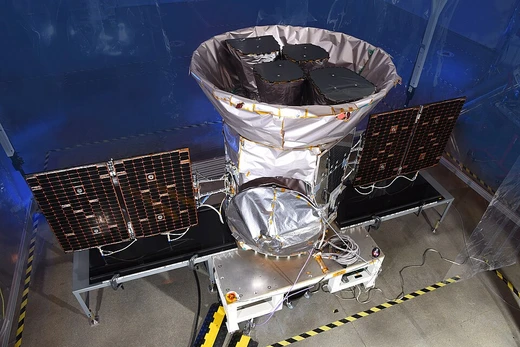
The planet was discovered by NASA's Kepler space telescope using the transit method, along with two other planets in the system, Kepler-37c and Kepler-37d. To confirm the planet's size, astronomers used asteroseismology to measure the host star's dimensions—Kepler-37 is the smallest star ever studied this way—allowing the planet's radius to be determined with high precision. Its detection was made possible by its short orbit, the star's relative brightness, and its low activity, which let brightness data average out quickly. Following the discovery, NASA scientist Jack Lissauer suggested that planets this small may be common in the galaxy.
Quick Facts
- Discovery Site
- Kepler space telescope
- Discovered
- February 20, 2013
- Discovery Method
- Transit
- Apsis
- astron
- Eccentricity
- <0.098
- Star
- Kepler-37
Facts from the source article.
Lore & Background
Kepler-37b is a sub-Earth exoplanet with a radius and mass smaller than Earth. Its equilibrium temperature is 718 K, and because of its small size and high temperatures, it is not expected to have an atmosphere. Its radius is approximately 0.31 Earth radii (about 1980 km), slightly larger than the Moon (0.27 Earth radii) but a little smaller than Mercury (0.38 Earth radii). Due to its small size, it is very likely a rocky planet with a solid surface, and it is too hot to support liquid water on its surface. The measurements do not constrain its mass, but masses above a few times that of the Moon give unphysically high densities.
The planet orbits a G-type star similar to the Sun, named Kepler-37, which is orbited by a total of four planets. The star has a mass of 0.80 solar masses and a radius of 0.79 solar radii. It has a temperature of 5417 K and is 5.66 billion years old. The star's apparent magnitude is 9.71, making it too dim to be seen with the naked eye. Kepler-37b orbits its parent star at a distance of about 15 million kilometers (9.3 million miles), with a period of roughly 13 days at a distance of 0.1 AU. The outer two planets in the system have orbital periods within one percent of the 8:5 and 3:1 resonances with Kepler-37b's period.
Reader's Guide
Kepler-37b was discovered by the Kepler space telescope, which observes stellar transits. After observing transits of Kepler-37b, astronomers had to compare it with the size of the parent star. The size of the star was obtained using asteroseismology; Kepler-37 is currently the smallest star to be studied using this process. This allowed the size of Kepler-37b to be determined with extreme accuracy. To date, Kepler-37b is the smallest planet discovered around a main-sequence star outside the Solar System. Detection of Kepler-37b was possible due to its short orbital period, relative brightness, and low activity of its host star, allowing brightness data to average out quickly. The discovery of Kepler-37b has led Jack Lissauer, a scientist at NASA's Ames Research Center, to conjecture that 'such little planets are common.' Its significance lies in demonstrating that planets smaller than Mercury exist around Sun-like stars and that asteroseismology can precisely characterize both the host star and its smallest companions.
Did You Know?
- Kepler-37b has a radius slightly larger than the Moon but smaller than Mercury.
- Its equilibrium temperature is 718 K, too hot for liquid water.
- The host star Kepler-37 is the smallest star studied using asteroseismology.
- The planet's orbital period is roughly 13 days at 0.1 AU from its star.
More in Transiting Exoplanets, Part 3 1-24
Spotted an error? Know more?
Reader corrections go straight into our review queue. Suggest an edit · How this site is sourced