Gliese 341 b
A nearby sub-Earth exoplanet with an uncertain atmosphere.
Gliese 341 b (also designated TOI-741 b or GJ 341 b) is a confirmed sub-Earth exoplanet orbiting the red dwarf star Gliese 341, located 33.9 light-years from Earth in the constellation Carina. Discovered in 2024 via transit observations, it was subsequently analyzed by the James Webb Space Telescope in the search for an atmosphere, making it a notable target for atmospheric characterization studies.
Quick Facts
- Discoverer
- James Kirk et al.
- Discovered
- January 11, 2024 (announced)
- Discovery Method
- Transit
- Eccentricity
- 0(fixed)
- Star
- Gliese 341
- Single Temperature
- 560 K (equilibrium temperature), 760 K (irradiation temperature)
Facts from the source article.
Lore & Background
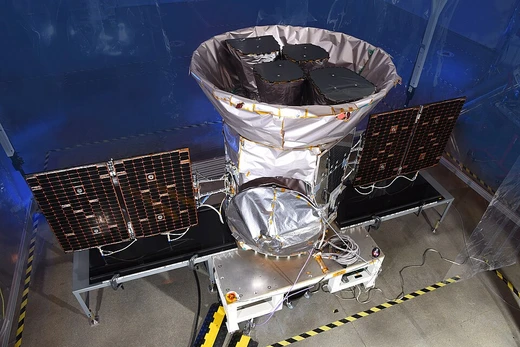
Gliese 341 b was first identified as a candidate planet by the Transiting Exoplanet Survey Satellite (TESS). Its confirmation was announced in January 2024 by a team led by James Kirk, who also presented a transmission spectrum obtained with the James Webb Space Telescope's Near Infrared Camera (NIRCam) instrument, based on observations of three transits. Later analysis by Victoria DiTomasso and colleagues refined the planetary and stellar parameters and ruled out additional planets with orbital periods less than 1750 days and masses greater than a certain threshold.
The planet has a radius of about 0.5 Earth radii and a poorly constrained mass, with only an upper limit of 3 Earth masses derived; mass-radius relationships estimate a mass of about 1 Earth mass. It orbits its host star every eight days, resulting in an equilibrium temperature of 560 K and an irradiation temperature of 760 K. As of 2024, it is not known whether the planet has an atmosphere. The transmission spectrum allows for scenarios including a hazy atmosphere, a water-dominated atmosphere, or no atmosphere at all, while scenarios with a high mean molecular weight atmosphere are ruled out.
The host star, Gliese 341, is a red dwarf about 48% the size of the Sun and 51% its mass, located 34 light-years away in the constellation Carina. With an apparent magnitude of 9.5, it is not visible to the naked eye but can be observed through a small telescope. The star is visually close to the False Cross asterism, particularly near Iota Carinae. It has long been studied for its proximity and high proper motion, and it serves as a photometric and radial velocity standard star. The closest star to TOI-741 is the red dwarf L 140-289, located 2.5 light-years away, and the neighboring star L 98-59 hosts four confirmed exoplanets.
Reader's Guide
Gliese 341 b holds significance as a nearby sub-Earth exoplanet discovered in 2024 and immediately scrutinized by the James Webb Space Telescope for atmospheric signatures. Its location 33.9 light-years away makes it one of the closer known exoplanets, and its classification as a sub-Earth places it in a category of small, rocky worlds that are prime targets for understanding planetary formation and atmospheric retention around red dwarfs. The uncertainty regarding its atmosphere—whether it has a hazy atmosphere, a water-dominated one, or none at all—highlights the challenges and ongoing investigations in exoplanetary science. The ruling out of a high mean molecular weight atmosphere provides a constraint on possible compositions. The planet's short eight-day orbit and high equilibrium temperature of 560 K place it in a regime where atmospheric escape may be significant. The legacy of Gliese 341 b lies in its role as a testbed for James Webb Space Telescope capabilities in characterizing small exoplanets, and its discovery contributed to the growing list of nearby transiting worlds that can be studied in detail. The refined parameters from subsequent analyses and the exclusion of additional planets in the system further define its context within its stellar neighborhood.
Did You Know?
- Gliese 341 b was discovered in 2024 via transit observations and confirmed by a team led by James Kirk.
- The planet's mass is poorly known, with only an upper limit of 3 Earth masses; mass-radius relationships estimate a mass of about 1 Earth mass.
More in Transiting Exoplanets, Part 3 1-24
Spotted an error? Know more?
Reader corrections go straight into our review queue. Suggest an edit · How this site is sourced