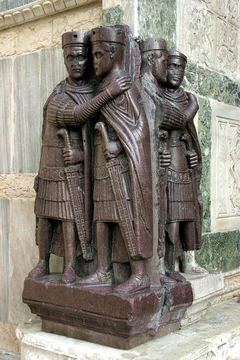
Severus II
Roman emperor of the Tetrarchy, killed by usurper Maxentius.

Flavius Valerius Severus, known as Severus II, ruled as a Roman emperor for roughly a year between 306 and 307, holding a position within the Tetrarchy. After Constantius I's death, Galerius promoted Severus to augustus, while Constantine was recognized as caesar (not co-augustus in the west) by Galerius. Severus's authority was not shared with Constantine; Constantine controlled Gaul and Britain, while Severus held Italy and Africa, but they were not co-rulers of the west. Most of his brief reign was consumed by a conflict with the rebel Maxentius. Maxentius ultimately captured Severus and forced him to commit suicide (or had him executed) in September 307, seizing control of Italy.
Severus came from a lowly background, born in northern Illyria around the mid-third century. He was a close associate of Emperor Galerius, through whom he advanced to a senior military command. Galerius proposed him for the junior imperial rank of caesar in the west. According to Lactantius, Diocletian initially resisted, calling Severus a dancer and a drunkard who confused night and day. Galerius insisted that Severus had been a reliable paymaster and army supplier, and Diocletian gave way. Severus became caesar on 1 May 305, serving as junior colleague to the western augustus, Constantius I.
When Constantius died in Britain in July 306, his troops immediately proclaimed his son Constantine I as augustus. At the same time, Galerius promoted Severus to the rank of augustus. Lactantius records that Galerius did this to elevate the older man to the higher office while accepting Constantine’s imperial symbols and granting him the lesser rank of caesar. Despite this, Constantine controlled most of the western empire—Britain, Gaul, and Hispania—leaving Severus with only Italy and Africa.
In October 306, Maxentius, son of the retired emperor Maximian, rebelled in Rome. Galerius ordered Severus to crush the uprising. Severus marched from his capital at Mediolanum toward Rome at the head of an army that had previously served under Maximian. Fearing Severus’s approach, Maxentius offered his father Maximian a co-rule. Maximian accepted, and when Severus besieged Rome, his troops deserted to Maxentius. Severus fled to the impregnable fortress of Ravenna. Maximian promised to spare his life and treat him kindly if he surrendered peacefully, which Severus did around April 307. Despite the
- known_for
- Brief reign as western augustus during the Tetrarchy; defeated and forced to commit suicide (or executed) by Maxentius
Lore & Background
Severus was of humble birth, born in Northern Illyria around the middle of the third century. A friend of emperor Galerius, he rose to become a senior officer in the Roman army, being nominated as caesar of the western half of the empire. According to Lactantius, Diocletian objected to Galerius's suggestion, calling Severus a 'dancer' and 'habitual drunkard,' but Galerius persisted, citing his faithful service as paymaster and purveyor. Diocletian acquiesced, and Severus succeeded to the post of caesar on 1 May 305, becoming the junior colleague of Constantius I, augustus of the western half of the empire.
When Constantius died in Britain in July 306, his soldiers acclaimed his son Constantine I as augustus, while Severus was also promoted to augustus by Galerius. Lactantius reports that Galerius did this to promote the older man to the higher office, while accepting Constantine as a member of the Tetrarchy with the rank of caesar. Despite his lower title, Constantine controlled most of the Western empire, leaving Severus with Italy and Africa. When Maxentius revolted at Rome in October, Galerius sent Severus to suppress the rebellion. Severus moved towards Rome from Mediolanum at the head of an army previously commanded by Maximian. Fearing Severus, Maxentius offered Maximian co-rule; Maximian accepted, and when Severus besieged Rome, his men deserted to Maxentius. Severus fled to Ravenna, an impregnable position. Maximian offered to spare his life if he surrendered peaceably, which he did around April 307. Despite the assurance, Severus was displayed as a captive and later imprisoned at Tres Tabernae. One belief is that when Galerius invaded Italy, the former ordered Severus's death, probably in September or October. Lactantius reports he was permitted to kill himself by opening his veins. Another belief is that he was killed in Ravenna.
Reader's Guide
Severus II's significance lies in his role as a short-lived western augustus during the turbulent transition of the Tetrarchy. His reign illustrates the fragility of the imperial system after Diocletian's abdication, as rival claims and military defections quickly undermined his authority. His defeat by Maxentius, aided by the defection of his own troops—formerly commanded by Maximian—highlights the importance of personal loyalty over institutional titles. The uncertainty surrounding his death, with conflicting accounts of suicide or execution, reflects the chaotic nature of civil war. His legacy is largely overshadowed by Constantine I and Maxentius, but his brief rule marks a key moment in the collapse of the Tetrarchy and the rise of new power struggles. The position of western augustus remained officially vacant until the Conference of Carnuntum in November 308, when Licinius was appointed. Severus was survived by his son Flavius Severianus, later executed by Licinius for treason.
Did You Know?
- Severus was of humble birth, born in Northern Illyria around the middle of the third century.
- According to Lactantius, Diocletian called Severus a 'dancer' and 'habitual drunkard' when Galerius proposed him as caesar.
- Severus's army deserted to Maxentius when he besieged Rome, forcing him to flee to Ravenna.
- One belief holds that Severus was permitted to kill himself by opening his veins; another says he was killed in Ravenna.
More in Tetrarchy 1-24
Spotted an error? Know more?
This is a living reference — every entry is fact-audited, and reader corrections feed straight into our audit queue. Suggest an edit · See this site's audit record