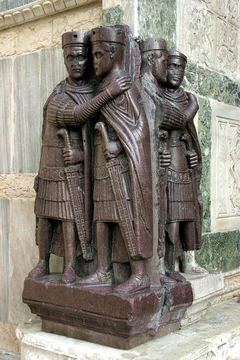
Civil wars of the Tetrarchy
Conflicts that dismantled Diocletian's tetrarchic system.

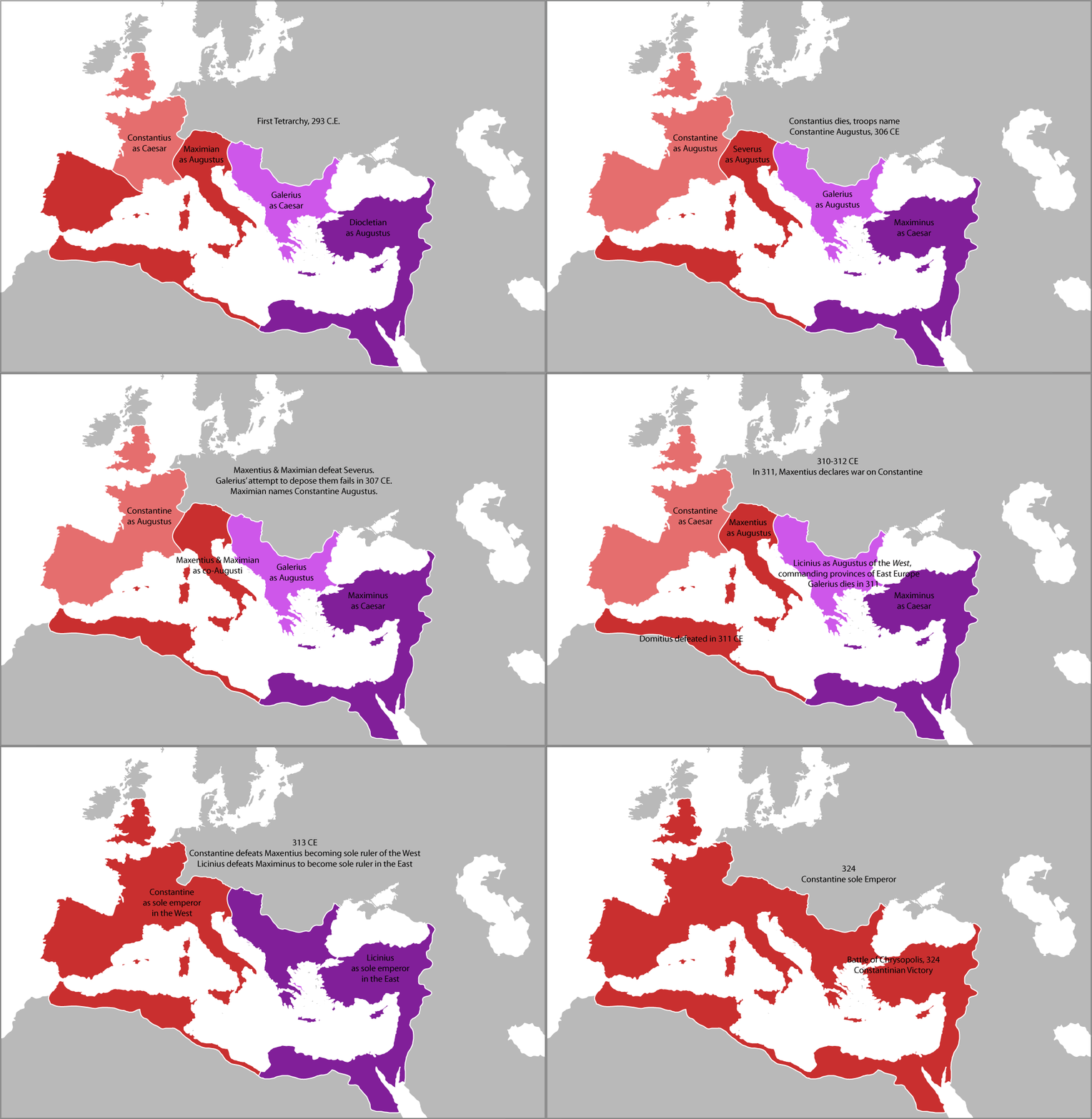
The civil wars of the Tetrarchy were a series of conflicts between the co-emperors of the Roman Empire, starting from 306 AD with the usurpation of Maxentius and the defeat of Severus, and ending with the defeat of Licinius at the hands of Constantine I in 324 AD. These wars arose from the breakdown of the Tetrarchy, the administrative division of the Roman Empire instituted by Diocletian in 293 AD, which had aimed to end the Crisis of the Third Century. The death of Constantius in 306 AD triggered a cascade of usurpations and military campaigns that ultimately dismantled the tetrarchic system.
- start_date
- 306 AD
- end_date
- 324 AD
- field
- Roman imperial civil wars
- key_belligerents
- Constantine I, Maxentius, Maximian, Galerius, Severus, Licinius, Maximinus Daza
- outcome
- Defeat of Licinius by Constantine I
Lore & Background
The Tetrarchy was established by Diocletian in 293 AD, dividing the empire into eastern and western halves under two Augusti and two Caesars. The senior emperors abdicated in 305 AD, elevating Constantius and Galerius to Augusti, with Severus and Maximinus Daza as Caesars. The death of Constantius at Eburacum in 306 AD led his troops to elevate his son Constantine to Augustus, bypassing Severus. Galerius compromised by granting Constantine the title Caesar, but this motivated Maxentius, son of Maximian, to declare himself emperor at Rome. Galerius ordered Severus to suppress Maxentius, but Severus's army defected to Maximian, and Severus was captured and later killed.
Reader's Guide
The civil wars of the Tetrarchy mark the final collapse of Diocletian's experiment in shared rule, which had stabilized the empire after the Crisis of the Third Century. The conflicts began with the usurpation of Maxentius in 306 AD and ended with Constantine's defeat of Licinius in 324 AD, leading to the reunification of the Roman Empire under a single ruler. These wars demonstrated the fragility of the tetrarchic system, as personal ambition and military loyalty often trumped constitutional arrangements. The wars also saw the rise of Constantine, whose victory at the Battle of the Milvian Bridge (implied in the article) and subsequent consolidation of power set the stage for the Christianization of the empire. The article notes that Constantine's campaign against Maxentius in 312 AD was marked by his disregard for unfavorable omens, a decision that inspired followers to believe he had supernatural guidance.
Did You Know?
- The civil wars began with the usurpation of Maxentius and the defeat of Severus in 306 AD.
- Galerius was forced to withdraw from Italy after many of his soldiers defected to Maxentius and Maximian.
- Maximian, after rebelling against Constantine in 310 AD, was captured at Massilia and later hanged himself.
- Galerius's final act in 311 AD was a letter proclaiming an end to the persecutions of Christians.
The Architecture of Collegial Power
Diocletian's reimagining of imperial governance introduced a structure unlike anything Rome had previously attempted: a college of four rulers, two senior and two junior, each with a defined role and a designated successor. The system began in 285 when Diocletian elevated the general Maximian to the rank of caesar, then promoted him to co-augustus a year later. Diocletian would oversee the eastern provinces while Maximian administered the west. By 293, Diocletian judged that the empire demanded more focused attention on both civic and military challenges, and with Maximian's agreement, he expanded the college by naming Galerius and Constantius as the two new caesares. The hierarchy carried deliberate mythological weight: the augustus embodied Jupiter, while his caesar stood as the equivalent of Hercules, Jupiter's son. In May 305, both senior emperors stepped down in a single, coordinated act of abdication, elevating Galerius and Constantius to the top rank and installing Valerius Severus and Maximinus Daza as the new caesares. For a brief window, the mechanism of orderly, planned succession appeared to function exactly as its architect intended.
The Shattering of Order
The carefully choreographed succession plan unraveled almost immediately after the 305 retirement. When Constantius died in July 306, his son Constantine was not elevated through the prescribed channel; instead, his father's troops proclaimed him both augustus and caesar of their own accord, bypassing the college entirely. In the west, a second disruption followed: Maxentius disputed Severus's right to the junior title, took the grandiose style princeps invictus for himself, and obtained the caesar rank through his father's backing in 306. By 307, Severus had surrendered to Maximian and Maxentius, and both men were recognized as augusti by the old emperor. Galerius, seeking to restore some semblance of the original design, appointed Licinius as augustus for the west in 308 and elevated Maximinus Daza to the same rank in 310. Yet these patches could not repair the fundamental breach: the principle that power moved only through the college's internal logic had been shattered by military acclamation and dynastic self-assertion. The tetrarchy had become, in practice, a patchwork of competing claims rather than a unified hierarchy.
The Wars of Unification
The final phase of the tetrarchic civil wars was defined by the elimination of rivals through direct military confrontation. In 312, Constantine defeated Maxentius at the Battle of the Milvian Bridge, securing uncontested control of the western half of the empire. In the east, Licinius inherited dominance following the death of Maximinus Daza. For a brief period, the two surviving claimants maintained a fragile equilibrium, even jointly recognizing their sons—Crispus, Constantine II, and Licinius II—as caesares in March 317, an act that echoed the original tetrarchic logic of pairing senior and junior rulers. That equilibrium proved short-lived. The mutually destructive civil wars that followed consumed most of the remaining claimants to power. The decisive blow came at the Battle of Chrysopolis, where Licinius was defeated and subsequently resigned his title as augustus. Around 324, Constantine stood alone in command of the entire Roman Empire, and the tetrarchic system that Diocletian had constructed three decades earlier was effectively extinguished.
The Long Shadow of Collegial Rule
Although the tetrarchic system as a formal structure dissolved in the 320s, its underlying logic of shared, hierarchical rule persisted in modified form for centuries. The Constantinian dynasty retained the practice of collegiate governance: Constantine appointed his son Constantius II as caesar in 324, followed by Constans in 333 and his nephew Dalmatius in 335. After Constantine's death in 337, his three surviving sons were declared joint augusti simultaneously. The very idea of partitioning the empire among several co-rulers proved remarkably durable, surviving all the way to the collapse of the Western Roman Empire, and in the Eastern Roman Empire the titles of augustus and caesar continued to be conferred sporadically. Ancient authors understood the Diocletianic arrangement not as four equals but as a musical ensemble arrayed around a conductor, all voices moving in concert under a single direction—a vision captured by Julian's comparison and reinforced by Ammianus, who recorded Constantius II invoking the submission of Diocletian's lesser colleagues as a model for obedience. The tetrarchy's true legacy was not its four-way division but the enduring Roman conviction that imperial power could be shared, ranked, and transmitted through a structured college.
Gallery
Frequently Asked Questions
What are the Civil Wars of the Tetrarchy?
They refer to a prolonged series of armed confrontations among Rome's co-emperors that stretched from 306 to 324 AD, ultimately shattering the four-part administrative framework Diocletian had established in 293 to stabilize the empire after the Crisis of the Third Century.
What event kicked off the Tetrarchy's civil wars?
The death of Constantius in 306 AD triggered a cascade of power grabs, beginning with Maxentius's usurpation and the subsequent defeat of Severus, which unraveled the carefully balanced tetrarchic order.
Who were the principal contenders fighting in these wars?
The main belligerents included Constantine I, Maxentius, Maximian, Galerius, Severus, Licinius, and Maximinus Daza, each claiming legitimate authority over the Roman state.
How did the Civil Wars of the Tetrarchy come to an end?
The conflicts concluded in 324 AD when Constantine I defeated Licinius in battle, removing the final rival claimant and leaving him as the sole ruler of the entire empire.
Why do historians regard these wars as a turning point for the Roman Empire?
They permanently dismantled Diocletian's tetrarchic system, replacing the multi-emperor arrangement with a single sovereign and fundamentally reshaping how Roman imperial power was structured and exercised.
More in Tetrarchy 1-24
Spotted an error? Know more?
This is a living reference — every entry is fact-audited, and reader corrections feed straight into our audit queue. Suggest an edit · See this site's audit record