Conference of Carnuntum
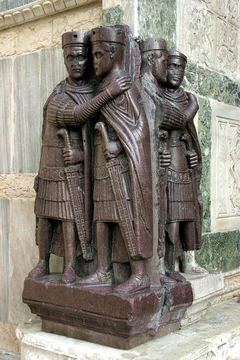
Roman conference to stabilize the Tetrarchy in 308.

Vladimir Drzik · Public domain
On 11 November 308, the Roman emperor Galerius called a meeting in the city of Carnuntum (modern Petronell-Carnuntum, Austria), then part of the province of Pannonia Prima. This gathering, known as the Conference of Carnuntum, aimed to fix the Tetrarchy—the empire’s four-ruler system—after a year of turmoil over who held the title of augustus in the West. The previous year, both Severus II and Galerius had led failed invasions to reclaim Italy from the usurper Maxentius and his father, the former emperor Maximian. Attending the conference were the retired emperor Diocletian and his old colleague Maximian.
The meeting’s decisions forced Maximian to give up his imperial position, though he later attempted to regain power, while Maxentius remained branded a usurper. Licinius, a close friend and comrade-in-arms of Galerius, was appointed Augustus of the West with the primary task of dealing with Maxentius. Constantine, who had been acclaimed emperor by his troops but never officially recognized as augustus by Galerius, was confirmed as caesar. These rulings pleased almost no one: Constantine rejected his demotion and kept calling himself augustus, while Maximinus Daza pressed Galerius for a promotion. Maximian, unhappy with his forced retirement, later attempted a final conspiracy in 310 at Constantine’s court in Arles. Licinius, for his part, took no action against Maxentius in the following years.
- Date
- 11 November 308
- Location
- Carnuntum (present-day Petronell-Carnuntum, Austria)
- Convened by
- Galerius (Eastern augustus, r. 305–311)
- Key attendees
- Diocletian, Maximian, Galerius, Licinius
- Purpose
- Stabilize the Tetrarchy and resolve a dispute over the title of augustus in the West
Lore & Background
The Conference of Carnuntum was convened by Galerius on 11 November 308 to address a dispute over the title of augustus in the West. This dispute had been ongoing since the previous year, when consecutive invasions by Severus II and Galerius had failed to recover Italy from the usurper Maxentius and Maximian. Present at the conference were the retired Diocletian and his former colleague, Maximian.
Reader's Guide
The Conference of Carnuntum was a pivotal attempt to restore order to the Tetrarchy, the Roman Empire's four-ruler system. Its decisions—forcing Maximian to retire permanently, treating Maxentius as a usurper, raising Licinius as western Augustus, and relegating Constantine to western caesar—were intended to stabilize the empire. However, these decisions did not please most of those involved: Constantine questioned his demotion and persisted in using the style of augustus, while Maximinus demanded promotion from Galerius. Maximian, also unsatisfied, later attempted a conspiracy in 310. Licinius did nothing in the following years to stop Maxentius. The conference ultimately failed to prevent further civil wars, as Constantine and Maximinus soon claimed the title of augustus, and the Tetrarchy collapsed.
Did You Know?
- The Conference of Carnuntum was held on 11 November 308.
- The retired emperor Diocletian briefly returned to public life to attend the conference.
- At the conference, Licinius was raised as Augustus of the West and tasked with dealing with Maxentius.
- The augusti present—including Maximian—rebuilt the Mithraeum of Carnuntum and dedicated it to the absent caesares and themselves.
Military Fortress and the Succession of Legions
Carnuntum's military identity stretches back to 6 AD, when Tiberius established it as his operational base during campaigns against the Germanic king Maroboduus. The site truly transformed into a major Roman military installation before 14 AD, when Legio XV Apollinaris was garrisoned there, triggering significant Romanisation of the area. A few years later, it became the central node of Danube frontier fortifications stretching from Vindobona to Brigetio. Around 50 AD, Emperor Claudius directed the Pannonian governor to station a legion with auxiliary forces along the Danube bank to mediate disputes between the Quadi and Marcomanni and deter invasion. The fortress saw a remarkable rotation of legions: Legio X Gemina was posted there briefly around 63 AD before returning to Hispania under Galba; Legio VII Gemina, newly created by Galba in 68, occupied the site until roughly 71 AD. From 117 or 118 AD, Legio XIV Gemina took permanent residence, remaining for three centuries until the frontier's collapse around 430. The site also served as headquarters for the Pannonian fleet from 50 AD.
Imperial Politics and the Conference of Carnuntum
Carnuntum's proximity to power made it a stage for some of the Roman Empire's most consequential political moments. During the Marcomannic Wars, Emperor Marcus Aurelius resided at the site for three years (172–175), and it was there he composed portions of his philosophical work, the Meditations. In 193, the Pannonian governor Septimius Severus was proclaimed emperor by his own soldiers at Carnuntum, replacing the murdered Pertinax. The Severan dynasty (193–235) brought an economic boom, with the civilian canabae reaching their maximum extent, and Caracalla elevated the settlement to colony status as Septimia Colonia Aurelia Antoniana. During Gallienus's reign, the Pannonians elected the usurper Regalianus, who set up a mint at the site before being killed by his own soldiers, likely at Carnuntum itself. Perhaps the most famous political gathering occurred in 308, when the retired Emperor Diocletian convened the Conference of Carnuntum with co-emperors Maximian and Galerius to address escalating tensions within the Tetrarchy.
Urban Grandeur and the Amber Trade
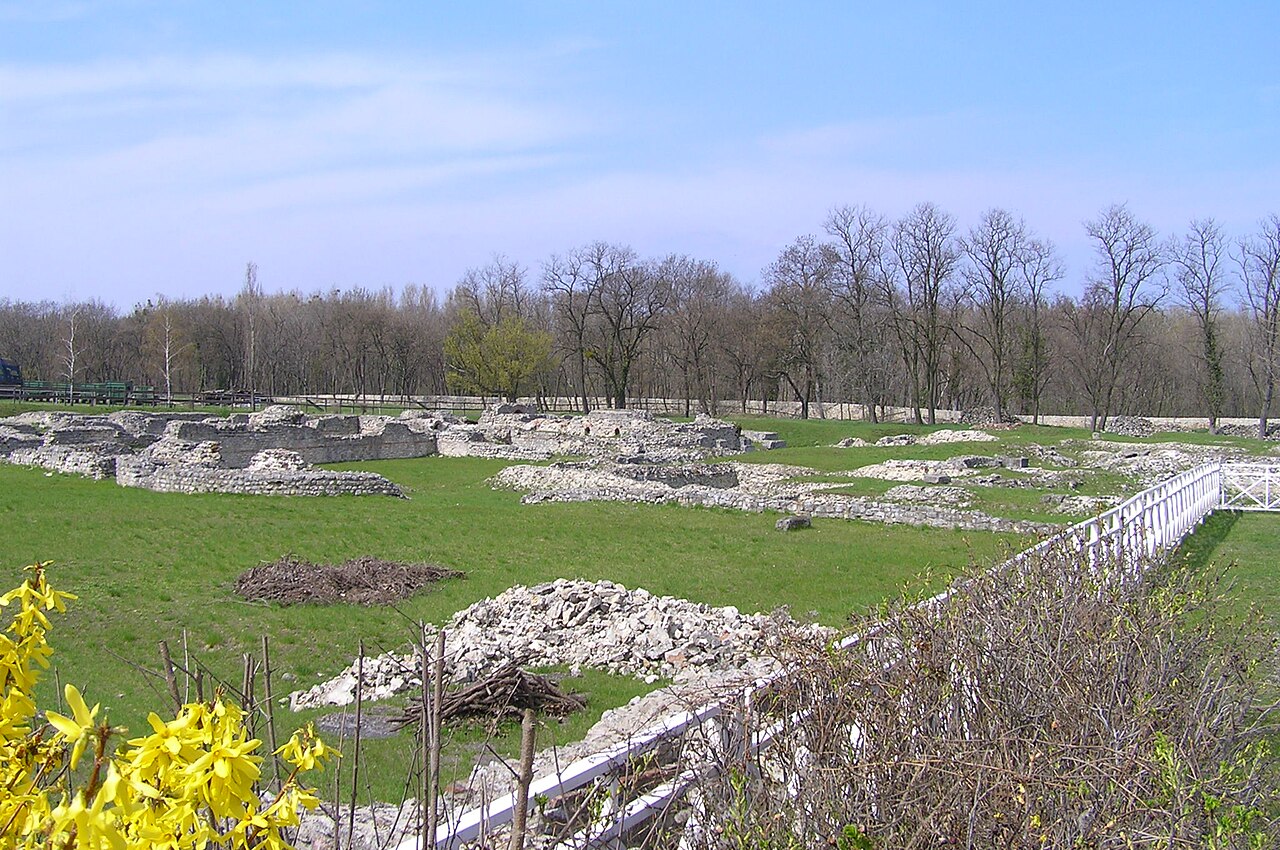
At its peak, Carnuntum housed approximately 50,000 inhabitants, making it one of the largest cities in the Roman world. Its strategic position on the Danube, halfway between modern Vienna and Bratislava, placed it at a critical junction of the Amber Road, where the main trading arm crossed the river. Merchants brought amber from the north to sell southward into Italy, generating considerable wealth. Hadrian granted the settlement municipium status as Aelium Carnuntum, and its civic infrastructure reflected its importance: a forum stood adjacent to palace ruins (also identified as large public baths), and a grand amphitheatre seated around 15,000 spectators. An inscription discovered at the site claims this was the fourth-largest amphitheatre in the entire Roman Empire. The civilian city's remains still surround the village of Petronell-Carnuntum, where an open-air museum exposes Roman streets and domestic architecture, including the reconstructed House of Lucius, rebuilt using traditional Roman techniques and opened to visitors in 2006.
Decline, Forgetting, and Modern Rediscovery
Carnuntum's final centuries were marked by catastrophe. Around 350, a severe earthquake damaged the city, and in 374, Germanic invaders—the Quadi and Iazyges—destroyed it. Although Emperor Valentinian I ordered partial restoration, the settlement never recovered its former prominence, and Vindobona (Vienna) supplanted it as the chief military centre. During the broader Barbarian Invasions, Carnuntum was ultimately abandoned, its stones quarried for building projects elsewhere, and its ground repurposed as a cemetery. The remains sank into obscurity, buried and forgotten for centuries. One structure, however, survived in isolation: the Heidentor, a triumphal arch erected between 354 and 361 AD, reportedly commissioned by Constantius II to commemorate his victories. Medieval inhabitants, encountering this lone monument in the landscape, mistook it for the tomb of a pagan giant and gave it the name 'Heathens' Gate.' Today, the Carnuntum Archaeological Park spans 10 square kilometres, preserving the museum, amphitheatre, fortress remains, and the annual Art Carnuntum World Theatre Festival, which stages classical and contemporary drama in the ancient amphitheatre.
Gallery
Frequently Asked Questions
What was the Conference of Carnuntum?
It was an emergency political summit held on 11 November 308 at Carnuntum in present-day Austria, convened by the Eastern ruler Galerius to patch up the crumbling four-emperor system after a year of rival claims to the Western throne.
Why did Galerius call the Conference of Carnuntum?
After two unsuccessful 307 campaigns to expel Maxentius and his father Maximian from Italy, Galerius turned to diplomacy rather than further warfare, seeking a collective decision on who should hold the Western augustinship.
Who was present at the Conference of Carnuntum?
The retired emperors Diocletian and Maximian sat alongside the active tetrarchs Galerius and Licinius, making it a rare four-way gathering of the system's principal figures under one roof.
What did the Conference of Carnuntum decide?
The assembly confirmed Licinius as the new Western Augustus, effectively cut Maximian out of any further political role, and restated the principle that the Tetrarchy's hierarchy must be respected.
Why is the Conference of Carnuntum significant in Tetrarchic history?
It represents the last serious attempt by the original architects of the system to enforce its rules collectively, coming just a few years before the Tetrarchy dissolved into open civil war.
More in Tetrarchy 1-24
Spotted an error? Know more?
This is a living reference — every entry is fact-audited, and reader corrections feed straight into our audit queue. Suggest an edit · See this site's audit record