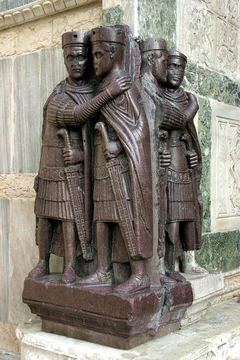
Crispus
Eldest son of Constantine I, caesar, and executed by his father.

Krzysztof Ziarnek, Kenraiz · CC BY-SA 4.0
Flavius Julius Crispus (c. 300 – 326) was the eldest son of the Roman emperor Constantine I and served as his junior colleague (caesar) from March 317 until his execution by his father in 326. He was the grandson of the augustus Constantius I and the elder half-brother of the future augustus Constantine II. Crispus ruled from Augusta Treverorum (Trier) in Roman Gaul between 318 and 323 and played a decisive role in the final defeat of Licinius I, notably commanding the fleet that won the Battle of the Hellespont in 324. His sudden execution in 326, along with the death of his stepmother Fausta, remains a mysterious and debated episode in Constantinian history.
- born
- c. 300
- died
- 326
- field
- Roman imperial politics and military command
- nationality
- Roman
- known_for
- Eldest son of Constantine I, caesar, victor at the Battle of the Hellespont, executed by his father
Lore & Background
Crispus was born before 307, as his father Constantine married Fausta in that year, meaning his mother Minervina was either dead or set aside. His tutor in rhetoric was the Late Latin historian Lactantius. On 1 March 317, Constantine and Licinius jointly proclaimed Crispus, his half-brother Constantine II, and his cousin Licinius II as caesares at Serdica. Crispus was appointed Commander of Gaul and resided at Augusta Treverorum (Trier). He was three times Roman consul (318, 321, and 324) and was titled princeps iuventutis.
Reader's Guide
Crispus's significance lies in his role as a key military commander for Constantine I during the final phase of the civil war against Licinius. His victory at the Battle of the Hellespont in 324, where his 200 ships defeated a larger fleet, was crucial to Constantine's sole rule. Despite his successes, Crispus was executed at Pola in 326 on his father's orders, with later Greek and Byzantine sources alleging an incestuous relationship with his stepmother Fausta. The true reasons remain unclear, and both Crispus and Fausta suffered damnatio memoriae. His story later inspired numerous literary and operatic works, including Bernardino Stefonio's neo-Latin tragedy Crispus (1597) and Donizetti's opera Fausta (1832).
Did You Know?
- Crispus was tutored in rhetoric by the early Christian historian Lactantius.
- He was three times Roman consul, for the years 318, 321, and 324.
- After his execution, Crispus was subjected to damnatio memoriae, with his name erased from inscriptions.
- The story of Crispus and Fausta resembles the myth of Phaedra and Hippolytus, casting doubt on its veracity.
Rise to Imperial Command & Military Triumphs
By early 317, the political landscape of the Roman Empire was being reshaped through the settlement that ended the Cibalensean War. On 1 March of that year, Constantine and his co-augustus Licinius jointly elevated three young men to the rank of caesar: Crispus, his younger half-brother Constantine II, and their cousin Licinius Junior. Crispus was immediately appointed Commander of Gaul and established his residence at Augusta Treverorum, the regional capital of Germania. In the years that followed, he proved himself a formidable military leader, leading victorious campaigns against the Franks and the Alamanni in 318, 320, and 323, thereby securing Roman control over Gaul and the Germanic frontier. His soldiers reportedly adored him for his strategic brilliance. The crowning achievement of his career came in 324, when Constantine placed him in command of a fleet of two hundred ships departing from Piraeus. At the Battle of the Hellespont, Crispus decisively defeated an enemy navy at least twice his size. He then led a portion of Constantine's legions to further victory at Chrysopolis. Together, these twin triumphs forced Licinius's resignation and left Constantine as the sole ruler of the entire empire.
The Mysterious Execution & Damnatio Memoriae
In 326, Crispus's life was cut short at Pola on the Istrian coast, on his father's direct orders. The precise circumstances surrounding his death remain shrouded in ambiguity. Some ancient sources describe a trial of unclear nature, while others, including Sidonius Apollinaris and Gregory of Tours, suggest he was killed by poison. His stepmother Fausta met a similar fate shortly afterward, reportedly perishing in a hot bath. The most lurid explanation, recorded by the Greek historians Zosimus and Zonaras, alleged that Constantine had accused Crispus of incest with Fausta. Modern scholars have debated this account extensively. T. D. Barnes pointed out that Crispus was stationed at Trier while Fausta resided in Constantinople, making an affair geographically implausible. Hans Pohlsander countered that Crispus had spent time in the East but noted the story's resemblance to the Phaedra and Hippolytus myth casts doubt on its reliability. David Woods proposed an alternative: that Crispus was exiled to Pola and took his own life, while Fausta died attempting to terminate a pregnancy. Regardless of the truth, both Crispus and Fausta were subjected to damnatio memoriae, their names systematically erased from public inscriptions.
Education, Honor & the Imperial Image
Crispus's intellectual formation was shaped by one of the most distinguished Christian teachers of his era. Constantine entrusted his eldest son's education in rhetoric to Lactantius, the Late Latin historian whose works remain foundational to early Christian thought. After Crispus's elevation to imperial rank, he assumed the title princeps iuventutis, or Prince of Youth, and the celebrated Latin rhetorician Nazarius composed a panegyric in his honor, preserved in the collection known as the Panegyrici Latini, celebrating his military successes against the Franks around 319. Crispus also held the prestigious office of Roman consul three times, in 318, 321, and 324. His public image was cultivated with extraordinary care: following his naval and land victories in 324, Constantine had his son's likeness struck onto imperial coinage and rendered in statues, mosaics, and cameos throughout the empire. Perhaps most remarkably, Eusebius of Caesarea penned a work for Crispus in which he described him as an emperor most dear to God, comparable in every respect to his father, and drew an explicit parallel between the father-son relationship and that of God the Father and God the Son.
Family, Legitimacy & the Constantinian Dynasty
Crispus occupied a complex position within the Constantinian family. As the eldest son of Constantine I and grandson of the augustus Constantius I, he was the senior male heir of the dynasty. Yet his origins carried an ambiguity that shadowed his status: the legal nature of the relationship between his mother Minervina and Constantine is nowhere clearly documented, and Crispus may well have been an illegitimate child. He must have been born before 307, the year Constantine married Maximian's daughter Fausta, by which point Minervina was either deceased or had been set aside. This made Crispus the elder half-brother of the future emperor Constantine II and the first cousin of Licinius Junior. His elevation to caesar in 317 was inseparable from the broader political settlement that concluded the Cibalensean War, binding the western and eastern halves of the empire through a shared ruling structure. By October 322, Crispus had married a woman named Helena and fathered a son, Flavius, an event that Constantine publicly celebrated and that was recorded in the Codex Theodosianus. After the final defeat of Licinius in 324, the Constantinian dynasty stood in undisputed control of the entire Roman world, with Crispus at its apex as the senior caesar.
Gallery






Frequently Asked Questions
Who is Crispus in the Tetrarchy?
Crispus (c. 300–326) was the eldest son of Emperor Constantine I and the grandson of the former augustus Constantius I. He held the rank of caesar from March 317 until his death, making him the senior junior ruler in Constantine's household.
What was Crispus's role and where did he govern?
As caesar, Crispus administered Roman Gaul from the imperial capital at Trier (Augusta Treverorum) between 318 and 323. He also held direct military command, most notably leading the naval force at the Battle of the Hellespont in 324, which sealed the final defeat of Licinius I.
How does Crispus's story end?
In 326, Constantine ordered the execution of his own son Crispus. The event is tied to the simultaneous death of Crispus's stepmother Fausta, and the precise circumstances remain one of the most debated episodes of the period.
Why is Crispus important to the Tetrarchy's narrative?
His naval victory at the Hellespont was the decisive blow that eliminated Licinius and unified the empire under Constantine. His sudden removal also shattered the succession line, directly setting the stage for the later conflict among his half-brothers.
What is Crispus's relationship to Constantine II?
Constantine II was Crispus's elder half-brother, both being sons of Constantine I but from different mothers. After Crispus's execution, Constantine II became the surviving son in the line of succession, which shaped the political dynamics of the 330s.
More in Tetrarchy 1-24
Spotted an error? Know more?
This is a living reference — every entry is fact-audited, and reader corrections feed straight into our audit queue. Suggest an edit · See this site's audit record