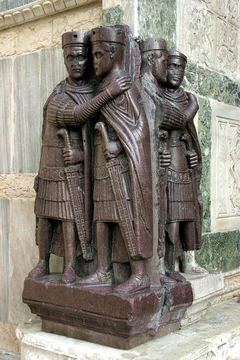
Constantius Chlorus
Roman emperor and father of Constantine the Great.

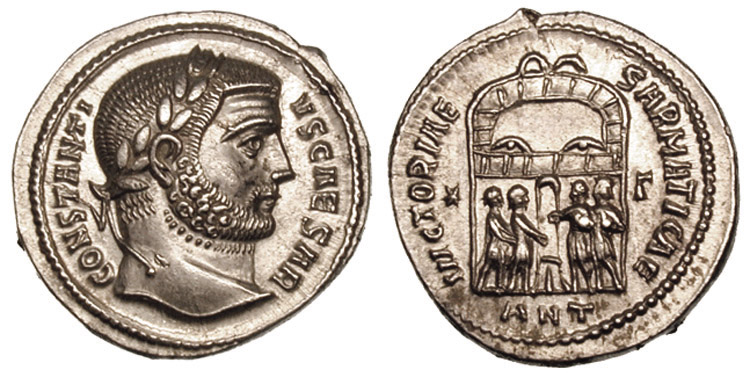
Unknown artist · Public domain
Marcus Flavius Valerius Constantius, known to history as Constantius I, lived from about 250 until 25 July 306. He ruled as Roman emperor for just over a year, from 305 to 306. He is best remembered as the father of Constantine the Great, the first emperor to embrace Christianity. Constantius was one of the four original members of the Tetrarchy, the system of shared rule created by Emperor Diocletian. He first served as a junior emperor, or caesar, from 293 to 305, and then became senior emperor, or augustus, until his death. The nickname "Chlorus," meaning "the Pale" in Greek, was only applied to him centuries later by Byzantine historians; no one called him that while he was alive.
Constantius came from a modest background and rose through the ranks as a soldier, eventually reaching the highest military positions. Around 289, he divorced Helena, the mother of Constantine, to marry Theodora, the daughter of Emperor Maximian. In 293, Diocletian and Maximian added him to the imperial college. He was given command of Gaul, where he defeated the usurper Carausius and then Carausius's successor, Allectus, in Britain. He also led many campaigns along the Rhine frontier, defeating the Alamanni and the Franks. When the Diocletianic Persecution of Christians began in 303, Constantius ordered the destruction of churches but did not actively hunt down Christians in his territory. After becoming senior emperor in May 305, he launched a successful punitive campaign against the Picts, though claims of operations beyond the Antonine Wall are unsupported by reliable evidence. He died suddenly at Eboracum, modern-day York, in July 306.
Following his death, the army—possibly at his own urging—immediately proclaimed his son Constantine as emperor. This act helped unravel the Tetrarchy and set off a series of civil wars that only ended when Constantine reunited the entire Roman Empire under his rule in 324. The *Oxford Classical Dictionary* notes that "Constantinian propaganda bedevils assessment of Constantius, yet he appears to have been an able general and a generous ruler." His descendants, the Constantinian dynasty, continued to rule the empire until the death of his grandson Julian in 363.
Constantius was born on 31 March, but the exact year is unknown; his career and his eldest son’s age suggest it was no later than about 250. He was either Thracian or Illyrian, bor
- born
- c. 250, Moesia Superior (later Dacia Ripensis)
- died
- 25 July 306, Eboracum (York)
- field
- Roman emperor, military commander
- nationality
- Thracian or Illyrian, Roman
- known_for
- Member of the Tetrarchy, father of Constantine the Great, campaigns in Gaul and Britain
Lore & Background
Upon becoming senior emperor in May 305, Constantius launched a successful punitive campaign against the Picts, though claims of operations beyond the Antonine Wall are unsupported by reliable evidence. He died suddenly at Eboracum (York) in July 306. After his death, the army, perhaps at his own instigation, immediately acclaimed his son Constantine as emperor, an act that contributed to the collapse of the Tetrarchy and sparked a series of civil wars that ended when Constantine united the Roman Empire in 324.
Reader's Guide
Constantius Chlorus was a key figure in the Tetrarchy, the system of four co-emperors established by Diocletian. His military campaigns secured Gaul and Britain for the empire, defeating usurpers and barbarian tribes along the Rhine frontier. His relatively lenient enforcement of the Diocletianic Persecution of Christians distinguished him from his colleague Galerius. His sudden death in 306 led to the acclamation of his son Constantine as emperor, an act that destabilized the Tetrarchy and initiated a series of civil wars. Constantine's eventual victory and unification of the empire under his sole rule in 324 marked the beginning of the Constantinian dynasty, which ruled until the death of his grandson Julian in 363. According to the Oxford Classical Dictionary, 'Constantinian propaganda bedevils assessment of Constantius, yet he appears to have been an able general and a generous ruler.' His legacy is thus intertwined with that of his son, but his own achievements as a military commander and administrator were significant.
Did You Know?
- Constantius's nickname 'Chlorus' (meaning 'the Pale') was first popularized by Byzantine-era historians and not used during his lifetime.
- He divorced Helena, the mother of Constantine the Great, around 289 to marry a daughter of Emperor Maximian.
- He ordered the demolition of churches during the Diocletianic Persecution but did not actively hunt down Christians in his domain.
- After his death, the army, perhaps at his own instigation, immediately acclaimed his son Constantine as emperor.
From Humble Soldier to Imperial Caesar
Constantius was born around 250 in Moesia Superior, a Roman province stretching along the south bank of the Middle Danube. His ethnic roots were Thracian or Illyrian, and his family belonged to the lower strata of society. The Historia Augusta asserts he was the son of a local nobleman named Eutropius and a niece of emperors Claudius Gothicus and Quintillus, yet modern scholars regard this lineage as a deliberate fabrication, most likely engineered by his son Constantine to sever any association with Maximian's memory. His genuine ascent was forged through decades of service: he joined the Protectores Augusti Nostri under Aurelian, saw action against the secessionist Palmyrene state in the east, earned the rank of tribunus, and was appointed governor of Dalmatia during Carus's brief reign. By 288 he had risen to praetorian prefect of the western provinces under Maximian. On 1 March 293, at Milan, Diocletian formally elevated him to the rank of caesar, entrusting him with Gaul, Britannia, and possibly Hispania.
Commander on the Western Frontier
With his capital established at Trier, Constantius's first major task was confronting Carausius, a Roman officer who had carved out a rump state in Britain and northern Gaul back in 286. In late 293, Constantius struck down Carausius's forces in Gaul and seized Boulogne-sur-Mer, after which the usurper was murdered by his own finance officer Allectus. Allectus clung to the British provinces until 296, and during that interval Constantius spent roughly two years dismantling the Frankish allies who propped up the usurper in the north. He also recorded victories against the Alamanni at the Rhine's mouth in 295. Only after Maximian personally relieved him at the frontier did Constantius muster two invasion fleets to cross the Channel: one led by his long-serving Praetorian prefect Julius Asclepiodotus from the Seine estuary, the other under his own command. After crushing Allectus, he returned to the Rhine, waging repeated campaigns against the Alamanni and Franks. In May 305, newly elevated to senior emperor, he pushed a successful punitive strike against the Picts beyond the Antonine Wall.
A Measured Approach to Persecution
When the Diocletianic Persecution was formally decreed in 303, Constantius occupied an awkward position as ruler of the western provinces. He carried out the edict's most visible requirement by ordering the demolition of churches within his territory. Yet he drew a firm line beyond that: he did not organize active hunts for Christians, nor did he subject them to the more brutal punishments that defined the persecution in other tetrarchic domains. This restrained posture suggests either personal reluctance or a pragmatic calculation that mass repression would destabilize his already volatile frontier provinces. His broader governing style reinforced this impression of measured authority. He made at least one journey to Italy to attend to administrative matters even while campaigns consumed his attention, and contemporary assessment—despite the distorting lens of his son's later propaganda—consistently portrays him as a capable military commander and a magnanimous ruler who governed with a degree of clemency unusual among the tetrarchs of his era.
Death at York and the Dynasty That Followed
Constantius died suddenly at Eboracum, the Roman name for York, in July 306, barely a year after his elevation to senior emperor. The precise circumstances of his passing are not recorded, but the political fallout was immediate and transformative. The army, possibly acting on instructions he had arranged in advance, proclaimed his son Constantine as emperor on the spot. This unilateral acclamation shattered the succession mechanism Diocletian had painstakingly designed, in which a designated caesar was to succeed the ruling augustus in an orderly fashion. The resulting power vacuum ignited a cascade of civil wars that engulfed the empire for nearly two decades, concluding only in 324 when Constantine at last unified the entire Roman world under his sole authority. The imperial line that sprang from Constantius—the Constantinian dynasty—continued to hold the throne until the death of his grandson Julian in 363, making a man whose own reign lasted scarcely a year the founding ancestor of one of Rome's most consequential ruling families.
Gallery
Frequently Asked Questions
Who is Constantius Chlorus?
Marcus Flavius Valerius Constantius, usually called Constantius I, was a Roman emperor and military commander who lived from roughly 250 to 306 CE. He is most widely recognized as the father of Constantine the Great, the first Roman emperor to embrace Christianity.
What does the nickname 'Chlorus' actually mean?
'Chlorus' is a Greek word meaning 'the Pale' or 'the Green,' and it was attached to his name only after his death. The epithet likely refers to the pallid or greenish appearance his body reportedly took on following his passing.
What was Constantius Chlorus's exact role in the Tetrarchy?
He held the junior rank of caesar from 293 to 305 under Diocletian's four-emperor system, then was promoted to senior augustus in 305. His assigned territory encompassed Gaul and Britain, where he led military campaigns against local threats.
How and where did Constantius Chlorus die?
He died on 25 July 306 at Eboracum, the Roman name for what is now York in Britain. His death came during a campaign in northern Britain, and his son Constantine was proclaimed emperor by the stationed troops shortly afterward.
Why does Constantius Chlorus matter in Tetrarchy history?
As one of the four original participants in Diocletian's system of shared rule, he helped keep the empire stable during a turbulent era. His lasting significance is amplified by his son Constantine, whose conversion to Christianity fundamentally reshaped Roman religious and political life.
More in Tetrarchy 1-24
Spotted an error? Know more?
This is a living reference — every entry is fact-audited, and reader corrections feed straight into our audit queue. Suggest an edit · See this site's audit record