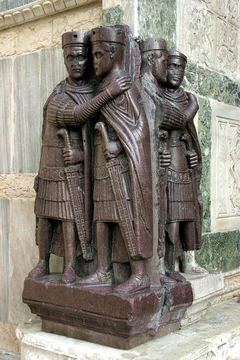
Bassianus (executed by Constantine)
Roman senator executed by Constantine after conspiracy accusation in 314 AD.

Giovanni Battista de'Cavalieri · CC0
Bassianus, a Roman senator, was executed in 314 AD on the orders of Emperor Constantine I, who had previously arranged for him to marry his half-sister Anastasia. Constantine’s plan to raise Bassianus to the rank of caesar in 314 fell through when his eastern co-emperor, Licinius, blocked the appointment. The late antique chronicle *Anonymus Valesianus* records that Bassianus was later charged with conspiracy against the throne and put to death by Constantine.
- died
- 314 AD
Lore & Background
Bassianus was a Roman senator whom Constantine I arranged to marry his half-sister, Anastasia. The choice of Bassianus is probably to be understood in light of the fact that Bassianus' brother, Senecio, was a high official in service of Licinius, Constantine's colleague in the East, and thus this marriage strengthened the bond between the two augusti. In 314 Constantine hoped to elevate Bassianus to the imperial rank of caesar, but Licinius successfully opposed the move.
Reader's Guide
Bassianus's significance lies in his role as a pawn in the power struggle between Constantine I and Licinius. His proposed elevation to caesar in 314, with authority over Italy, was intended to strengthen ties between the two augusti through his brother Senecio's position in Licinius's court. However, Licinius refused to acknowledge the appointment and allegedly used Senecio to incite Bassianus to kill Constantine and conquer Italy for Licinius. The conspiracy was discovered, leading to Bassianus's execution. Constantine then demanded Licinius hand over Senecio, but Licinius refused and overthrew Constantine's statues at Emona, triggering the civil war known as the bellum Cibalense. Recent prosopographical studies suggest Bassianus and Senecio were members of the Anicii and Nummii Albini Seneciones families, but this remains uncertain. His legacy is that of a catalyst for open conflict between the two emperors.
Did You Know?
- Bassianus was a Roman senator whom Constantine I arranged to marry his half-sister, Anastasia.
- Constantine hoped to elevate Bassianus to caesar in 314, but Licinius opposed the move.
- According to the Anonymus Valesianus, Bassianus was accused of plotting against the throne and executed by Constantine.
- Bassianus's brother Senecio was a high official in service of Licinius.
The Diplomatic Marriage
Bassianus, a Roman senator of the early fourth century, found himself at the center of imperial diplomacy when Emperor Constantine I arranged for him to wed the emperor's half-sister, Anastasia. This union was far more than a personal alliance; it served a calculated political purpose. Bassianus had a brother, Senecio, who held a senior administrative position in the service of Licinius, Constantine's co-ruler governing the eastern half of the empire. By binding his own sister to the brother of a key Licinian official, Constantine effectively wove a familial thread between the two augusti, reinforcing the fragile peace that held their shared rule together. The marriage thus functioned as a diplomatic instrument, a tangible symbol of cooperation between the two spheres of influence that divided the Roman state. For a senator of Bassianus's standing, such a connection to the imperial household represented both extraordinary honor and extraordinary vulnerability, placing his family squarely within the orbit of the most dangerous political forces of the age.
The Ambition for the Purple
Constantine's vision for Bassianus extended well beyond a senatorial marriage. In 314, the emperor first entertained the idea of elevating his brother-in-law to the rank of caesar, a title that would place Bassianus within the innermost circle of imperial authority. The formal diplomatic effort came in 316, when Constantine dispatched his half-brother Julius Constantius to Licinius at Sirmium bearing the specific proposal: Bassianus would receive the caesarship along with governing power over Italy. This was an extraordinary grant, effectively creating a new tier of imperial authority in the western provinces. Licinius, however, flatly refused to acknowledge the appointment. His opposition was not merely passive; the sources indicate he went further, instructing Senecio to reach out to his brother and urge him to murder Constantine, seize arms, and conquer Italy on Licinius's behalf. The rejection of the caesarship, combined with this alleged incitement to regicide, transformed what had been a diplomatic negotiation into a matter of life and death for Bassianus.
Conspiracy, Arrest, and Execution
The Anonymus Valesianus, a Latin chronicle composed during the late antique period, records that Bassianus was formally accused of plotting against the throne. The conspiracy, as the surviving sources describe it, was not a spontaneous act of personal ambition but was allegedly instigated from the eastern court. After rejecting the caesarship proposal, Licinius directed Senecio to contact his brother with instructions to kill Constantine and raise forces to take Italy for the eastern ruler. When the plot was uncovered, Bassianus was arrested and put to death by order of Constantine. The emperor then demanded that Licinius surrender Senecio for justice, but his colleague in the East refused to comply. This refusal, combined with Licinius's act of toppling Constantine's statues at Emona—a city situated on the border between their respective zones of authority—shattered whatever remained of the diplomatic relationship. The execution of a senator who had been married into the imperial family and who had been the subject of a caesarship negotiation represented a dramatic and deeply personal act of imperial retribution, one that Constantine clearly attributed to Licinian machination.
Aftermath: The Bellum Cibalense and Family Origins
Bassianus's murder did not end in a quiet prison cell; it detonated a civil war. Licinius's refusal to hand over Senecio and his public desecration of Constantine's statues at Emona, on the frontier dividing their two spheres of influence, were acts of open defiance that precipitated armed conflict between the two emperors. This episode of civil war became known as the bellum Cibalense, a term that anchors Bassianus's brief and violent story to one of the defining military confrontations of Constantine's reign. The affair is preserved in several primary sources, including the Origo Constantini, Eusebius of Caesarea's Vita Constantini, and Zosimus's Historia nea, each offering their own perspective on the sequence of events. Beyond the immediate political drama, modern prosopographical research has illuminated the family's social standing, suggesting that Bassianus and Senecio belonged to the prominent Anicii and Nummii Albini Seneciones lineages. This genealogical connection situates the brothers within the broader world of late Roman senatorial families, lending his brief and tragic story a dimension of dynastic significance that extends well beyond the single year in which he met his end.
Gallery


Frequently Asked Questions
Who is Bassianus (executed by Constantine)?
Bassianus was a Roman senator from the early fourth century who became entangled in Constantine I's dynastic schemes. He was put to death in 314 AD after being accused of plotting against the imperial throne.
What was Bassianus's role in Constantine's court?
He held the rank of senator and was positioned by Constantine as a potential heir-apparent, having been matched in marriage to the emperor's half-sister Anastasia. His intended elevation to caesar would have made him a junior co-ruler, though that plan was never realized.
How does Bassianus's story end?
After his elevation to caesar was vetoed by Licinius, Bassianus was later charged with conspiracy against the throne and executed on Constantine's direct order in 314 AD. The *Anonymus Valesianus* is the principal late-antique source recording his condemnation and death.
Why did Constantine arrange Bassianus's marriage to Anastasia?
The marriage was part of a broader strategy to slot Bassianus into the imperial succession as a junior caesar under Constantine's authority. By binding him through family ties, Constantine hoped to secure a loyal branch of the dynasty, though Licinius's opposition derailed the plan.
Why is Bassianus (executed by Constantine) important to Tetrarchy history?
His brief rise and sudden fall illustrate the fragile, faction-driven politics of the late Tetrarchy, where a single co-emperor's veto could unravel an entire succession arrangement. His execution also shows how quickly Constantine could eliminate perceived threats once a political ally no longer served his interests.
More in Tetrarchy 1-24
Spotted an error? Know more?
This is a living reference — every entry is fact-audited, and reader corrections feed straight into our audit queue. Suggest an edit · See this site's audit record