Centres of governance in the Roman Empire
Governance followed the emperor, not a fixed capital.

In the Roman Empire, the centre of governance was wherever the emperor resided, as all administrative, legal, fiscal, and military power derived from him. The court moved with the emperor, and multiple cities served as imperial residences, minting locations, or sites for major legislation throughout the empire's history.
- label
- Centres of governance in the Roman Empire
- type
- Historical concept
- period
- 27 BC – AD 480
- key_cities
- Rome, Constantinople, Antioch, Nicomedia, Mediolanum, Sirmium, Trier, Ravenna
- governing_body
- Roman emperor and his court
Lore & Background
The system of government in the Roman Empire vested all power in the emperor, so the centre of governance was his location. Rome was the centre until the Crisis of the Third Century and Tetrarchy, but returned to importance in the 5th century. Antioch, Nicomedia, Thessalonica, Sirmium, Trier, and Mediolanum were used as residences by multiple emperors in the 3rd and 4th centuries. Constantinople was dedicated by Constantine the Great in 330 AD and became a permanent imperial residence from his reign onward, with successors such as Constantius II and Valens also using it as their main seat. After 312 AD emperors including Constantius II and Gratian did reside in Rome later in the 4th century, and Ravenna was used as a residence by Honorius and Valentinian III.
Reader's Guide
The Roman Empire's governance was uniquely centralized on the person of the emperor rather than a fixed city. This meant that wherever the emperor traveled—whether to military camps, provincial capitals, or palaces—the administrative, legal, fiscal, and military apparatus followed. This mobility allowed emperors to respond directly to crises, such as wars or rebellions, but also created periods of instability when multiple emperors claimed power from different locations. The Tetrarchy formalized this division, with two augusti and two caesars ruling from different cities, though all laws were enacted in all four names. Over time, Constantinople emerged as the permanent eastern capital, while western emperors shifted between Rome, Ravenna, and other cities. The minting of coinage similarly followed imperial movements and needs, with mints opening and closing in response to military campaigns, civil wars, and administrative reforms. This system persisted until the deposition of Romulus Augustulus, after which the western centres of governance ceased to function under Roman control.
Did You Know?
- Augustus acquired the legal powers of the Senate and magistrates for the emperor during his reign.
- Theodosius I enacted laws in Constantinople, Selymbria, Heraclea, Adrianople, Beroe, Cosintus, Thessalonica, Stobi, Scupi, Ulpiana, Sirmium, Aquileia, Concordia, Vicenza, Verona, Mediolanum, Forum Flaminii, and Rome.
- The mint in Constantinople was established in 326 AD, shifting the centre of coinage striking to the east.
- After 312 AD emperors such as Constantius II and Gratian still resided in Rome later in the 4th century.
The Emperor as the State
The defining structural principle of Roman imperial governance was that the state itself had no fixed capital. Administrative, legal, fiscal, and military authority all resided in the person of the emperor, meaning the effective centre of government was wherever he happened to be. The court, its officials, and its legislative activity travelled with the ruler. Augustus consolidated the legal powers previously held by the Senate and magistrates into the imperial office, and Caligula was the first to assume the full bundle of those powers in a single act rather than accumulating them gradually. Cassius Dio observed that meaningful public political debate effectively ended after Augustus, with significant matters shifting from open senatorial votes to private consultations with the emperor. In practice, emperors held court in diverse locations: Vespasian and Hadrian presided over legal proceedings publicly in Rome, while Trajan conducted his hearings privately at Civitavecchia. Diocletian promulgated major edicts from Nicomedia, Antioch, and Alexandria, and Theodosius I issued legislation from a remarkable string of cities stretching from Constantinople to Verona. The state was, in essence, a mobile institution anchored to a single individual.
Rome's Long Eclipse and Constantinople's Ascendancy
Rome served as the primary seat of imperial power from the founding of the Principate until the upheavals of the third century and the Tetrarchy. Yet its dominance was not permanent. After 312 AD, no emperor in the fourth century made Rome his residence, and the city's political relevance waned sharply. The turning point came in 330 AD, when Constantine the Great dedicated Constantinople as a new imperial capital. Under Theodosius I, the city became the permanent seat of the eastern emperors, a shift institutionalized through the creation of a new senate whose members held equal rank with their Roman counterparts—a status granted by Constantius II in the 350s. A dedicated urban prefect for Constantinople was appointed in 359, and subsequent legislation limited the Roman prefect to appeals from Italian provinces while the Constantinopolitan prefect gained jurisdiction over Thrace and Asia Minor. In the west, Ravenna emerged as an important residence for Honorius and Valentinian III, and western emperors alternated between Rome and Ravenna until the deposition of Romulus Augustulus. Constantinople's rise thus marked a permanent redistribution of political gravity toward the eastern Mediterranean.
The Tetrarchy and the Multiplicity of Imperial Seats
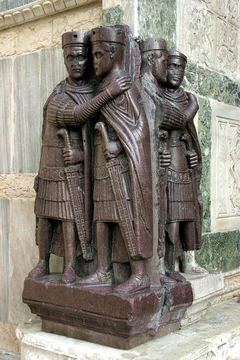
Diocletian's Tetrarchy fundamentally restructured where and how imperial authority was exercised. The empire was divided so that two augusti and two caesars shared administration, yet every law was formally enacted in the names of all four rulers, preserving a fiction of unified sovereignty. This system necessitated multiple concurrent centres of governance. Throughout the third and fourth centuries, emperors used Antioch, Nicomedia, Thessalonica, Sirmium, Trier, and Mediolanum as residences, each serving as a base from which legislation, military commands, and coinage decisions radiated. Constantine the Great operated from Sirmium as his political and military headquarters between 319 and 324 AD, and it was in Mediolanum that he and Licinius met to produce the Edict of Milan. Theodosius I's legislative output was spread across an extraordinary range of cities—Constantinople, Selymbria, Heraclea, Adrianople, Beroe, Cosintus, Thessalonica, Stobi, Scupi, Ulpiana, Sirmium, Aquileia, Concordia, Vicenza, Verona, Mediolanum, Forum Flaminii, and Rome—demonstrating that even in the late fourth century, no single city could claim to be the sole seat of law.
Mints as Markers of Political Control
Where coinage was struck revealed as much about imperial power as where the emperor slept. Under Augustus and Tiberius, all gold and silver in the empire was produced at a single large mint in Lugdunum, after numerous provincial mints were closed around 14 BC. The senatorial mint in Rome had ceased bronze production in 82 BC and gold and silver in 36 BC, though Augustus reopened it in 23 BC. Vespasian, after consolidating power, shut down most mints opened during the Year of the Five Emperors, retaining only Antioch before making Lugdunum the primary site in 74 AD. The third century brought decentralization: Antioch's prominence grew under Septimius Severus amid civil war and Persian conflicts, and Gallienus established a Mediolanum mint after losing the Gallic mints to the breakaway Gallic Empire. Diocletian inherited seven mints and reformed the system into fourteen—eight in the west, six in the east. The establishment of a Constantinople mint in 326 AD, accompanied by the closure of Carthage, London, and Ticinum, permanently shifted the coinage centre eastward. The Ptolemaic-era Alexandria mint retained its own tetradrachm system until 296 AD, and the client rulers of the Bosporan Kingdom remained the only non-Romans to strike aurei.
Frequently Asked Questions
What were the centres of governance in the Roman Empire?
Rather than a single fixed capital, the seat of government simply followed the emperor wherever he resided, since all administrative, legal, fiscal, and military authority flowed directly from his person. The imperial court traveled with him, and whichever city he occupied at a given moment became the de facto centre of power.
Why didn't the Roman Empire have one permanent capital city?
Because governance was tied to the emperor's physical presence rather than to any particular location, the court and its apparatus moved from city to city as the emperor saw fit. Over the span from 27 BC to AD 480, numerous cities could function as the effective seat of government at different times without any single one holding exclusive status.
Which cities served as imperial governance centres?
Cities such as Rome, Constantinople, Antioch, Nicomedia, Mediolanum, Sirmium, Trier, and Ravenna all hosted the emperor and his court at various points throughout the empire's history. These locations also doubled as mints or venues for significant legislative activity, but none was permanently designated as the sole capital.
How did the Tetrarchy reshape the idea of a governance centre?
By dividing imperial authority among four rulers, the Tetrarchy effectively created multiple simultaneous centres of power, each anchored to a different emperor's residence. This made the mobile-court model more explicit, as each tetrarch maintained his own court and administrative base in a distinct city.
What constituted the governing body in this system?
The governing body was essentially the emperor and his surrounding court — the officials, advisors, and military commanders who accompanied him. There was no separate institutional parliament or fixed bureaucracy independent of the emperor's person; authority was personal and mobile.
More in Tetrarchy 1-24
Spotted an error? Know more?
This is a living reference — every entry is fact-audited, and reader corrections feed straight into our audit queue. Suggest an edit · See this site's audit record