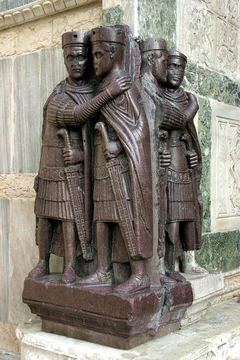
Portrait of the Four Tetrarchs
Porphyry sculpture of four Roman emperors from around 300 AD.

The Portrait of the Four Tetrarchs is a sculpture group carved from porphyry, depicting four Roman emperors and dating to around 300 AD. It likely represents the four rulers of the first Tetrarchy, the system instituted by Emperor Diocletian. The group has been mounted on a corner of St. Mark’s Basilica in Venice since the Middle Ages, after being taken from Constantinople in 1204 or shortly afterward, as spoils of the Fourth Crusade. The statues were originally two separate sculptures, each showing a pair of armored late Roman emperors embracing. They stand on plinths supported by a console of the same stone, with their backs set into the remains of large porphyry columns, all carved from a single piece. The columns are now lost, and one pair is missing part of its plinth and an emperor’s foot—the heel of which was found in Istanbul in the 1960s and is now in the Istanbul Archaeology Museum. One statue pair has been sliced vertically, losing a large portion of the right-hand emperor’s right side, while another vertical cut divides the two figures, sawing through their embracing arms.
The identity and original placement of the statues are debated. One suggestion is that the Eastern rulers form one pair and the Western rulers the other, each consisting of a senior augustus and a junior caesar. Another possibility is that the two augusti are paired together and the two caesares together. An older theory holds that they represent a dynastic group from the Constantinian dynasty. The figures do not offer personal portraits; instead, they symbolize the concept of the tetrarchy. Each tetrarch looks identical except that two—likely the older augusti—have beards, while the other two, probably the caesars, do not. The pairs embrace, uniting the rulers, and the overall effect conveys unity and stability. The choice of porphyry, a rare and expensive stone from Egypt, suggests permanence and rigidity, and was reserved for imperial honorands. All four figures are armed and wear military garb, an unmistakable display of collective power meant to reinforce the tetrarchs’ strength and authority over the empire, rewarding the faithful and quashing rebellion. Displayed in a prominent public place, such an image kept these themes in the public mind.
The tetrarchy gave way to a united empire under Constantine, who took control of both halves in 324. When he refounded Byzantium
- Date
- around 300 AD
- Material
- porphyry
- Original Location
- probably Constantinople (Philadelphion)
- Current Location
- St Mark's Basilica, Venice, Italy
- Subject
- four Roman emperors of the first Tetrarchy
- Known For
- symbolizing the tetrarchy; spolia from the Fourth Crusade
Lore & Background
The Portrait of the Four Tetrarchs is a porphyry sculpture group of four Roman emperors dating from around 300 AD. The sculptural group has been fixed to a corner of the façade of St Mark's Basilica in Venice, Italy since the Middle Ages. It probably formed part of the decorations of the Philadelphion in Constantinople, and was removed to Venice in 1204 or soon after. Spolia from the Fourth Crusade, the statues were originally designed as two separate sculptures, each consisting of a pair of armoured late Roman emperors embracing one another. The paired statues stand on plinths supported by a console of the same stone, and their backs are engaged in the remains of large porphyry columns to which the statues were once attached, carved all of a piece. The columns no longer exist, and one emperor pair is missing part of the plinth and an emperor's foot, which has been found in Istanbul. One statue pair has been sliced vertically and is missing a large portion of the right-hand emperor's right side, while another vertical slice divides the two figures and has sawn through their embracing arms.
Reader's Guide
The Portrait of the Four Tetrarchs symbolizes the concept of the tetrarchy, rather than providing four personal portraits. Each tetrarch looks the same, without any individualized characteristics, except that two, probably representing the older augusti, have beards, and two do not who might have symbolized the caesars. The group is divided into pairs, each embracing, which unites augusti and caesars together. The overall effect suggests unity and stability. The very choice of material, the durable porphyry (which came from Egypt), symbolizes a permanence and rigidity reminiscent of Egyptian statuary. Porphyry was rare and expensive, hard to obtain in sculptural quantities, and therefore limited to imperial honorands in statuary. Their function would have been similar to many other representations of rulers in other cities. Chiefly, this purpose was to reinforce the strength and power the Tetrarchs held over the Empire, power that could reward the faithful and quash the rebellious. This latter theme seems to be reflected by the fact that all four tetrarchs are armed, wearing military garb, an unmistakable representation of collective power. Having such an image in a prominent public place would have caused these themes to be on the minds of the public as they went about their daily business. The figures are stout and blocky, far from the verisimilitude or the idealism of earlier Graeco-Roman art. The figures are stiff and rigid, the attire being patterned and stylized. Their faces are repetitive and they seem to stare in a kind of trance. This shift in artistic style points towards the style of the Middle Ages.
Did You Know?
- The statues were originally designed as two separate sculptures, each consisting of a pair of armoured late Roman emperors embracing one another.
- One emperor pair is missing part of the plinth and an emperor's foot, which has been found in Istanbul.
- The Portrait of the Four Tetrarchs probably depicts the four rulers of the Empire instituted by Emperor Diocletian – the first Tetrarchy.
- Porphyry was rare and expensive, hard to obtain in sculptural quantities, and therefore limited to imperial honorands in statuary.
More in Tetrarchy 1-24
Spotted an error? Know more?
This is a living reference — every entry is fact-audited, and reader corrections feed straight into our audit queue. Suggest an edit · See this site's audit record