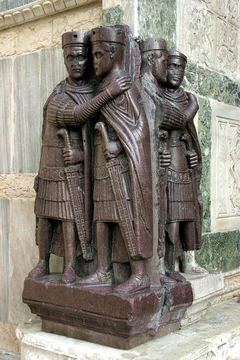
Maximinus Daza
Roman emperor and last pagan pharaoh of Egypt.

Maximinus Daza, born Daza (c. 270–313), was Roman emperor from 310 until his death. His uncle, Emperor Galerius, made him a caesar in the Tetrarchy in 305, a divisive move that helped spark the following year’s civil wars. A staunch pagan, he renewed the persecution of Christians after Galerius’s Edict of Toleration and was the final ruler to be recognized as Pharaoh of Egypt.
Originally from Illyria, he was called Daza—an ancient name of obscure, high distinction—though the Christian writer Lactantius misspelled it as “Daia.” At Galerius’s request, he took the name Maximinus. Modern scholars often call him Maximinus Daza, though no ancient inscription or text uses that exact form.
He was born in the Danubian region (Illyria). In 305, Galerius, now eastern Augustus, adopted him as heir and gave him the rank of Caesar, with authority over Syria and Egypt. After Licinius was made Augustus in 308, Maximinus and Constantine I were declared “sons of the Augusti.” Around 310, during a campaign against the Sassanids, Maximinus likely began styling himself Augustus with his troops’ backing. Galerius died in 311, and Maximinus split the Eastern Empire with Licinius. Already married, he proposed divorcing his wife to wed Galerius’s daughter Valeria; when she refused, he seized her and her mother’s property and exiled them to Syria.
As Licinius and Constantine allied, Maximinus secretly sided with the usurper Maxentius in Italy. He broke openly with Licinius in 313. On April 30, their armies clashed at the Battle of Tzirallum near Heraclea Perinthus. Maximinus’s 70,000 troops were crushed; he fled first to Nicomedia, then to Tarsus, where he died that July.
He renewed Christian persecution after Galerius’s edict, responding to urban demands to expel Christians. In a rescript to Tyre (recorded by Eusebius), he argued that good crops, health, and calm seas depended on the gods’ favor, blaming Christians for disaster. An inscription from Arycanda shows him approving cities’ requests to ban Christians, hoping they would be “snatched from a grave illness.” After Constantine defeated Maxentius, Maximinus advised his praetorian prefect to use persuasion rather than force. On the eve of his war with Licinius, he accepted Galerius’s edict; after his defeat, just before death, he issued his own tolerance edict, restoring Christians’ rights to assemble, build churches, and
- born
- 20 November c. 270
- died
- c. July 313
- field
- Roman emperor
- nationality
- Roman (Illyrian origin)
- known_for
- Last persecutor of Christians; last Pharaoh of Egypt; defeated at Battle of Tzirallum
Lore & Background
Maximinus was born in the Danubian region (Illyria) and originally called Daza. In 305 his maternal uncle Galerius adopted him and gave him the rank of caesar, with jurisdiction in Syria and Egypt. After Galerius died in 311, Maximinus divided the Eastern Empire with Licinius. He claimed the title of augustus in 310, supported by his troops during a campaign against the Sassanids, and later entered a secret alliance with the usurper Maxentius.
Maximinus renewed the persecution of Christians after Galerius' Edict of Toleration, responding to urban authorities who demanded their expulsion. In a rescript to Tyre, he argued that the gods' favor brought good crops, health, and peaceful seas, blaming Christians for disasters. After Constantine's victory over Maxentius, Maximinus advised using exhortations rather than force,
Reader's Guide
Maximinus Daza occupies a significant place in Roman and Egyptian history as the last emperor to actively persecute Christians and the last person to hold the title of Pharaoh. His reign marked the end of the Tetrarchy's fragile stability, as his controversial appointment as caesar helped trigger civil wars. His defeat by Licinius at Tzirallum sealed the decline of pagan opposition to Christianity within the empire. The edict of tolerance he issued shortly before his death, though forced by circumstances, contributed to the legal recognition of Christianity. His death also symbolically ended the 3,400-year-old office of Pharaoh, as no subsequent Christian or Islamic ruler revived the title. The Christian writer Eusebius portrayed him as avaricious, superstitious, and dissolute, but the reliability of such accounts is debated. Modern scholarship often refers to him as Maximinus Daza, though this form is not attested in ancient inscriptions or literature.
Did You Know?
- Maximinus Daza was the last person to hold the title of Pharaoh of Egypt.
- His original name was Daza, and the form 'Daia' used by Lactantius is considered a misspelling.
- He issued an edict of tolerance restoring Christian freedoms shortly before his death in 313.
- A modern theory suggests he may have died from severe thyrotoxicosis due to Graves' disease.
More in Tetrarchy 1-24
Spotted an error? Know more?
This is a living reference — every entry is fact-audited, and reader corrections feed straight into our audit queue. Suggest an edit · See this site's audit record