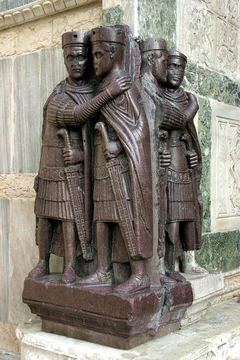
Maximian
Co-emperor with Diocletian; military strongman who twice abdicated.

Maximian (c. 250 – c. July 310), nicknamed Herculius, was Roman emperor from 286 to 305, serving as Augustus alongside his co-emperor and superior Diocletian. His military prowess complemented Diocletian's political acumen, and he played a key role in suppressing rebellions, defending the Rhine frontier, and later abdicating under pressure. His later attempts to reclaim power led to conflict with his son Maxentius and his son-in-law Constantine, ending in his forced suicide.
- born
- c. 250 near Sirmium, Pannonia
- died
- c. July 310, Marseille
- field
- Roman emperor, military commander
- nationality
- Roman (Pannonian origin)
- known_for
- Co-emperor with Diocletian, suppression of the Bagaudae, campaigns on the Rhine, abdication in 305, and later failed usurpation
Lore & Background
Maximian was born around 250 near Sirmium in Pannonia into a family of shopkeepers. He joined the army, serving under Aurelian and Probus, and probably participated in Carus' Mesopotamian campaign of 283. He attended Diocletian's election as emperor in November 284. Diocletian appointed him Caesar in July 285, and he became Augustus in 286. His swift appointment suggests a pre-arranged alliance, though direct evidence is lacking. Maximian was described as uneducated, preferring action to thought, and left politics to Diocletian. He had two children with his wife Eutropia: Maxentius and Fausta. Maximiana Theodora, wife of Constantius, is generally considered his stepdaughter, not his natural daughter.
Reader's Guide
Maximian's significance lies in his role as Diocletian's military partner, stabilizing the western empire through campaigns against the Bagaudae, Germanic tribes, and pirates. His abdication in 305 as part of Diocletian's tetrarchic system was a key moment in Roman imperial succession. However, his later attempts to reclaim power—first aiding his son Maxentius, then trying to depose him, and finally attempting to seize Constantine's title—undermined the tetrarchy and contributed to civil war. His suicide in 310 on Constantine's orders marked the end of his turbulent career. After Constantine's victory over Maxentius, Maximian's image was rehabilitated and he was deified, reflecting the shifting political fortunes of the era. His legacy is that of a capable general whose personal ambition ultimately destabilized the system he helped build.
Did You Know?
- Maximian was nicknamed Herculius, while Diocletian took the title Iovius, symbolizing their roles as Hercules and Jove.
- He failed to oust the rebel Carausius in 289 or 290 when his invasion fleet was destroyed by storms.
- Maximian abdicated on 1 May 305 at Diocletian's behest, giving the Augustan office to Constantius.
- He killed himself in mid-310 on Constantine's orders after a failed attempt to seize Constantine's title.
More in Tetrarchy 1-24
Spotted an error? Know more?
This is a living reference — every entry is fact-audited, and reader corrections feed straight into our audit queue. Suggest an edit · See this site's audit record