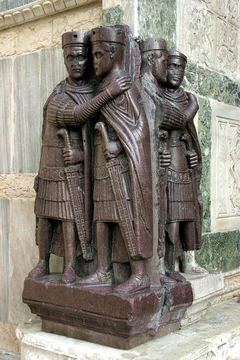
Licinius
Roman emperor who co-authored the Edict of Milan.

Valerius Licinianus Licinius (c. 265 – 325) ruled as Roman emperor from 308 until 324. For much of his time in power, he served alongside Constantine I, first as an ally and later as a rival. Together, they issued the Edict of Milan, which officially tolerated Christianity across the empire. Constantine ultimately defeated Licinius at the Battle of Chrysopolis in 324 and later had him executed.
Licinius was born to a Dacian peasant family in Moesia Superior. As a child, he became close friends with the future emperor Galerius and accompanied him on a Persian campaign in 298. Galerius trusted him enough to send him as an envoy to Italy in 307, hoping to negotiate with the usurper Maxentius. When Galerius later left to confront Maxentius personally, he placed the eastern provinces under Licinius’s care. Upon returning east, Galerius elevated Licinius to the rank of Augustus in the East on 11 November 308, giving him command over the Balkan provinces of Illyricum, Thrace, and Pannonia. In 310, Licinius led a campaign against the Sarmatians and inflicted a heavy defeat on them.
After Galerius died in May 311, Licinius struck a deal with Maximinus Daza to divide the eastern provinces. The Hellespont and Bosporus became the boundary, with Licinius controlling the European side and Maximinus the Asian. Facing an alliance between Maximinus and Maxentius, the two remaining emperors—Licinius and Constantine—formalized their own pact. In March 313, Licinius married Flavia Julia Constantia, Constantine’s half-sister, in Mediolanum (Milan). Their son, Licinius the Younger, was born in 315. The wedding provided the occasion for the Edict of Milan, which reissued Galerius’s earlier decree allowing Christianity and any other religion to be practiced, restored confiscated property to Christian congregations, and exempted Christian clergy from civic duties. The version of the edict recorded by Lactantius, based on the text Licinius posted in Nicomedia on 14 June 313, used neutral language, expressing a wish to appease “any Divinity whatsoever in the seat of the heavens.”
Meanwhile, Maximinus Daza decided to attack Licinius. He left Syria with 70,000 men, but harsh weather weakened his army. In April 313, he crossed the Bosporus and besieged Byzantium, capturing it after eleven days. He then took Heraclea after a short siege. Licinius, with a much smaller force—perhaps arou
- born
- c. 265
- died
- 325
- field
- Roman emperor
- nationality
- Roman (born in Moesia Superior to a Dacian peasant family)
- known_for
- Co-authoring the Edict of Milan; rival of Constantine I
Lore & Background
Born to a Dacian peasant family in Moesia Superior, Licinius accompanied his close childhood friend and future emperor Galerius on the Persian expedition in 298. He was trusted enough by Galerius that in 307 he was sent as an envoy to Italy, to attempt to reach some sort of agreement with the usurper Maxentius. When Galerius went to deal with Maxentius personally after the death of Severus II, he left the eastern provinces in Licinius's care. Upon his return to the east Galerius elevated Licinius to the rank of Augustus in the East on 11 November 308, and under his immediate command were the Balkan provinces of Illyricum, Thrace and Pannonia. In 310 he took command of the war against the Sarmatians, inflicting a severe defeat on them. On the death of Galerius in May 311, Licinius entered into an agreement with Maximinus Daza to share the ea
Reader's Guide
Licinius's significance lies primarily in his role as co-author of the Edict of Milan (313), which granted official toleration to Christians throughout the Roman Empire and restored confiscated properties to Christian congregations. This edict marked a turning point in the legal status of Christianity. However, his legacy is deeply contested: Constantine actively portrayed him as a pagan supporter, but contemporary evidence suggests Licinius was, at least for a period, a committed supporter of Christians. He adopted Christian symbols for his armies and attempted to regulate the affairs of the Church hierarchy. Yet Eusebius of Caesarea, writing under Constantine's rule, charges him with expelling Christians from the Palace and ordering military sacrifices to pagan gods. It has been theorized that he originally supported Christians along with Constantine, but later in his life turned against them and to paganism. He has also been traditionally credited for ordering the execution of the Forty Martyrs of Sebaste c. 320, though the earliest surviving description comes from a homily by Basil of Caesarea roughly 50 years later. After his defeat and execution, his memory was branded with infamy; his statues were thrown down; and by edict, all his laws and judicial proceedings during his reign were abolished—an official erasure from the public record called damnatio memoriae.
Did You Know?
- Licinius was born to a Dacian peasant family in Moesia Superior.
- He co-authored the Edict of Milan with Constantine I in 313.
- He was defeated by Constantine at the Battle of Chrysopolis in 324 and later executed.
- After his death, his memory was officially erased through damnatio memoriae.
More in Tetrarchy 1-24
Spotted an error? Know more?
This is a living reference — every entry is fact-audited, and reader corrections feed straight into our audit queue. Suggest an edit · See this site's audit record