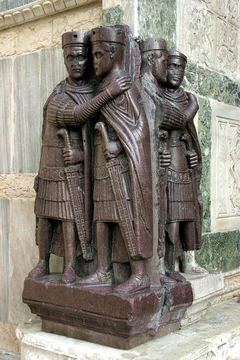
Constantius Gallus
Caesar of the East under Constantius II, executed for disloyalty.

Flavius Claudius Constantius Gallus (326–354) was a Roman statesman and ruler who served as Caesar, or deputy emperor, in the eastern provinces of the Roman Empire from 351 to 354 under his cousin, Emperor Constantius II. A grandson of Emperor Constantius Chlorus and a member of the Constantinian dynasty, Gallus was one of the few male relatives to survive the purges following the death of his uncle Constantine the Great. His rule, based in Antioch, is noted for suppressing a Jewish revolt and for his eventual fall from favor and execution, after which he was replaced as Caesar by his younger half-brother Julian.
- born
- 326, Massa Veternensis, Italia
- died
- 354, Pola, Istria
- field
- Statesman, ruler
- nationality
- Roman
- known_for
- Caesar of the eastern Roman Empire (351–354); suppression of the Jewish revolt (351–352); execution by Constantius II
Lore & Background
Gallus was born in 326 in Massa Veternensis, Italia, after his father Julius Constantius had been recalled from exile. His father and elder brother were killed in the purges after Constantine the Great's death in 337, but Gallus—along with his younger half-brother Julian and cousin Nepotianus—survived because of his youth. Ammianus Marcellinus described Gallus as very good-looking, with soft blond hair. There is debate over where he spent his youth: one view places him with Julian in Nicomedia under Bishop Eusebius, later moving to Constantinople, and then to the imperial household in Macellum, Cappadocia; an alternative view suggests he studied in Ephesus, then was exiled to Tralles before going to Macellum.
Reader's Guide
Gallus's significance lies in his brief tenure as Caesar of the East, a role that highlighted the fragility of the Constantinian dynasty's power-sharing arrangements. Appointed in 351 to counter the usurper Magnentius, Gallus governed from Antioch, where he crushed a Jewish revolt (351–352) and faced challenges including famine, grain shortages, and accusations of judicial overreach. His alienation of the senatorial class and his execution of officials—including the Praetorian Prefect Domitianus and quaestor Montius Magnus—undermined his position. Constantius II, suspecting disloyalty, reduced his troops and summoned him to the West. Gallus's execution in 354, despite a last-minute reprieve that was blocked by the eunuch Eusebius, paved the way for his half-brother Julian to become Caesar. His legacy is that of a ruler whose harsh methods and strained relationship with his cousin led to his downfall, illustrating the volatile politics of the late Roman Empire.
Did You Know?
- Gallus was one of the few male members of the Constantinian dynasty to survive the purges after Constantine the Great's death in 337.
- Gallus staged a chariot race in Constantinople's Hippodrome and crowned the victor, an honor reserved only for an Augustus, which enraged Constantius II.
- His younger half-brother Julian succeeded him as Caesar after his execution.
Frequently Asked Questions
Who is Constantius Gallus?
Constantius Gallus (326–354) was a Roman prince of the Constantinian dynasty, born in Massa Veternensis in Italy. He was a grandson of Emperor Constantius Chlorus and one of the few male relatives to survive the purges that followed Constantine the Great's death.
What position did Constantius Gallus hold?
He served as Caesar, the junior emperor governing the eastern provinces, from 351 to 354 out of Antioch under the authority of his cousin, the senior emperor Constantius II.
What is Constantius Gallus most known for?
His short reign is chiefly remembered for quelling a major Jewish revolt in the east during 351–352, as well as for his dramatic loss of imperial favor and eventual execution.
How does Constantius Gallus's story end?
After falling out of Constantius II's confidence, Gallus was stripped of his authority and put to death in 354 at Pola in Istria; his younger brother Julian was then appointed in his stead as Caesar of the East.
Why is Constantius Gallus important in Roman imperial history?
He occupies a brief but pivotal spot in the Constantinian succession, linking the era of Constantine the Great's heirs to the rise of Julian the Apostate, while also illustrating the lethal risks of imperial family politics under Constantius II.
More in Tetrarchy 1-24
Spotted an error? Know more?
This is a living reference — every entry is fact-audited, and reader corrections feed straight into our audit queue. Suggest an edit · See this site's audit record