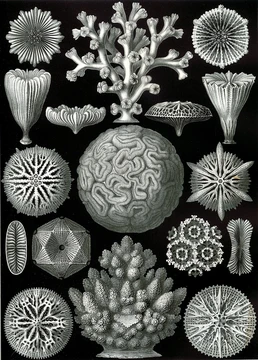
Stephanocoenia intersepta
A Near Threatened stony coral of the tropical western Atlantic.

Stephanocoenia intersepta, called blushing star coral or small eyed star coral, is a colonial stony coral belonging to the family Astrocoeniidae. It lives in shallow waters across the tropical western Atlantic Ocean and the Caribbean Sea, and the IUCN lists it as Near Threatened.
This coral usually forms a flattened, hemispherical shape. It is sometimes mistaken for the massive starlet coral (S. siderea), but S. intersepta has large, protruding corallites, while S. siderea’s are retracted. Its polyps often extend their tentacles during the day, giving the coral a cream, tan, gray, or brown appearance. When disturbed, the tentacles pull back, changing the coral’s color and inspiring the name “blushing star coral.”
The species occupies reefs throughout most of the Caribbean Sea, the Gulf of Mexico, and the Florida Keys. It typically lives at depths between 1 and 100 meters, and has been found as far south as the coast of Brazil.
Stephanocoenia intersepta is zooxanthellate, hosting photosynthetic dinoflagellates in its tissues that supply 70% to 95% of its energy. The polyps get the rest by trapping passing plankton. In reef communities, the crustose form is usually found in shallower water (5 to 15 meters), while the boulder form occurs deeper (10 to 20 meters). Average age of maturity is three to eight years, and the average generational age is about 10 years.
Quick Facts
- Genus
- Stephanocoenia
- Species
- intersepta
Facts from the source article.
Lore & Background
Stephanocoenia intersepta commonly grows in a flattened hemispherical shape. It is occasionally misidentified as massive starlet coral (S. siderea), but S. intersepta has large, protruding corallites as opposed to S. siderea's retracted corallites. Polyp tentacles are usually extended during the day, contributing to its cream, tan, gray, or brown color. When disturbed, these tentacles retract, changing the color of the coral and giving it the common name blushing star coral.
This coral is found in reefs occupying the majority of the Caribbean Sea, Gulf of Mexico, and Florida Keys. Typically found between depths of 1m and 100m, it has been found as far south as the coast of Brazil. It is a zooxanthellate species, containing single-celled dinoflagellates in its tissues that are photosynthetic and provide the coral with 70% to 95% of its energy needs. The rest of its needs are supplied by the polyps which trap passing plankton.
Found in most reef communities, the crustose form of this coral is typically found in shallower environments between 5 and 15 meters, while the boulder form is found in deeper communities (10-20m). The average age of maturity is around three to eight years, and average generational age is around 10 years.
Reader's Guide
Stephanocoenia intersepta is notable as a colonial stony coral in the family Astrocoeniidae, found across a wide geographic range from the Caribbean Sea and Gulf of Mexico to the coast of Brazil. Its IUCN assessment as Near Threatened highlights its conservation concern. The species exhibits two distinct growth forms—crustose in shallower waters (5-15m) and boulder form in deeper communities (10-20m)—which reflect its ecological adaptability. As a zooxanthellate coral, it relies heavily on symbiotic dinoflagellates for 70% to 95% of its energy, with the remainder obtained by trapping plankton. Its common name, blushing star coral, derives from the color change that occurs when its tentacles retract upon disturbance. The species reaches maturity between three and eight years, with a generational age of about 10 years, indicating a relatively slow life history. Its presence in most reef communities underscores its role in reef ecosystems, while its misidentification with S. siderea points to the need for careful taxonomic distinction based on corallite morphology.
Did You Know?
- Stephanocoenia intersepta is also known as blushing star coral because its color changes when disturbed tentacles retract.
- It is a zooxanthellate species, obtaining 70% to 95% of its energy from photosynthetic dinoflagellates.
- The crustose form is typically found between 5 and 15 meters, while the boulder form occurs at 10-20 meters.
More in Stony Corals 1-24
Spotted an error? Know more?
Reader corrections go straight into our review queue. Suggest an edit · How this site is sourced