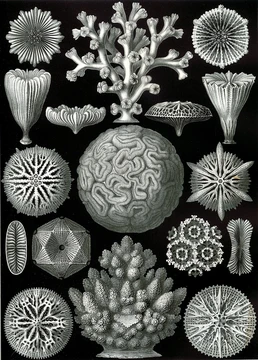
Scleractinia
Stony corals are marine animals that build hard skeletons and form reefs.

Scleractinia—commonly known as stony or hard corals—are marine animals belonging to the phylum Cnidaria. Each individual, called a polyp, has a cylindrical body topped by an oral disc fringed with tentacles around a central mouth. While some species live alone, most form colonies. The first polyp settles and begins secreting calcium carbonate to shield its soft body. Solitary corals can reach up to 25 cm (10 in) across, but colonial polyps are usually only a few millimeters in diameter. These polyps reproduce asexually through budding, staying connected to create a multi-polyp colony of clones sharing a single skeleton, which can grow several meters in diameter or height depending on the species.
A coral colony’s shape and appearance depend not just on its species but also on factors like location, depth, and water movement. Many shallow-water corals host symbiotic unicellular organisms called zooxanthellae within their tissues. These symbionts give the coral its color, which can vary based on the specific species of zooxanthella present. Stony corals are close relatives of sea anemones and, like them, possess stinging cells called cnidocytes. Corals reproduce both sexually and asexually. Most species release gametes into the water for external fertilization, and the resulting planula larvae drift as plankton; a few species, however, brood their eggs internally. Asexual reproduction mostly occurs through fragmentation, where a broken piece of a colony detaches and reattaches elsewhere.
Stony corals are found in all the world’s oceans. Much of the framework of modern coral reefs is built by scleractinians. Reef-building, or hermatypic, corals are mostly colonial; most of these contain zooxanthellae and live in shallow, sunlit waters. Other corals that do not build reefs can be solitary or colonial, and some inhabit abyssal depths where no light reaches. Stony corals first appeared in the Middle Triassic, but their relationship to the tabulate and rugose corals of the Paleozoic remains unclear. In modern times, stony coral numbers are expected to decline due to global warming and ocean acidification.
**Anatomy**
Scleractinian corals can be solitary or colonial. Colonies can become quite large, made up of many individual polyps.
Quick Facts
- Taxon
- Scleractinia
Facts from the source article.
Lore & Background
Scleractinia first appeared in the Middle Triassic, but their relationship to the tabulate and rugose corals of the Paleozoic is currently unresolved. The individual animals are known as polyps, with a cylindrical body crowned by an oral disc fringed with tentacles. Although some species are solitary, most are colonial. The founding polyp settles and secretes calcium carbonate to protect its soft body. Solitary corals can be as much as 25 cm across, but in colonial species the polyps are usually only a few millimetres in diameter. These polyps reproduce asexually by budding, remaining attached to form a multi-polyp colony of clones with a common skeleton, which may be up to several metres in diameter or height.
The shape and appearance of each coral colony depends not only on the species, but also on its location, depth, water movement, and other factors. Many shallow-water corals contain symbiotic unicellular organisms called zooxanthellae within their tissues, which give the coral its colour. Stony corals are closely related to sea anemones and are armed with stinging cells known as cnidocytes. Corals reproduce both sexually and asexually; most release gametes into the sea, but a few brood their eggs. Asexual reproduction is mostly by fragmentation.
Stony corals occur in all the world's oceans. Reef-building or hermatypic corals are mostly colonial and zooxanthellate, found in shallow waters where sunlight penetrates. Other corals that do not form reefs may be solitary or colonial, some occurring at abyssal depths where no light reaches. In modern times, stony coral numbers are expected to decline due to the effects of global warming and ocean acidification.
Reader's Guide
Scleractinia are significant as the primary architects of modern coral reefs, with much of the reef framework formed by these animals. Reef-building or hermatypic corals are mostly colonial and contain symbiotic zooxanthellae, which provide up to 50% of organic compounds used as food by polyps and enable growth rates up to three times faster than similar species without symbionts. These corals typically grow in shallow, well-lit, warm water with moderate to brisk turbulence and abundant oxygen, preferring firm, non-muddy surfaces. Ahermatypic corals, which do not build reefs, are found in all regions of the ocean, from tropical waters to polar seas and depths down to about 6,000 m. The skeleton of scleractinians is composed of calcium carbonate in the form of aragonite crystals, and its structure is light and porous. Growth rates vary by species: branching corals can increase in height by around 10 cm per year, while dome and plate species grow only 0.3 to 2 cm per year. Examination of cross sections of coral can show bands of deposition indicating annual growth, similar to tree rings. The first appearance of stony corals in the Middle Triassic and their unresolved relationship to Paleozoic corals highlight their long evolutionary history, but modern threats from global warming and ocean acidification are expected to cause declines.
Did You Know?
- Solitary corals can be as much as 25 cm across, while colonial polyps are usually only 1 to 3 mm in diameter.
- Some branching coral species can increase in height by around 10 cm per year, about the same rate as human hair grows.
- Up to 50% of organic compounds produced by symbiotic zooxanthellae are used as food by coral polyps.
Architecture of the Polyp and Colony
Each scleractinian polyp is a surprisingly complex organism packed into a cylindrical body. At its crown sits an oral disc ringed by tentacles, with a central mouth leading down through a tubular pharynx into a gastrovascular cavity that fills the interior of both the body and the tentacles. What sets scleractinians apart from other cnidarians is that this cavity is divided by radiating sheets of living tissue called mesenteries, and the gonads are embedded in the cavity walls. The body wall itself is a sandwich of mesoglea between two epidermal layers, and the base of the polyp is where the stony skeleton is secreted. In colonial species, horizontal sheets of tissue called coenosarc stretch across the outer surface of the skeleton, linking every polyp and allowing food and water to circulate throughout the colony. The skeleton of each individual polyp, the corallite, is a cup studded with radially aligned plates called septa, inserted in multiples of six between the mesenteries. All modern scleractinian skeletons are built from aragonite crystals of calcium carbonate, giving the structure a light, porous quality rather than the solid mass seen in prehistoric rugose corals.
Reproduction and the Spread of Colonies
Scleractinia employ two fundamentally different strategies to make new individuals. Sexually, most species broadcast their gametes into the surrounding seawater, where fertilization occurs externally. The resulting planula larvae then join the plankton and drift until they find a suitable substrate to settle on. A smaller number of species take a more protective route, brooding their eggs before release. Asexually, the dominant mechanism is budding, and it comes in two flavors. In intratentacular budding, a new polyp forms on the oral disc within the ring of tentacles, sometimes producing a row of partially separated polyps sharing an elongated oral disc with multiple mouths, all enclosed by a single corallite wall as seen in brain corals. Extratentacular budding always yields fully separate polyps, each with its own corallite, and in branching species like Acropora, lateral budding from axial polyps builds out the trunk and branches. Fragmentation also plays a role: a broken piece of colony can detach, reattach elsewhere, and grow into a new individual. In rare cases, adjacent colonies of the same species can even fuse into a single larger colony.
Symbiosis, Color, and Habitat Range
Stony corals are found in every ocean on Earth, yet their appearance varies enormously depending on species, depth, water movement, and location. A key driver of both color and ecological success is the presence of zooxanthellae, unicellular symbionts living within the coral's tissues. These organisms lend their pigments to the host, so two colonies of the same species can look strikingly different depending on which symbiont species they harbor. Reef-building, or hermatypic, corals are overwhelmingly colonial and zooxanthellate, thriving in the sunlit shallow waters where their symbionts can photosynthesize. These corals are the architects of the vast reef frameworks that define tropical marine landscapes. Beyond the sunlit zone, however, stony corals persist in solitary or colonial forms at abyssal depths where no light penetrates at all. Size ranges are equally dramatic: a solitary polyp can spread to roughly twenty-five centimeters across, while in colonial species individual polyps are typically only a few millimeters wide, yet the colony they collectively build can stretch to several meters in diameter or height.
Deep Time and a Fragile Future
The fossil record places the first scleractinians in the Middle Triassic, yet their exact evolutionary relationship to the tabulate and rugose corals that dominated the Paleozoic remains unresolved to this day. One striking example of ancient diversity is Coelosimilia, a prehistoric scleractinian whose skeleton was built from calcite rather than the aragonite that characterizes all living members of the group. The structural philosophy of modern stony corals is also distinct: their skeletons are light and porous, a far cry from the solid construction of rugosans, and their septal insertion pattern—cyclic, with plates added in multiples of six between mesenteries—differs from the serial, bilaterally symmetric arrangement seen in some fossil corals. Despite this long and successful history, the future of scleractinia looks precarious. In the modern era, populations are projected to decline as global warming and ocean acidification threaten the very calcium carbonate chemistry that allows these animals to build and maintain their stony skeletons.
Frequently Asked Questions
Who is Scleractinia?
Scleractinia is the informal name fans use for the order of stony (hard) corals, a group of marine cnidarians whose individual polyps secrete calcium carbonate to build rigid skeletons. They are the primary architects of the world's coral reefs.
What are Scleractinia's powers/abilities?
Each polyp can deposit a hard calcium carbonate skeleton around its soft tissue, and through asexual budding a single polyp clones itself into a multi-polyp colony. Branching species extend roughly 10 cm per year, while dome- and plate-forms add only 0.3 to 2 cm annually.
When did Scleractinia first appear?
The fossil record places the earliest stony corals in the Middle Triassic, making them one of the older lineages of reef-building organisms.
How big can Scleractinia get?
A solitary polyp can spread to about 25 cm across, whereas colonial polyps are typically just 1 to 3 mm in diameter. Entire colonies, however, can stretch to several metres in diameter or height.
Why is Scleractinia important?
By constructing massive calcium carbonate frameworks, stony corals create the three-dimensional reef habitats that shelter an enormous diversity of marine life. Without them, the structural foundation of tropical reef ecosystems would collapse.
More in Stony Corals 1-24
Spotted an error? Know more?
Reader corrections go straight into our review queue. Suggest an edit · How this site is sourced