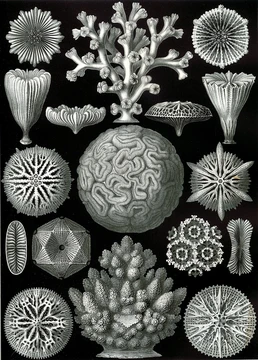
Blastomussa merleti
A large polyp stony coral native to the Indo-Pacific region.

Blastomussa merleti, called pineapple coral, is a large polyp stony coral whose family placement is uncertain. It comes from the west and central Indo-Pacific and is occasionally kept in reef aquariums.
In young colonies, each corallite grows outward from a shared dome-shaped center. As they age, these corallites separate, making the colony a group of cloned, solitary individuals. Each corallite is under 7 mm across. The septa have toothed edges and are arranged in two cycles; only the first cycle reaches the central columella. Polyps extend only at night. Colors include dark red, pink, orange, brown, or dark grey, often with contrasting green oral discs.
This coral lives in the Indo-Pacific, alongside other Blastomussa species like B. wellsi and B. loyae. Its range stretches from the Red Sea and East Africa, across the Indian Ocean, to northern and western Australia, Japan, the East China Sea, and the western Pacific islands. It occupies various reef habitats, including steep slopes and crevices, down to about 50 meters deep.
Blastomussa merleti is moderately common and widely distributed. Its population trend is unknown, but mature colony numbers likely decline due to reef destruction. The IUCN lists it as least concern.
In aquaria, it is valued for its bright colors and considered moderately easy to care for. Besides capturing food with tentacles and getting energy from symbiotic zooxanthellae, its polyps can extract organic carbon from the water.
Quick Facts
- Taxon
- Blastomussa merleti
Facts from the source article.
Lore & Background
Young colonies of Blastomussa merleti have each corallite extending out from a common, dome-shaped centre. Over time, these individual corallites become separated and the colony could be considered a group of cloned, solitary individuals. The corallites are less than 7 mm in diameter, and the septa have toothed margins arranged in two cycles, with only the first cycle reaching the central columella. The polyps are only extended at night. This coral may be dark red, pink, orange, brown, or dark grey, often with contrasting green oral discs.
Blastomussa merleti is native to the Indo-Pacific region, coexisting with other species in the same genus, B. wellsi and B. loyae. Its range extends from the Red Sea and the coast of East Africa, through the Indian Ocean, to northern and western Australia, Japan, the East China Sea, and the islands of the oceanic West Pacific. It inhabits a range of reef habitats, including steep slopes and crevices, at depths down to about 50 metres.
The species is moderately common with a widespread distribution. The population trend is unknown, but it is probable that the number of mature colonies is decreasing as a result of destruction of its reef habitats. Its conservation status has been assessed as being of 'least concern' by the International Union for Conservation of Nature.
Reader's Guide
Blastomussa merleti is notable for its uncertain taxonomic placement—the family of the genus Blastomussa remains unclear. Its bright colors make it a candidate for reef aquaria, where it is said to be moderately easy to care for. In the aquarium, the polyps collect food particles with their tentacles, obtain energy from symbiotic zooxanthellae, and can extract organic carbon from the water. The species is moderately common and widespread, but its population trend is unknown, and it is likely declining due to reef habitat destruction. The IUCN has assessed it as 'least concern,' reflecting its current status despite potential threats. Its ability to form colonies that eventually separate into cloned solitary individuals is a distinctive biological characteristic. The coral's nocturnal polyp extension and varied coloration, often with contrasting green oral discs, contribute to its appeal in both natural reef ecosystems and captive settings.
Did You Know?
- It is unclear in which family the genus Blastomussa belongs.
- Young colonies have corallites extending from a common dome-shaped centre, but over time they become separated cloned individuals.
- It can extract organic carbon from the water in addition to feeding with tentacles and using symbiotic zooxanthellae.
Taxonomic Identity and Genus Context
Blastomussa merleti is a species of large polyp stony coral that belongs to the genus Blastomussa, which is classified within the family Plerogyridae. The species was originally described by Wells in 1961, and it carries the taxonomic notation (Wells, 1961), indicating it was later reclassified into the genus Blastomussa from a different original placement. As a member of the large polyp stony coral group, it occupies a particular ecological and morphological niche among reef-building organisms. The genus Blastomussa itself is recognized by the World Register of Marine Species as containing six valid species, placing B. merleti among a relatively small but distinct group of corals. Its placement in Plerogyridae situates it within a broader family of stony corals, and the large-polp designation distinguishes it from smaller-polyped coral groups. The species epithet merleti follows standard taxonomic nomenclature conventions, honoring an individual whose name is preserved in the scientific literature.
The Genus Roster and Species Diversity
The genus Blastomussa, as recognized by the World Register of Marine Species, encompasses six described species, each attributed to different taxonomists across a span of over seven decades. Beyond B. merleti, the roster includes B. loyae described by Head in 1978, B. omanensis named by Sheppard and Sheppard in 1991, B. simplicitexta described by Umbgrove in 1942 and now marked as extinct with the dagger symbol, B. vivida described by Benzoni, Arrigoni, and Hoeksema in 2014, and B. wellsi described by Wijsman-Best in 1973. The presence of an extinct species, B. simplicitexta, indicates that the genus has a fossil record and that not all members survive to the present day. The geographic hint embedded in B. omanensis suggests a connection to the waters around Oman. The span from 1942 to 2014 in the original descriptions shows that taxonomic work on this genus continued well into the twenty-first century, with new species still being formally recognized.
Presence in Reef Aquariums
One of the notable aspects of the genus Blastomussa, and by extension B. merleti, is its occasional presence in the reef aquarium hobby. Members of this genus are sometimes kept in captive marine environments, where they are appreciated as part of curated reef displays. The fact that these large polyp stony corals find a place in aquarium settings speaks to their relative manageability in captive conditions compared to some other coral groups. The ReefCorner Database maintains a dedicated entry for B. merleti, indicating that the species has been documented and discussed within the aquarium community. This database entry serves as a reference point for hobbyists and aquarists seeking information about the species. The inclusion of Blastomussa species in reef aquariums also highlights the broader intersection between marine taxonomy and the hobbyist trade, where scientific names and classifications become practical tools for identification and care. The qualifier sometimes in the literature suggests that while these corals do appear in aquariums, they are not among the most commonly traded or widely available species.
Taxonomic History and Scientific Recognition
The taxonomic history of Blastomussa merleti reflects a broader pattern of coral classification work spanning the twentieth and early twenty-first centuries. Wells described the species in 1961, and the parenthetical notation in its current binomial signals that the species was originally placed in a different genus before being transferred to Blastomussa. This reclassification is a common occurrence in coral taxonomy as understanding of morphological and genetic relationships evolves. The genus itself has been the subject of work by numerous taxonomists, including Head, the Sheppards, Umbgrove, Benzoni, Arrigoni, Hoeksema, and Wijsman-Best, each contributing a species description between 1942 and 2014. The World Register of Marine Species serves as the authoritative body that currently recognizes all six species within the genus. The fact that B. vivida was not described until 2014 demonstrates that even well-studied coral groups continue to yield new taxa to science, and that the taxonomic picture of Blastomussa remains a living document subject to revision and expansion.
Frequently Asked Questions
What is Blastomussa merleti?
Blastomussa merleti, commonly called pineapple coral, is a large polyp stony coral native to the western and central Indo-Pacific. Its precise family placement is still unresolved among taxonomists, so it sits in a somewhat ambiguous corner of the coral tree of life.
How does a pineapple coral colony grow over time?
In its youth the colony is a tight dome of corallites radiating from a shared center, each unit under 7 mm across. As the coral matures those corallites gradually separate, so an adult colony is essentially a cluster of cloned solitary individuals rather than a single fused structure.
What colors does Blastomussa merleti come in?
Body coloration ranges from dark red and pink to orange, brown, or dark grey, and the oral discs frequently show a contrasting green. Polyps only extend at night, so the full color display is best appreciated after the lights go out.
Where does pineapple coral live and can I keep it in a reef aquarium?
It occurs across the western and central Indo-Pacific at depths reaching roughly 50 meters (about 160 ft). It is occasionally maintained in reef tanks, though its nocturnal polyp extension means daytime viewing is limited to the skeletal corallites and septa.
Is Blastomussa merleti endangered?
The IUCN currently classifies it as Least Concern, reflecting its broad Indo-Pacific range and no identified population-level threats. It is not considered at risk in the wild at this time.
More in Stony Corals 1-24
Spotted an error? Know more?
Reader corrections go straight into our review queue. Suggest an edit · How this site is sourced