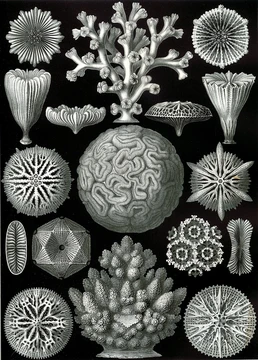
Acroporidae
Staghorn corals are the dominant group of reef builders.

Acroporidae is a family of small-polyped stony corals within the phylum Cnidaria, often called staghorn corals and popular among reef aquarium enthusiasts. Their name comes from the Greek word "akron," meaning "summit," referencing the corallite found at the tip of each branch.
These corals are the primary builders of reefs, appearing in a wide range of shapes and sizes, with color and form varying greatly even within a single species. Most are branching, table- or wall-shaped, or encrusting over rock. Colors include browns, whites, pinks, blues, yellows, greens, and purple, influenced by both species and growing conditions. Identifying them is challenging, requiring close inspection of corallites along with biochemical and genetic analysis. Except in the genus *Astreopora*, each branch tip has a small corallite with up to twelve septa arranged in two cycles.
Geographically, *Anacropora*, *Astreopora*, and *Montipora* occur in the Indian and Pacific Oceans. *Acropora* is widespread, common, and conspicuous, typically dominating Indo-Pacific reefs. *Enigmopora* is known from a single new species, *Enigmopora darveliensis*, found in Malaysia and the Philippines.
Staghorn corals are hermaphrodites, mostly broadcast-spawners, with some species participating in annual synchronous mass-spawning events on the Great Barrier Reef and in Japanese and Indonesian waters. Some reproduce asexually through fragmentation, which can lead to reefs composed of a single species.
Quick Facts
- Taxon
- Acroporidae
Facts from the source article.
Lore & Background
Staghorn corals are the dominant group of reef builders. They come in many shapes and sizes and can be highly variable in colour and form, even within the same species. Most are either a branching variant or a wall/table top variant shaped and some are encrusting (growing over rock structures). Their colours vary between browns, whites, pinks, blues, yellows, greens and purple, depending not only on species but also on the growing conditions. Identification is difficult and requires close examination of the corallites and a biochemical and genetic analysis. There is a corallite at the tip of each branch and, with the exception of Astreopora, these are small with up to twelve septa in two cycles.
Reader's Guide
Acroporidae are notable as the dominant group of reef builders, playing a key role in coral reef ecosystems. Their high variability in colour and form, even within the same species, makes them both challenging to identify and popular among reef hobbyists who grow them in aquaria. The family includes genera such as Anacropora, Astreopora, Montipora, Acropora, and Enigmopora. Acropora is cosmopolitan and is both common and conspicuous, usually being dominant in Indo-Pacific reefs. Enigmopora is represented by a single new species, Enigmopora darveliensis, found in Malaysia and the Philippines. Biologically, staghorn corals are hermaphrodites and mostly broadcast-spawners; some species have been involved in annual synchronous mass-spawning events on the Great Barrier Reef and in Japanese and Indonesian waters. Some species undergo fragmentation, a form of asexual reproduction, which sometimes results in reefs composed of a single species.
Did You Know?
- The name Acroporidae comes from the Greek 'akron' meaning 'summit', referring to a corallite at the tip of each branch.
- Some species undergo fragmentation, a form of asexual reproduction, sometimes resulting in reefs composed of a single species.
A Name Written in the Summits
The family Acroporidae takes its name from the Greek word "akron," which translates to "summit," a reference to the distinctive corallite that crowns the very tip of every coral branch. This small polyped stony coral group belongs to the phylum Cnidaria and is widely recognized by reef enthusiasts as staghorn corals. Their physical forms are remarkably diverse: most individuals grow as either a branching structure or a wall and tabletop configuration, while a subset adopts an encrusting habit, spreading across existing rock surfaces. The color palette across the family spans browns, whites, pinks, blues, yellows, greens, and purples, and this variation is driven not only by species identity but also by the particular growing conditions an individual coral experiences. Even within a single species, two colonies can look strikingly different. Structurally, the terminal corallites are generally small and feature up to twelve septa arranged in two cycles, though the genus Astreopora breaks this pattern.
The Puzzle of Identification
Despite their conspicuous presence on coral reefs, members of Acroporidae remain notoriously difficult to identify with confidence. The family encompasses several genera, including Anacropora, Astreopora, Montipora, Acropora, and Enigmopora, yet visual inspection alone is insufficient to pin down a specimen's true identity. Accurate classification demands a close, meticulous examination of the corallites themselves, supplemented by biochemical and genetic analysis. This challenge is compounded by the extreme morphological variability within the family; a single species can present in branching, wall, tabletop, or encrusting forms, and its coloration shifts across a wide spectrum depending on environmental conditions. The genus Enigmopora stands apart as the most taxonomically constrained, represented by only a single newly described species, Enigmopora darveliensis, known from waters around Malaysia and the Philippines. For researchers and hobbyists alike, the combination of form, color, and septal arrangement makes definitive identification a multi-step process rather than a simple visual match.
Reproduction and Reef Architecture
Every member of Acroporidae is a hermaphrodite, carrying both male and female reproductive capabilities within a single organism. The predominant mode of sexual reproduction across the family is broadcast spawning, in which gametes are released into the surrounding water column. In certain regions, this process escalates into extraordinary annual events of synchronous mass spawning, documented on the Great Barrier Reef as well as in Japanese and Indonesian waters, where vast numbers of corals release their gametes in coordinated bursts. Beyond sexual reproduction, some species also propagate asexually through fragmentation, a process in which a piece of the colony breaks off and establishes a new individual. This asexual pathway can have dramatic ecological consequences: when fragmentation dominates, it can produce reefs composed almost entirely of a single species, creating monoculture-like structures that differ markedly from the polycoral diversity seen elsewhere. The interplay between broadcast spawning and fragmentation thus shapes not only population genetics but also the very architecture and species composition of the reefs these corals build.
Dominant Builders of Tropical Reefs
Staghorn corals hold the position of the dominant group among reef-building organisms, a role that makes them both ecologically critical and visually striking in their natural habitats. The genus Acropora is cosmopolitan in its range, appearing across tropical waters worldwide, and within Indo-Pacific reef systems it is typically the most common and conspicuous coral, often dominating the community structure. The genera Anacropora, Astreopora, and Montipora have a more restricted distribution, confined to the Indian and Pacific Oceans. Their ecological dominance is matched by their cultural significance beyond the reef: staghorn corals are widely cultivated in aquaria by reef hobbyists around the world, who appreciate their dramatic branching forms and vivid coloration. Whether they are encrusting a rocky substrate, rising in towering branching structures, or spreading as tabletop formations, these small polyped stony corals of the phylum Cnidaria remain the defining architectural elements of the tropical reef landscape, shaping the three-dimensional habitats that countless marine species depend upon.
Frequently Asked Questions
Who is Acroporidae?
Acroporidae is a family of small-polyped stony corals within the phylum Cnidaria, widely known by the common name staghorn corals. The name traces back to the Greek word 'akron,' meaning 'summit,' a reference to the corallite perched at the very tip of each branch.
What are Acroporidae's powers or role in the reef?
As the dominant group of reef builders, Acroporidae corals erect the structural framework that defines tropical coral reefs. They grow in branching, table-like, wall-shaped, or encrusting forms, producing the three-dimensional architecture that shelters an enormous diversity of marine life.
Why is Acroporidae so important to reef ecosystems?
They are the primary architects of tropical reef habitats, providing shelter, feeding grounds, and spawning sites for countless other species. Their notably rapid growth rate also makes them central to reef recovery and restoration projects.
What makes Acroporidae's appearance so varied?
Even within a single species, colony color can shift across browns, whites, pinks, blues, yellows, greens, and purples, driven largely by symbiotic algae and environmental conditions. Skeletally, most members display up to twelve septa arranged in two cycles, though the genus Astreopora departs from that pattern.
More in Stony Corals 1-24
Spotted an error? Know more?
Reader corrections go straight into our review queue. Suggest an edit · How this site is sourced