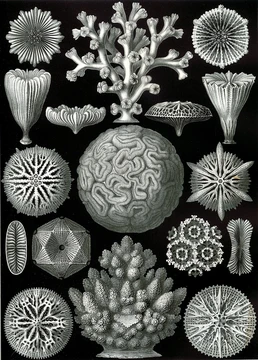
Caryophylliidae
Stony corals from tropics to temperate seas and deep water.

Stony corals in the family Caryophylliidae live across a vast range of conditions. They occur in both tropical and temperate waters, and their depth range extends from shallow reefs down into very deep ocean zones.
Quick Facts
- Taxon
- Caryophylliidae
Facts from the source article.
Lore & Background
The Caryophylliidae are a family of stony corals. The source article lists numerous genera within this family, including both extant and extinct forms, such as Asterosmilia †, Brachytrochus †, Coelosimilia †, Dendrosmilia †, Discocyathus †, Leptocyathus †, Lophosmilia †, Thecocyathus †, and Trochosmilia †. The family includes genera described by various authors, such as Africana Ocana & Brito, 2015, and Anomocora Studer, 1878.
Reader's Guide
The Caryophylliidae are a family of stony corals whose significance lies in their broad ecological distribution, occurring from tropical to temperate seas and from shallow to very deep water. The article provides a comprehensive list of genera, including both living and fossil taxa, indicating the family's long evolutionary history. The presence of extinct genera such as Asterosmilia, Brachytrochus, and Trochosmilia suggests a rich fossil record. The family includes many genera described by prominent coral taxonomists, such as Milne-Edwards & Haime, and Studer. The literature reference to S. A. Fossa and A. J. Nilsen's Coral Reef Aquarium, Volume 4, indicates the family's relevance to aquarium science. The family's legacy is tied to its role in understanding coral diversity across different depths and latitudes.
Did You Know?
- Caryophylliidae are found from the tropics to temperate seas.
- Caryophylliidae occur from shallow to very deep water.
- The genus Caryophyllia was described by Lamarck in 1801.
Ecological Breadth and Habitat Range
The Caryophylliidae stand out among stony corals for their extraordinary ecological versatility. Rather than being confined to a single climatic zone or depth band, members of this family are documented across a sweeping gradient of marine environments. Their geographic reach stretches from the warm waters of the tropics all the way into temperate seas, meaning they tolerate a far wider range of temperatures than many other scleractinian groups. Equally remarkable is their vertical distribution: Caryophylliidae occur in shallow, sunlit waters as well as in very deep marine settings, suggesting physiological adaptations that allow them to thrive under vastly different light and pressure conditions. This combination of latitudinal and bathymetric breadth makes the family a subject of particular interest for marine ecologists studying how coral communities assemble across environmental gradients. Whether anchored in a tropical reef flat or embedded in a deep-sea substrate, these stony corals demonstrate a resilience and adaptability that sets them apart within the broader coral fauna.
A Profusion of Genera
The taxonomic roster of Caryophylliidae is strikingly long, encompassing well over fifty recognized genera. This breadth reflects both genuine biological diversity and the sustained attention the family has received from coral specialists over more than a century and a half. Names like Caryophyllia, described by Lamarck in 1801, anchor the family's nomenclature, while later additions such as Africana (Ocana & Brito, 2015) and Monohedotrochus (Kitahara & Cairns, 2005) show that new genera continue to be recognized even in the modern era. The list spans an enormous range of morphological forms implied by their names—labyrinthine, concentric, branching, fimbriated, and more—hinting at a family that has explored many structural solutions. The sheer number of distinct genera, each with its own diagnostic skeletal characters, makes Caryophylliidae one of the more taxonomically rich families among stony corals and a continuing challenge for systematists seeking to resolve relationships within the group.
Fossil Lineages and Deep Time
A notable feature of the Caryophylliidae genus list is the presence of several taxa marked with a dagger, indicating they are known only from the fossil record. These extinct genera include Asterosmilia (Duncan, 1867), Brachytrochus (Reuss, 1864), Coelosimilia, Dendrosmilia (Milne-Edwards & Haime, 1848), Discocyathus (Milne-Edwards & Haime, 1848), Leptocyathus (Milne-Edwards & Haime, 1850), Lophosmilia, Thecocyathus (Milne-Edwards & Haime, 1848), and Trochosmilia (Milne-Edwards & Haime, 1848). The fact that many of these were described in the 1840s and 1850s tells us that paleontologists were already recognizing distinct coral forms in ancient rock long before modern molecular tools existed. Their presence in the family's taxonomy underscores that Caryophylliidae have a deep evolutionary history, with lineages that flourished in past seas and left behind calcified skeletons that still inform our understanding of how stony coral diversity has shifted across geological time.
The Taxonomists Who Shaped the Family
The history of Caryophylliidae classification is inseparable from the work of several pioneering naturalists. Milne-Edwards and Haime, working in 1848, described an extraordinary cluster of genera in a single year—Bathycyathus, Ceratotrochus, Coenocyathus, Heterocyathus, Paracyathus, Parasmilia, Phyllangia, Trochocyathus, and others—laying a foundational framework that still structures the family today. Duncan followed with key contributions in the 1860s and 1870s, adding Asterosmilia, Polycyathus, Pourtalosmilia, and Solenosmilia. Pourtalès enriched the list in the 1870s with Colangia, Coenosmilia, and Dasmosmilia. In the twentieth century, Cairns emerged as a particularly prolific authority, describing Concentrotheca, Labyrinthocyathus, Paraconotrochus, Phacelocyathus, and Rhizosmilia, often in collaboration with Zibrowius. This layered succession of taxonomists, spanning from Lamarck's 1801 description of Caryophyllia to Ocana and Brito's 2015 Africana, illustrates a family whose taxonomy has been refined continuously across two centuries of scientific inquiry.
Frequently Asked Questions
What is Caryophylliidae?
Caryophylliidae is a family of stony corals recognized by its strikingly broad environmental tolerance. Rather than being locked into one narrow niche, its members are found spanning tropical, temperate, and even deep-ocean settings.
Where do Caryophylliidae corals actually live?
Their range stretches from warm tropical reefs all the way into cooler temperate seas. In terms of depth, they show up on shallow reef flats and also persist in very deep ocean zones, making them one of the most vertically distributed stony coral families.
What makes Caryophylliidae stand out among other stony coral families?
Most stony coral families are tied to a particular temperature band or depth window, but Caryophylliidae defies that pattern. A single family can be encountered in both tropical and temperate waters, from sunlit shallows to the lightless deep, which is unusual for reef-building corals.
Can Caryophylliidae corals survive in very deep water?
Yes—their depth range extends well beyond the typical shallow-reef zone into very deep ocean habitats. This means some members are adapted to low-light, high-pressure conditions that would preclude most other stony coral families.
Why do coral-keeping enthusiasts and marine biologists pay attention to Caryophylliidae?
Because the family demonstrates how a single stony coral lineage can colonize an enormous swath of the ocean, it serves as a key reference point when studying coral adaptability and biogeography. For hobbyists, that wide ecological range also signals a diversity of species worth exploring beyond the usual tropical-reef favorites.
More in Stony Corals 1-24
Spotted an error? Know more?
Reader corrections go straight into our review queue. Suggest an edit · How this site is sourced