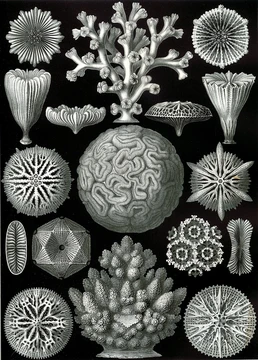
Agariciidae
A family of reef-building stony corals with symbiotic algae.

The Agariciidae are a family of stony corals that build reefs. Common names for corals in this group include cactus corals, plate corals, and lettuce corals. These corals host symbiotic algae, known as zooxanthellae, within their tissues, which help supply their energy.
These corals are colonial and hermatypic, meaning they contribute to reef formation. They typically form large, massive structures that are often laminar or foliate in shape. The corallites are connected by closely packed septa with smooth or finely toothed edges that do not fuse. The corallites do not protrude from the coral’s surface and have poorly defined walls formed by thickened septa.
The World Register of Marine Species lists these genera in the family: *Agaricia*, which mostly forms thin vertical plates, though some species have horizontal plates; *Coeloseris*, a monotypic genus whose only species is *Coeloseris mayeri*, known as tombstone coral; *Dactylotrochus*, monotypic with *Dactylotrochus cervicornis*; *Gardineroseris*, monotypic with *Gardineroseris planulata*, or Gardiner’s coral; *Helioseris*, monotypic with *Helioseris cucullata*, the sunray lettuce coral; *Leptoseris*, whose species are either crustose or laminar and often have striations; and *Pavona*, which displays various forms, from massive to frond-like.
Quick Facts
- Taxon
- Agariciidae
Facts from the source article.
Lore & Background
Members of this family are colonial, hermatypic corals that form massive structures, often of a laminar or foliate form. The corallites are linked by closely packed septa which have smooth or finely toothed margins and do not fuse together. The corallites do not stand out from the surface of the coral and have ill-defined walls formed by a thickening of the septa.
The World Register of Marine Species includes these genera in the family: Agaricia (most species form thin vertical plates, but in some, the plates are horizontal), Coeloseris (monotypic, the single species is Coeloseris mayeri, the tombstone coral), Dactylotrochus (monotypic, the single species is Dactylotrochus cervicornis), Gardineroseris (monotypic, the single species is Gardineroseris planulata, Gardiner's coral), Helioseris (monotypic, the single species is Helioseris cucullata, the sunray lettuce coral), Leptoseris (species are either crustose or laminar in form, frequently having striations), and Pavona (displays various forms, some being massive and others frond-like).
Reader's Guide
The Agariciidae are notable as a family of reef-building stony corals that contribute to the structure of coral reefs. Their colonial, hermatypic nature means they actively build the reef framework. The presence of symbiotic zooxanthellae in their tissues is a key feature, as these algae help provide the corals' energy requirements, enabling them to thrive in nutrient-poor tropical waters. The family's morphological diversity—from thin vertical plates in Agaricia to massive or frond-like forms in Pavona—allows them to occupy different ecological niches on the reef. The genera include several monotypic groups, such as Coeloseris (tombstone coral) and Helioseris (sunray lettuce coral), each with distinct growth forms. The corallite structure, with linked septa that do not fuse and ill-defined walls, is a defining characteristic that distinguishes them from other coral families. Their role as reef builders and their varied forms make them an important component of coral reef ecosystems.
Did You Know?
- The Agariciidae family includes cactus corals, plate corals, and lettuce corals.
- Members of this family contain symbiotic algae called zooxanthellae in their tissues.
Reef-Builders and Symbiotic Energy
The Agariciidae occupy a foundational position in tropical reef ecosystems as hermatypic, or reef-building, stony corals. Unlike solitary organisms, every member of this family grows in colonial arrangements, contributing collectively to the construction of massive three-dimensional frameworks that define reef architecture. A critical element of their biology is the presence of zooxanthellae—symbiotic algae housed within their tissues. These microscopic partners play a vital role in meeting the coral's energy demands, effectively supplementing the metabolic needs of the colony. This mutualistic relationship underpins the family's capacity to build and maintain the large structural formations that characterize their ecological niche. The combination of colonial growth, calcium carbonate skeleton production, and algal symbiosis makes Agariciidae a cornerstone group in reef ecology, linking biological energy capture to the physical structure that shelters countless marine species.
Structural Architecture of the Colony
The internal and external architecture of Agariciidae corals reveals a distinctive design philosophy. Their corallites—the individual skeletal cups that once housed polyps—do not project prominently above the colony's surface. Instead, they sit relatively flush, bounded by ill-defined walls that arise from a localized thickening of the septa rather than from discrete, sharply delineated boundaries. The septa themselves are tightly packed and interlink adjacent corallites, yet they never fully fuse into a single continuous sheet. Their margins present as either smooth or bearing fine, tooth-like projections. At the macro scale, colonies tend to assume massive, laminar, or foliate shapes, giving the reef a layered, shelf-like appearance. This structural arrangement—interconnected but non-fused septa, recessed corallites, and broad plate-like growth—distinguishes the family's skeletal blueprint from that of many other reef-building coral groups.
Taxonomic Roster and Common Names
The World Register of Marine Species recognizes seven genera within Agariciidae, each contributing a distinct morphological signature to the family's diversity. Agaricia, described by Lamarck in 1801, typically produces thin vertical plates, though some species orient their plates horizontally. Pavona, also named by Lamarck in the same year, exhibits a broader range of body plans, spanning massive boulder-like forms to delicate frond-like structures. Leptoseris, introduced by Milne-Edwards and Haime in 1849, appears in either crustose or laminar configurations and frequently displays surface striations. Four genera are monotypic, each represented by a single species: Coeloseris mayeri, known as the tombstone coral; Dactylotrochus cervicornis; Gardineroseris planulata, called Gardiner's coral; and Helioseris cucullata, the sunray lettuce coral. Together, these genera encompass the familiar cactus, plate, and lettuce coral forms that diversify reef habitats.
A Spectrum of Growth Forms
One of the most striking features of Agariciidae is the extraordinary range of growth forms represented across its member genera. At one extreme, some Agaricia species extend as thin, upright vertical plates, while others lay their plates flat in a horizontal orientation. Leptoseris species may hug the substrate in a low, encrusting crustose shape or stretch outward in laminar sheets, often marked by parallel striations running across their surfaces. Pavona pushes the morphological envelope further, producing both solid massive structures and lacy, frond-like colonies that resemble underwater foliage. The monotypic Coeloseris mayeri earns its common name—tombstone coral—presumably from its distinctive slab-like silhouette, while Helioseris cucullata, the sunray lettuce coral, evokes the ruffled, layered appearance of a lettuce leaf. This spectrum, from encrusting to plate-like to frond-like, ensures that Agariciidae corals fill multiple structural niches within a single reef community.
Frequently Asked Questions
Who is Agariciidae?
Agariciidae is a family of colonial stony corals that includes the well-known cactus, plate, and lettuce corals. The family spans seven genera and is classified as hermatypic, meaning its members actively construct reef structures.
What are Agariciidae's powers/role?
These corals house symbiotic zooxanthellae algae inside their tissues, which supply a major share of their energy. In exchange, the coral provides the algae a protected home and steady access to dissolved nutrients.
How do Agariciidae corals grow?
They typically develop into large, massive colonies shaped like broad plates or sheets (laminar or foliate forms). Individual corallites are linked by tightly packed septa whose edges are smooth or finely toothed but never fuse together.
Why is Agariciidae important?
As hermatypic reef-builders, members of this family contribute directly to the physical architecture of coral reefs. Their massive colonies create habitat, shelter, and structural complexity for countless other marine organisms.
What makes Agariciidae's design unique?
Unlike some other stony coral families, the corallites in Agariciidae do not protrude above the colony's surface. This gives their colonies a smoother, more unified look compared to spikier, more three-dimensional relatives.
More in Stony Corals 1-24
Spotted an error? Know more?
Reader corrections go straight into our review queue. Suggest an edit · How this site is sourced