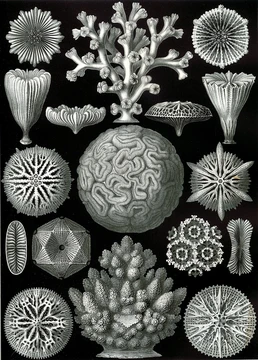
Brain coral
Spheroid stony corals with brain-like grooves, found worldwide.

Brain coral is the common name for a group of corals belonging to the families Mussidae and Merulinidae. They get their name from their round, brain-like shape and the grooves that cover their surface. Each coral head is actually a colony of identical polyps that build a hard skeleton out of calcium carbonate. This makes them key builders of coral reefs, just like other stony corals in the order Scleractinia.
These corals live in shallow, warm waters on reefs around the world. They are part of the phylum Cnidaria and the class Anthozoa, which means "flower animals." The largest brain corals can live up to 900 years and grow as tall as 1.8 meters (6 feet) or more.
At night, brain corals extend their tentacles to catch food. During the day, they use those same tentacles for protection, wrapping them over the grooves on their surface. The hard surface itself also provides good defense against fish and hurricanes. Branching corals, like staghorn corals, grow faster but are more easily damaged by storms.
Like other corals, brain corals eat small drifting animals and get nutrients from algae living inside their tissues. One common genus, *Favia*, is semiaggressive—it stings nearby corals with long sweeper tentacles at night.
Scientists have studied the grooved surface of brain corals to learn how to give spherical wheels better grip.
- Maximum lifespan years
- 900
- Maximum height meters
- 1.8
- Maximum height feet
- 6
- Families
- Mussidae and Merulinidae
- Order
- Scleractinia
- Phylum
- Cnidaria
- Class
- Anthozoa
Lore & Background
Brain corals are found in shallow warm water coral reefs in all the world's oceans. They are part of the phylum Cnidaria, in a class called Anthozoa or 'flower animals'. The lifespan of the largest brain corals is 900 years. Colonies can grow as large as 1.8 m (6 ft) or more in height. Brain corals extend their tentacles to catch food at night. During the day, they use their tentacles for protection by wrapping them over the grooves on their surface. The surface is hard and offers good protection against fish or hurricanes. Branching corals, such as staghorn corals, grow more rapidly, but are more vulnerable to storm damage. Like other genera of corals, brain corals feed on small drifting animals, and also receive nutrients provided by the algae which live within their tissues. The behavior of one of the most common genera, Favia, is semiaggressive; it will sting other corals with its extended sweeper tentacles during the night. The grooved surface of brain corals has been used by scientists to investigate methods of giving spherical wheels appropriate grip strength.
Reader's Guide
Brain corals are notable as important reef builders within the order Scleractinia, secreting a hard skeleton of calcium carbonate that contributes to the structure of coral reefs. Their common name derives from their spheroid shape and grooved surface, which resembles a brain. Found in shallow warm water reefs across all the world's oceans, they belong to the families Mussidae and Merulinidae. The largest specimens can live up to 900 years and reach heights of 1.8 m (6 ft) or more. Their hard surface provides protection against fish and hurricanes, unlike faster-growing branching corals such as staghorn corals, which are more vulnerable to storm damage. Brain corals feed at night by extending tentacles to catch small drifting animals, and during the day they wrap their tentacles over their grooves for protection. They also receive nutrients from algae living within their tissues. The genus Favia exhibits semiaggressive behavior, stinging other corals with sweeper tentacles at night. Scientists have studied the grooved surface of brain corals to explore methods for giving spherical wheels appropriate grip strength, highlighting an unexpected application of their morphology.
Did You Know?
- The genus Favia is semiaggressive and stings other corals with sweeper tentacles at night.
- Scientists have used the grooved surface of brain corals to investigate grip strength for spherical wheels.
Physical Form & Colony Architecture
Brain coral earns its name from the unmistakable resemblance its surface bears to a human brain—rounded, spheroid heads covered in deep, winding grooves. What appears to be a single massive organism is in fact a colony of genetically identical polyps working in concert, each secreting a hard skeleton of calcium carbonate. This collective architecture places brain corals firmly among the stony corals of the order Scleractinia, making them vital reef builders. Their physical dimensions are striking: colonies can reach heights of 1.8 meters or more, and the largest specimens are estimated to live as long as 900 years. They belong to the phylum Cnidaria and the class Anthozoa, often called "flower animals," and are distributed across shallow, warm-water reefs in every ocean on Earth. The two families that house the common name "brain coral" are Mussidae and Merulinidae, encompassing a wide array of genera from Favia to Diploria and beyond.
Daily Rhythms & Storm Resilience
Brain corals operate on a clear day-night cycle that governs both their feeding and their defense. At night, they extend their tentacles outward to capture small drifting animals passing through the water. During daylight hours, those same tentacles are retracted and wrapped tightly over the grooved surface, serving as a protective covering. The hard, calcified exterior of the colony provides a formidable barrier against predation by fish and the physical force of hurricanes. This structural robustness comes with a trade-off: branching corals like staghorn grow at a faster rate but are far more vulnerable to storm damage. Brain corals, with their solid spheroid form, sacrifice rapid growth for durability, allowing them to persist through repeated weather events and accumulate centuries of skeletal material. Their presence in shallow warm waters across all the world's oceans underscores how well this design suits the exposed reef environment.
Feeding Ecology & Intraspecific Competition
Nutrition for brain corals comes from two complementary sources. They actively capture small drifting animals using their tentacles, a process that occurs primarily during nighttime hours when the tentacles are fully extended. In addition, they benefit from a symbiotic relationship with algae living within their tissues, which supply essential nutrients. Not all brain corals are passive neighbors, however. The genus Favia, one of the most common representatives of the group, displays semiaggressive behavior. At night, Favia colonies deploy specialized sweeper tentacles that they extend toward adjacent corals, delivering stings that can damage or kill competitors. This territorial aggression highlights a less visible dimension of reef life: even corals that appear stationary and slow-growing engage in active stinging combat for space. The combination of drift-feeding, algal symbiosis, and competitive stinging makes the ecological niche of brain corals far more dynamic than their solid, brain-like appearance might suggest.
Taxonomic Breadth & Engineering Inspiration
The common name "brain coral" spans a remarkable taxonomic breadth. Within the families Mussidae and Merulinidae, dozens of genera have been described, including Favia, Favites, Diploria, Colpophyllia, Diploastrea, and Platygyra, some bearing additional common names like candy cane coral, honeycomb coral, or great star coral. These genera were described by taxonomists spanning from 1786 to 1995, reflecting ongoing discovery and reclassification. Beyond their biological significance, the grooved surface of brain corals has attracted the attention of scientists and engineers. Researchers have studied these natural grooves to investigate methods of giving spherical wheels appropriate grip strength, drawing directly on the coral's textured design. This cross-disciplinary interest underscores how a reef organism's form, optimized for protection and structural integrity, can offer practical lessons for human mechanical design.
Frequently Asked Questions
Who is Brain coral?
Brain coral is the everyday name for a group of stony corals found in the families Mussidae and Merulinidae, all part of the order Scleractinia. They belong to the phylum Cnidaria and the class Anthozoa, which translates to 'flower animals.' Their signature look comes from a rounded head covered in winding, brain-like grooves.
What are Brain coral's powers or role?
Each brain coral head is actually a tight colony of genetically identical polyps working together to secrete a hard calcium carbonate skeleton. This makes them essential reef architects, helping to build and maintain the three-dimensional structure that countless other marine species depend on.
Why is Brain coral important?
As prolific calcium carbonate producers, brain corals are among the primary structural engineers of tropical reef systems worldwide. Their massive, long-lived heads create sheltered microhabitats and contribute to the overall resilience of the reef ecosystem.
Where can fans spot Brain coral in the wild?
Brain corals are found in shallow, warm reef waters across the globe, from the Indo-Pacific to the Caribbean. They typically settle on reef flats and slopes where sunlight and steady water flow support their slow, steady growth.
More in Stony Corals 1-24
Spotted an error? Know more?
Reader corrections go straight into our review queue. Suggest an edit · How this site is sourced