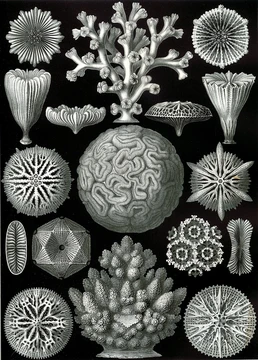
Euphylliidae
A family of stony corals with bubble-like tentacles, popular in aquariums.

Euphylliidae (Greek eu-, true; Greek phyllon, leaf) are known as a family of polyped stony corals under the order Scleractinia. As of the year 2000, the order Scleractinia was divided into 18 artificial families, known as the Acroporidae, Astrocoeniidae, Pocilloporidae, Euphyllidae, Oculinidae, Meandrinidae, Siderastreidae, Agariciidae, Fungiidae, Rhizangiidae, Pectiniidae, Merulinidae, Dendrophylliidae, Caryophylliidae, Mussidae, Faviidae, Trachyphylliidae, and Poritidae (sensu Veron 2000). These corals are often kept in home aquariums, valued for their appearance and for providing shelter to fish. In the wild, they may be either sparse or conspicuous on the ocean floor. They are commonly called "bubble" or "grape" corals because their large, fleshy tentacles and vesicles puff out during the day, giving them that look. As of the year 2000, the order Scleractinia was split into 18 artificial families, including Euphyllidae. At that time, only 11 of those families were known to contain truly reef-building corals, and all scleractinian families considered were zooxanthellates, meaning they host photosynthetic symbionts. By 2022, the World Register of Marine Species listed over 30 families within Scleractinia and 845 reef-building coral species. The genera currently recognized under Euphylliidae include Ctenella, Euphyllia, Fimbriaphyllia, Galaxea, Gyrosmilia, Montigyra, and Simplastrea. Acrhelia and Acrohelia are treated as synonyms of Galaxea, while Leptosmilia is considered a synonym of Euphyllia. In appearance, Euphylliidae are typical of stony corals: long, tubular or cylindrical, with many branches reaching upward. Their exoskeleton is made of limestone or calcium carbonate, formed by numerous polyps. The corallum has a phaceloid growth form and is green, gray, bluish, or pale brown. Tentacles have greenish to cream tips that are round, kidney-shaped, or bean-shaped depending on the species. Polyps are usually at least partly extended. Corallites are very tall—up to 150 mm—and either single or in rows; they rise separately from encrusting leaves and are typically 1–40 mm in diameter. Calices are rounded. Septa are numerous and arranged in cycles, with larger ones protruding up to 10 mm over the corallite wall. Septal margins are smooth, finely granulated, or minutely dentate. There is no columella.
Quick Facts
- Taxon
- Euphylliidae
Facts from the source article.
Lore & Background
As of the year 2000, the order Scleractinia was divided into 18 artificial families, including Euphyllidae (sensu Veron 2000). By 2022, more than 30 families were recognized under Scleractinia. The family includes genera such as Euphyllia, Galaxea, and Fimbriaphyllia, with Acrhelia and Acrohelia considered synonyms of Galaxea, and Leptosmilia a synonym of Euphyllia. The most conspicuous of this family are the genera Plerogyra and Euphyllia. Euphylliidae are found in the Indo-Pacific, Australia, Southeast Asia, the Ryukyu Islands and East China Sea, the Solomon Islands, Fiji, and Palau, often on fringing reef crests, mid-slope terraces, and lagoons at depths of about 2 to 25 meters. These corals have a phaceloid, meandroid, or flabello-meandroid growth form, with large, solid, widely spaced septo-costae.
Reader's Guide
Euphylliidae are notable as a family of stony corals that are both sparse and conspicuous in the wild, yet are commonly kept in home aquariums. Their conservation status overall is unthreatened, but specific species are of higher concern due to environmental issues such as increased sea surface temperature, ocean acidification, and overfishing for the marine aquarium trade. The family's body plan is characterized by radial symmetry, and they are benthic, sessile organisms that do not move actively except through outward growth. They are photosymbiotic suspension feeders, with polyps catching zooplankton using stinging structures called nematocysts. Reproduction occurs both asexually (by budding) and sexually, with most species being broadcast spawners that release eggs and sperm into the water. The resulting planulae exhibit positive phototaxis, swimming upward toward light before settling and metamorphosing into polyps. The family's legacy is tied to its distinctive appearance and its role in reef ecosystems, as well as its popularity in the aquarium trade.
Did You Know?
- The family includes the genera Plerogyra and Euphyllia, which are the most conspicuous members.
- Some Euphylliidae species have tentacles with a distinctive U-shaped tip, while others lack this feature.
- The family's name comes from Greek eu- (true) and phyllon (leaf).
Taxonomic Identity & Genera
Euphylliidae derives its name from two Greek roots—eu, meaning "true," and phyllon, meaning "leaf"—and occupies a defined position within the order Scleractinia as a family of polyped stony corals. The family encompasses several recognized genera, including Coeloseris, Ctenella, Euphyllia, Fimbriaphyllia, Galaxea, Gyrosmilia, Montigyra, and Simplastrea, each described by different taxonomists between 1815 and 1939. Taxonomic nomenclature within the group has undergone consolidation: Acrhelia and Acrohelia are now treated as synonyms of Galaxea, while Leptosmilia has been folded into Euphyllia. The broader context of scleractinian taxonomy has shifted considerably over time. In the year 2000, the order was partitioned into eighteen families, of which only eleven were recognized as genuinely reef-building. By 2022, the World Register of Marine Species acknowledged more than thirty families and identified 845 species capable of reef construction. Every scleractinian family, including Euphylliidae, harbors photosynthetic endosymbiotic algae known as zooxanthellae, a trait that unites the entire order in a shared metabolic partnership.
Morphology & the 'Bubble Coral' Identity
Members of Euphylliidae present a striking silhouette: long, tubular or cylindrical bodies studded with upward-reaching branches, all built from a calcareous aragonite endoskeleton secreted by countless tiny polyps. In the wild, colonies display hues of green, gray, bluish, or pale-brown, while their tentacles often terminate in greenish or cream-colored tips shaped round, kidney-like, or bean-like depending on the species. Corallites—the cuplike skeletal cups housing each polyp—can grow remarkably tall, reaching up to 150 millimeters, with diameters ranging from 1 to 40 millimeters. Their calices are rounded, septa are numerous and arranged in cycles, and no columella is present. The family's most visually arresting feature, however, is its daytime behavior: large fleshy tentacles and vesicles expand fully, lending the colony a puffed, bubble-like or grape-like appearance. This is why aquarists and divers commonly call them "bubble" or "grape" corals. Unlike most hard corals, which are distinguished by skeletal microstructure, Euphylliidae are more readily separated by examining tentacle architecture—some species bear a distinctive U-shaped tip, while others lack it entirely. Their radial symmetry ensures every direction is equally equipped to detect and respond to both prey and predators.
Feeding Strategy & Symbiotic Partnership
Although they are frequently mistaken for plants, Euphylliidae are unequivocally marine animals—benthic, sessile creatures that anchor themselves to the ocean floor for their entire lives. They lack the capacity for active locomotion and instead rely on a dual feeding strategy. As suspension feeders, their polyps extend tentacles armed with nematocysts, microscopic stinging cells that fire in response to touch or chemical cues. These cells may deliver toxins or produce a sticky adhesion, capturing floating zooplankton and other small drifting organisms. Simultaneously, the family is photosymbiotic: microscopic algae called zooxanthellae reside within coral tissues, sheltered and supplied with metabolic waste products, which they convert into energy through photosynthesis. This mutualistic arrangement means the coral gains nutritional benefit while the algae gain protection and a steady carbon source. Polyp feeding activity is modulated by environmental variables including water current patterns, temperature, and the concentration of available food. Each individual polyp is remarkably small—most no thicker than a nickel—yet collectively they secrete the limestone framework that, through endless cycles of growth, death, and regeneration, can sustain a colony for extraordinary durations.
Habitat, Distribution & Conservation Outlook
Euphylliidae corals are distributed across the Indo-Pacific region, with records from Australia and Southeast Asia, typically inhabiting shallow waters where they may appear either sparse or conspicuously abundant. In turbid lagoonal settings, certain genera such as Plerogyra and Euphyllia can form particularly dense populations. Beyond their natural range, these corals have become popular inhabitants of home aquariums, where their vivid coloration and the protective relationship they share with resident fish make them a favorite among hobbyists. At the family level, the current conservation assessment is unthreatened; however, individual species face more pressing risks. The primary pressures include rising sea surface temperatures, progressive ocean acidification, and intensified collection for the marine aquarium trade. These combined stressors can disrupt the delicate zooxanthellae symbiosis, impair calcification, and reduce population resilience. Because Euphylliidae are sessile and cannot relocate in response to changing conditions, they are especially vulnerable to localized environmental degradation. Their long-lived colonies, built over generations of polyp turnover, represent not merely individual organisms but accumulated ecological heritage that, once lost, takes considerable time to re-establish.
Frequently Asked Questions
Who is Euphylliidae?
Euphylliidae is a family of polyped stony corals within the order Scleractinia, taking its name from Greek roots meaning 'true leaf.' It encompasses seven genera recognized by WoRMS and is instantly identifiable by the inflated, bubble-like tips on its tentacles.
What are Euphylliidae's powers or role?
These corals secrete hard calcium carbonate skeletons that help build reef structure, while their elongated polyps create a dramatic, flowing visual display. They also serve as living shelter for a variety of small reef-dwelling organisms.
Why is Euphylliidae important?
As one of the 18 families of Scleractinia (per Veron's 2000 classification), it adds both structural and biological diversity to coral reef ecosystems. It is also a cornerstone of the marine aquarium hobby, prized for its striking bubble-tip appearance and the microhabitat it offers.
What's Euphylliidae's backstory?
The family name blends Greek 'eu-' (true) with 'phyllon' (leaf), a nod to the leaf-like arrangement of its polyps. Its corallites span diameters from just 1 to 40 mm, and the group has long been catalogued among the diverse Scleractinia families.
More in Stony Corals 1-24
Spotted an error? Know more?
Reader corrections go straight into our review queue. Suggest an edit · How this site is sourced