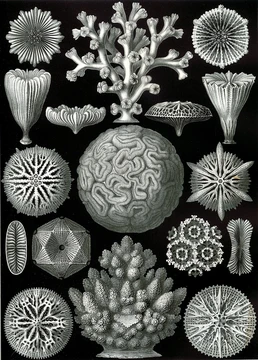
Fungiidae
Mushroom corals that can change sex and move as adults.

The Fungiidae are a family of Cnidaria, commonly known as mushroom corals or plate corals. The family contains thirteen extant genera, ranging from solitary corals to colonial species. Some genera such as Cycloseris and Fungia are solitary organisms, while others like Polyphyllia consist of a single organism with multiple mouths, and Ctenactis and Herpolitha may be considered as solitary organisms with multiple mouths or a colony of individuals, each with its separate mouth.
Quick Facts
- Taxon
- Fungiidae
Facts from the source article.
Lore & Background
Species are generally solitary marine animals capable of benthic locomotion. These corals often appear to be bleached or dead. In most genera, a single polyp emerges from the center of the skeleton to feed at night. Most species remain fully detached from the substrate in adulthood, though some are immobile as well as colonial.
Some species of mushroom coral such as Fungia repanda and Ctenactis echinata are able to change sex. This is posited to take place in response to environmental or energetic constraints, and to improve the organism's evolutionary fitness; similar phenomena are observed in some dioecious plants.
One fungiid species, Heliofungia actiniformis ("anemone coral"), can be easily mistaken for a sea anemone because its tentacles remain visible during the day. They also provide shelter to some fish species (Gobiidae and Labridae). Fungia spp. have a commensal pipefish, Siokunichthys nigrolineatus. Some fungiids can be elongated and look like a sea cucumber. Some fungiids (Danafungia scruposa) have been observed eating jellyfish.
Reader's Guide
Members of the family Fungiidae are not of any commercial importance, but are collected for the aquarium trade and are sold as "plate corals". Their notable characteristics include the ability of some species to change sex, a trait posited to improve evolutionary fitness under environmental or energetic constraints. The family's benthic locomotion and frequent detachment from the substrate in adulthood distinguish them from many other stony corals. Their appearance often leads to misidentification: Heliofungia actiniformis resembles a sea anemone, and some elongated forms look like sea cucumbers. The family also engages in ecological interactions such as providing shelter for gobies and wrasses, hosting a commensal pipefish, and occasionally consuming jellyfish. These features, combined with their solitary to colonial range and ambiguous organization in some genera, make them a subject of interest in marine biology and aquarium husbandry.
Morphology & the Spectrum of Solitude
The Fungiidae family encompasses thirteen extant genera of Cnidaria, widely recognized as mushroom corals or plate corals. What distinguishes this group is the extraordinary breadth of body plans it harbors. At one extreme, genera like Cycloseris and Fungia exist as genuinely solitary individuals, each a single organism on its own. At the opposite end, species form true colonies of multiple individuals. Occupying the middle ground are genera such as Polyphyllia, a single organism bearing several mouths, and Ctenactis and Herpolitha, which sit ambiguously between solitary and colonial — interpretable either as one body with multiple mouths or as a cluster of individuals each with its own. Most fungiids are benthic, dwelling on the seafloor, and many can move across the substrate. In the majority of genera, a single polyp rises from the center of the skeleton to feed after dark. Crucially, most species stay fully detached from the substrate once adult, and some are entirely immobile, making them a far cry from the rigid reef-builders people typically picture when they hear the word coral.
Ecological Strategies & Unusual Feeding
Fungiidae display a striking array of ecological adaptations that set them apart within the Cnidaria. Perhaps the most remarkable is the capacity for sex change seen in species such as Fungia repanda and Ctenactis echinata. This shift is believed to be triggered by environmental stress or energetic limitations, ultimately boosting the organism's evolutionary fitness — a strategy with clear parallels in certain dioecious plant species. On the dietary front, fungiids are predominantly nocturnal feeders, with a single polyp emerging from the skeleton's center to capture prey in the dark. Yet some push well beyond typical cnidarian habits: Danafungia scruposa has been observed consuming jellyfish, an unusual and bold prey choice. Fungia species also support a commensal pipefish, Siokunichthys nigrolineatus, which gains shelter and protection without harming its host. Together, these behaviors reveal fungiids as ecologically dynamic participants in reef communities rather than the static, passive organisms their flat, disc-like shapes might suggest.
Mimicry, Misidentification & Ecological Roles
One of the most captivating features of Fungiidae is their talent for disguise, which has led to persistent misidentification among both scientists and hobbyists. Heliofungia actiniformis, the so-called anemone coral, is so readily confused with a true sea anemone that its tentacles stay visible throughout the day, breaking the pattern of nocturnal polyp emergence seen in most relatives. Other fungiids adopt an entirely different camouflage: certain elongated species bear a striking resemblance to stichopodid sea cucumbers. Beyond active mimicry, many fungiids simply look bleached or lifeless to a passing observer, their pale, flat skeletons blending seamlessly into the reef floor. Despite this unassuming exterior, they fulfill meaningful ecological functions. Heliofungia actiniformis, for example, offers shelter to fish belonging to the families Gobiidae and Labridae. The family's deceptive appearances remind us how much hidden complexity lies beneath what seems like a simple, flat disc resting on the sand.
Human Interaction, Trade & Classification
For all their morphological diversity and ecological significance, members of the Fungiidae family carry no commercial importance in any conventional sense. They are not harvested for food, pharmaceuticals, or industrial materials. Their primary point of contact with humans comes through the aquarium trade, where they are collected and marketed under the familiar label "plate corals." This trade represents the most meaningful human interaction with the family, driven largely by their unusual shapes and the curiosity they spark among reef-keeping enthusiasts. Taxonomically, the family is well catalogued in the World Register of Marine Species, which recognizes the thirteen extant genera that compose the group. Their placement within Cnidaria links them to stony corals and sea anemones, yet their solitary or semi-solitary lifestyles, ability to move across the seafloor, and lack of permanent substrate attachment in adulthood distinguish them sharply from the familiar reef-building corals. For the casual viewer, a fungiid's flat, plate-like skeleton might read as a broken dish or a dead organism, making the aquarium trade's "plate coral" name both fitting and subtly misleading.
Frequently Asked Questions
Who is Fungiidae?
Fungiidae is a family within the class Cnidaria, best recognized by reef hobbyists as the mushroom or plate corals. The group currently includes thirteen living genera, spanning everything from a single standalone polyp to loosely organized colonies.
What are Fungiidae's powers?
Unlike most stony corals, Fungiidae members can crawl across the substrate even as fully grown adults. They also have the ability to switch between male and female reproductive roles over the course of their lifespan.
How is Fungiidae organized?
The family shows a striking range of body plans: Cycloseris and Fungia each exist as a single, standalone polyp, while Polyphyllia is one organism bearing several mouths. Ctenactis and Herpolitha sit in a gray zone, interpretable either as a solitary animal with multiple mouths or as a small colony of individual polyps.
Why is Fungiidae important to the reef?
As stony corals, Fungiidae contribute calcium carbonate to reef structure, but their unusual mobility and reproductive flexibility make them a key study group for understanding how cnidarians adapt to shifting environments.
What are Fungiidae's closest relatives?
All thirteen genera belong to the order Scleractinia, placing Fungiidae among the hard, reef-building corals. Within that order, their distinct plate-like skeleton and often solitary lifestyle set them apart from the more encrusting or branching families.
More in Stony Corals 1-24
Spotted an error? Know more?
Reader corrections go straight into our review queue. Suggest an edit · How this site is sourced