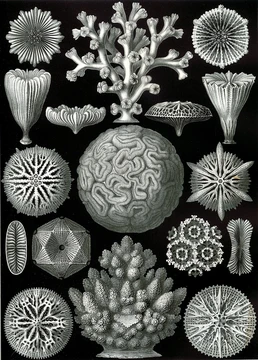
Cladocora caespitosa
Stony coral forming the Mediterranean's only true coral reef.

Cladocora caespitosa, called Mediterranean pillow coral or cushion coral, is a stony coral belonging to the subclass Hexacorallia. It is the largest stony coral in the Mediterranean, with colonies reaching up to 50 cm across. Its polyps are a clear maroon color, about 5 mm in diameter, and form cushion-shaped colonies. They live in symbiosis with Zooxanthella algae and produce calcium carbonate deposits that build the stony structures they inhabit. The species has an average generation length of roughly 30 years. This coral is endemic to the Mediterranean Sea, where fossils show it existed as early as the Upper Pliocene. It is common on rocky seabeds from a few meters down to 60 meters deep. A small coral reef made of this species exists in the marine lagoon of Veliko Jezero, within the Mljet island marine reserve in Croatia. This was long thought to be the only true coral reef in the Mediterranean. However, recent discoveries in the Adriatic Sea have found an extensive corallith bed of *C. caespitosa* in the Tremiti Islands Marine Protected Area, and it is now known that this is not the only reef-building species in the Mediterranean. The species grows through budding, but spreads when plankton-like larvae settle on suitable seabed. It has a unique survival strategy called rejuvenescence, which allows it to recover after warming events. Despite this, *C. caespitosa* is classified as endangered on the IUCN red list, mainly due to recent mass die-offs caused by heat waves in the Mediterranean.
Quick Facts
- Taxon
- Cladocora caespitosa
Facts from the source article.
Lore & Background
Cladocora caespitosa is endemic to the Mediterranean Sea, where it has been attested since the Upper Pliocene. It forms cushion-shaped colonies of clear maroon polyps, about 5 mm in diameter, in symbiosis with Zooxanthella algae. The polyps produce calcium carbonate deposits that build the calciate structures they inhabit. It is the largest stony coral in the Mediterranean, reaching up to 50 cm in diameter, with an average generation length of about 30 years. The species is common on rocky seabeds between a few metres and 60 metres in depth. A small coral reef made up of C. caespitosa exists in the marine lagoon of Veliko Jezero, within the marine reserve of Mljet island, Croatia. This was believed to be the only true coral reef in the Mediterranean, but recent findings in the Adriatic Sea show that C. caespitosa is not the only reef-building species there. An extensive corallith bed of C. caespitosa has been found in the Tremiti Islands Marine Protected Area. Colonies grow through budding, and the species spreads via settlement of plankton-like larvae on suitable seabed. Cladocora caespitosa is classified as endangered under the IUCN red list, mostly due to recent mass die-offs caused by heat wave events in the Mediterranean. The species has been observed to demonstrate rejuvenescence, a unique survival strategy enabling recovery after warming events.
Reader's Guide
Cladocora caespitosa holds significance as the only stony coral species known to form a true coral reef in the Mediterranean Sea, specifically the reef in the marine lagoon of Veliko Jezero on Mljet island, Croatia. This reef was long considered unique, though recent findings in the Adriatic Sea, including an extensive corallith bed in the Tremiti Islands Marine Protected Area, indicate that other reef-building species exist in the Mediterranean. The species is the largest stony coral in the region, reaching up to 50 cm in diameter, and has an average generation length of about 30 years. Its survival strategy of rejuvenescence allows it to recover after warming events, which is critical given that mass die-offs from heat waves have led to its endangered status on the IUCN red list. The coral's symbiosis with Zooxanthella algae and its calcium carbonate deposition are key to its reef-building role. Its presence since the Upper Pliocene underscores its long-term ecological importance in the Mediterranean, though recent threats highlight its vulnerability.
Physical Form and Biology
Cladocora caespitosa, widely recognized as the Mediterranean pillow coral or cushion coral, belongs to the stony coral subclass Hexacorallia. Its most striking visual feature is the cluster of clear maroon polyps, each roughly 5 millimetres across, which collectively build broad, rounded colonies. These polyps maintain a symbiotic partnership with Zooxanthella algae, and together they secrete calcium carbonate that hardens into the calcareous framework the organisms inhabit. In terms of sheer size, it stands as the largest stony coral found anywhere in the Mediterranean, with individual colonies capable of expanding to roughly 50 centimetres in diameter. The species operates on a notably slow biological clock, with an average generation length hovering around 30 years, a pace that underscores how each colony represents decades of accumulated growth in its underwater environment.
Range and Deep Geological Roots
Endemic to the Mediterranean basin, Cladocora caespitosa carries a remarkably deep geological footprint, with fossil evidence placing it in the region as far back as the Upper Pliocene epoch. In living waters, the species thrives on rocky seabeds spanning depths from just a few metres down to approximately 60 metres. One of its most celebrated habitats is the marine lagoon of Veliko Jezero, situated within the marine reserve surrounding Mljet island in Croatia, where a small but genuine coral reef has been constructed entirely from this species. For a long time, that site was thought to be the sole true coral reef in the entire Mediterranean. However, more recent discoveries in the Adriatic have complicated that narrative: an extensive corallith bed of C. caespitosa was identified in the Tremiti Islands Marine Protected Area, revealing that the species builds reef-like structures in more locations than previously appreciated. These findings collectively paint a picture of a coral with a long, geologically ancient presence and a broader structural role in Mediterranean seas than once assumed.
Growth and Reproductive Strategy
The life cycle of Cladocora caespitosa involves two distinct mechanisms for expansion. At the colony level, growth proceeds through budding, a process in which new polyps emerge from existing ones, gradually thickening and broadening the cushion-shaped structure over time. At the species level, however, dispersal relies on a very different strategy: the release of plankton-like larvae into the water column. These free-swimming juveniles drift until they encounter a seabed suitable for colonisation, where they settle and begin building a new colony. This two-tiered approach means that while individual colonies expand slowly and locally through budding, the species as a whole can colonise new rocky substrates across the Mediterranean. Given the species' average generation length of roughly 30 years, each successful larval settlement represents a significant generational event, and the slow pace of both budding and larval development makes population recovery particularly vulnerable when environmental conditions turn adverse.
Endangerment and a Surprising Resilience
Despite its ancient lineage and ecological importance, Cladocora caespitosa now carries an endangered classification on the IUCN Red List, a designation driven largely by recent mass die-off events triggered by extreme heat waves sweeping through Mediterranean waters. These thermal anomalies have proven devastating for a coral whose 30-year generation cycle leaves little room for rapid population rebound. Yet the species has revealed an unexpected counter to this vulnerability: a phenomenon termed rejuvenescence. This unique survival strategy allows colonies to recover following warming events, effectively resetting part of their biological age and restoring physiological function after thermal stress. The discovery of rejuvenescence offers a glimmer of hope for the species' long-term persistence, suggesting that not every heat-wave encounter is fatal. Still, the frequency and intensity of recent marine heat events in the Mediterranean raise serious questions about whether this resilience mechanism can keep pace with the accelerating climate pressures the coral now faces.
Frequently Asked Questions
What is Cladocora caespitosa?
It is a stony coral in the Hexacorallia subclass, widely known as the Mediterranean pillow coral or cushion coral. It holds the title of the largest stony coral in the Mediterranean Sea.
How big can a Cladocora caespitosa colony get?
Each individual polyp is only about 5 mm in diameter, but together they build dense, cushion-shaped colonies that can spread to roughly 50 cm across.
Where does Cladocora caespitosa live and at what depth?
The species is entirely endemic to the Mediterranean Sea, with colonies settling anywhere from just a few metres below the surface down to around 60 metres.
How long does Cladocora caespitosa live?
A single generation of this coral averages about 30 years, reflecting its slow, steady pace of reef construction.
Why is Cladocora caespitosa considered so important?
It is the only stony coral in the Mediterranean that builds a true coral reef, secreting calcium carbonate while sustaining a symbiotic relationship with Zooxanthella algae for mutual nutrition.
More in Stony Corals 1-24
Spotted an error? Know more?
Reader corrections go straight into our review queue. Suggest an edit · How this site is sourced