Pocilloporidae
Colonial reef-building corals of the Pacific and Indian Oceans.

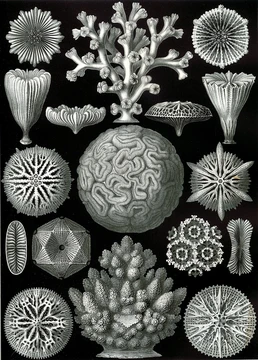
The Pocilloporidae family includes stony corals found in the Pacific and Indian Oceans. These corals are colonial, with most species helping to build reefs. Their size and shape vary widely—some are thick and sturdy, while others branch out like trees or form many-branched structures. The tiny corallites can be either sunken or raised into cones. Inside, the columellae are well developed, and the septa often fuse with them. The skeleton’s coenosteum is covered in small spinules. This family is closely related to the Astrocoeniidae and Acroporidae families.
Within the family, different genera can change their growth form depending on their surroundings, especially light and wave action. The colonies are hermaphrodites. Sperm is released into the water and enters other polyps. After internal fertilization, the parent broods the planula larvae before releasing them into the water. This keeps dispersal distances short but improves the chance of finding a good spot to settle.
The World Register of Marine Species lists these genera: *Madracis*, *Pocillopora*, *Seriatopora*, and *Stylophora*.
Quick Facts
- Taxon
- Pocilloporidae
Facts from the source article.
Lore & Background
Pocilloporids are colonial stony corals that are highly variable in size and shape, ranging from submassive to arborescent or ramose forms. Their corallites are small and can be sunken or raised into cones, with well-developed columellae and fused septa. The coenosteum lining the skeleton is covered with spinules. The family is closely related to Astrocoeniidae and Acroporidae.
The genera within Pocilloporidae are polymorphic, meaning their growth form changes according to habitat, particularly in response to light availability and wave action. Colonies are hermaphrodites; sperm is released into the sea and enters other polyps. After internal fertilization, planula larvae are brooded by the parent before being ejected into the water column. This brooding strategy results in small dispersal distances but increases the likelihood of finding suitable substrate for settlement.
The World Register of Marine Species lists four genera: Madracis, Pocillopora, Seriatopora, and Stylophora.
Reader's Guide
The Pocilloporidae family is significant as a group of reef-building corals that contribute to the structure of coral reefs in the Pacific and Indian Oceans. Their colonial nature and ability to take on various growth forms—submassive, arborescent, or ramose—allow them to occupy diverse habitats, adapting to light availability and wave action. The family's reproductive strategy, involving brooded planula larvae, enhances local recruitment and settlement success, which is important for reef resilience. The close relationship with Astrocoeniidae and Acroporidae places Pocilloporidae within a broader evolutionary context of scleractinian corals. The four recognized genera—Madracis, Pocillopora, Seriatopora, and Stylophora—represent the taxonomic diversity of the family. Their small corallites, well-developed columellae, and spinulose coenosteum are key skeletal features that aid in identification. The family's legacy lies in its ecological role as a builder of reef frameworks and its adaptability to environmental conditions, as described in the source article.
Did You Know?
- Pocilloporidae occur in the Pacific and Indian Oceans.
- Most species in this family are reef-building.
- The family includes four genera: Madracis, Pocillopora, Seriatopora, and Stylophora.
- Pocilloporids brood their planula larvae before releasing them into the water column.
More in Stony Corals 1-24
Spotted an error? Know more?
Reader corrections go straight into our review queue. Suggest an edit · How this site is sourced