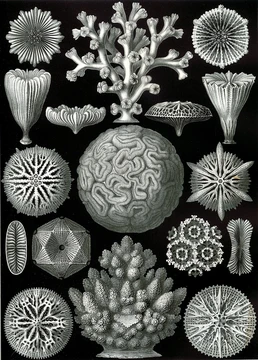
Mussidae
Atlantic stony corals, many called brain corals, vulnerable to climate change.

Mussidae is a family of stony corals belonging to the order Scleractinia. After a taxonomic revision in 2012, this family now includes only Atlantic species; those from the Pacific were moved to the newly created family Lobophylliidae. Many species are commonly called brain corals due to their rounded shape and grooved surface, which resemble the folds of a brain. These corals appear in the reef aquarium trade and are popular in captivity, but they face threats from environmental damage such as coral bleaching. Mussidae is among the coral families most susceptible to climate change.
On morphological grounds, Mussidae had long been recognized as a family, but recent molecular studies revealed that it and several related families are polyphyletic, with similarities arising from convergent evolution. Some traditional genera, including *Favia* and *Scolymia*, also proved polyphyletic; Atlantic faviids and scolymids are more closely related to each other than to their Pacific counterparts. The 2012 classification placed Pacific species into Lobophylliidae and kept Mussidae for Atlantic species, while reducing Faviidae to a subfamily, Faviinae, within Mussidae.
The World Register of Marine Species lists these genera under Mussidae: Subfamily Faviinae includes *Colpophyllia*, *Diploria*, *Favia*, *Manicina*, *Mussismilia*, and *Pseudodiploria*. Subfamily Mussinae includes *Isophyllia*, *Mussa*, *Mycetophyllia*, *Scolymia*, and the extinct *Variabilifavia*.
Mussids are hermatypic, or reef-building, corals that can be solitary or colonial. They typically form massive, robust, dense skeletons. Their corallites—the stony cups housing the polyps—are large, with septa (stony ridges) bearing long teeth. The polyps themselves are large and fleshy; in some species, the body cavity inflates with water during the day, partly exposing the skeleton. All species are zooxanthellate, hosting symbiotic, photosynthetic dinoflagellates in their tissues that supply nutrients from photosynthesis during daylight. At night, the polyps extend their tentacles to capture zooplankton. Budding in mussids is always intracalicular, occurring inside the oral disc within the ring of tentacles. Corallites are either separate or arranged in series, and when coenosteum is present, it extends beyond the septal wall, making it costate.
Quick Facts
- Taxon
- Mussidae
Facts from the source article.
Lore & Background
The family Mussidae has long been recognised on morphological grounds but recent molecular analysis has shown that it, and several other related families, are polyphyletic, the similarities between the species having occurred through convergent evolution. Additionally, some traditional genera such as Favia and Scolymia have been found to be polyphyletic, with the Atlantic faviids and scolymids being more closely related to each other than they are to their Pacific relatives. A revised classification, proposed in 2012, places the Pacific species in a new family, Lobophylliidae and retains the taxon Mussidae for the Atlantic species. The family Faviidae is reduced to a subfamily of Mussidae, Faviinae.
Mussids are hermatypic or reef-building corals and can be either solitary or colonial. They are generally massive corals with robust, dense skeletons. The corallites are large, with the septa decorated by long teeth. The polyps are large and fleshy, and in certain species, the body cavity becomes inflated with water during the day, partially revealing the underlying skeleton. All species are zooxanthellate. At night, the tentacles of the polyps expand and capture zooplankton. Budding in mussids is always intracalicular. The corallites are either separate, or arranged in series, and when the coenosteum is present, it extends beyond the wall of the septa. The septal teeth are pointed and even, either arranged transversely to the plane of the septa or in random directions. With the exception of Scolymia lacera, the teeth are the same size in each cycle of septa. The columella is 'trabecular', in that it lacks discrete individual corallites, because the budding of new polyps within the tentacles on the oral disc results in a series of mouths surrounded by a continuous whorl of tentacles; such intramural budding results in 'trabecular' mouths, which are not individually encircled by tentacles. The resulting corallites that merge form the meandering valleys between costate septa typical of brain corals.
Reader's Guide
Mussidae is notable for its taxonomic revision in 2012, which restricted the family to Atlantic species after molecular analysis revealed polyphyly among traditional groupings. This revision also reduced the family Faviidae to a subfamily of Mussidae, Faviinae. The family is significant in the reef aquarium trade, where its members are popular but slow-growing and require careful separation from other corals. They are described as voracious feeders and easy to care for in captivity. However, Mussidae is under threat from environmental destruction like coral bleaching and is considered one of the coral families most vulnerable to climate change. The family's brain coral morphology—spheroid form with grooved surface—is a result of intracalicular budding that produces meandering valleys between costate septa. All species are zooxanthellate, relying on symbiotic dinoflagellates for nutrients during the day, while capturing zooplankton at night. The family's legacy includes its role in understanding convergent evolution among scleractinian corals, as morphological similarities between Atlantic and Pacific species were found to be due to convergent evolution rather than close relatedness.
Did You Know?
- Mussidae was restricted to Atlantic species following a taxonomic revision in 2012, with Pacific species moved to the new family Lobophylliidae.
- Many Mussidae species are called brain coral due to their spheroid form and grooved surface resembling brain convolutions.
- Budding in mussids is always intracalicular, occurring inside the oral disc of the polyp within the whorl of tentacles.
More in Stony Corals 1-24
Spotted an error? Know more?
Reader corrections go straight into our review queue. Suggest an edit · How this site is sourced