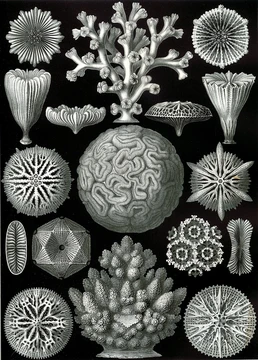
Montastraea
Monotypic Caribbean coral genus with one species, great star coral.

Montastraea is a genus of colonial stony coral that lives in the Caribbean Sea. It belongs to its own family, Montastraeidae, which contains only this genus and a single species: Montastraea cavernosa, commonly called great star coral. The coral grows into large boulders or, in deeper water, flat plates. Its polyps are about the size of a human thumb and come out fully at night.
Colonies of great star coral form massive boulders and domes more than 5 feet (1.5 meters) across in shallow to moderately deep water. In deeper areas, it grows as plates. It appears in most reef environments and is the dominant coral at depths between 40 and 100 feet (12.2 to 30.5 meters). Sometimes the coral shows a fluorescent red or orange color during the day; researchers have suggested this comes from phycoerythrin, a protein from cyanobacteria. The coral may host both symbiotic zooxanthellae and endocellular cyanobacteria, possibly to help fix nitrogen. However, a later study by Oswold et al. (2007) found no functional phycoerythrin in M. cavernosa.
The species is gonochoric, meaning each colony is either male or female. It spawns about one week after the full moon in late August. The skeletons differ by sex: females have less dense skeletons than males, likely because they use energy for egg production.
Bleaching in M. cavernosa can be hard to distinguish from naturally white coral using standard reflectance methods. A survey in the Bay of All Saints found that this confusion could lead to nearly double the estimated rate of bleaching.
Quick Facts
- Grandparent Authority
- Yabe & Sugiyama, 1941
- Taxon
- Montastraea cavernosa
Facts from the source article.
Lore & Background
Great star coral colonies form massive boulders and domes over 5 feet in diameter in shallow and moderate depths. In deeper waters, this coral has been observed growing as a plate formation. It is found throughout most reef environments and is the predominant coral at depths of 40–100 feet. This coral occasionally has a fluorescent red or orange color during daytime; it has recently been suggested that this hue is due to phycoerythrin, a cyanobacterial protein. It appears that, in addition to symbiotic zooxanthella, this coral harbors endocellular symbiotic cyanobacteria, possibly to help it fix nitrogen. However, more recently, Oswold et al. (2007) showed an absence of functional phycoerythrin in M. cavernosa. The species is gonochoric (colonies can be either male or female) and spawns one week after the full moon in late August. Skeletons show sex-related differences, with females having a less dense skeleton compared to males, which is presumably due to reallocating energy to egg production.
Reader's Guide
Montastraea is notable as the sole genus in the family Montastraeidae, containing only Montastraea cavernosa, the great star coral. Its significance lies in its dominance in Caribbean reef environments, particularly at depths of 40–100 feet, where it is the predominant coral. The species exhibits morphological plasticity, forming massive boulders in shallow waters and plates in deeper waters. A unique characteristic is its occasional fluorescent red or orange coloration, initially attributed to phycoerythrin from cyanobacteria, though later research by Oswold et al. (2007) found an absence of functional phycoerythrin, leaving the cause uncertain. The coral also hosts endocellular symbiotic cyanobacteria in addition to zooxanthellae, possibly aiding nitrogen fixation. Its reproductive biology is gonochoric, with spawning timed one week after the full moon in late August, and females have less dense skeletons, likely due to energy allocation to egg production. A practical challenge in monitoring is that bleaching in M. cavernosa is difficult to distinguish from naturally white corals using standard reflectance techniques, leading to potential nearly two-fold overestimation of bleaching, as shown in a survey in the Bay of All Saints.
Did You Know?
- Montastraea is the only genus in the monotypic family Montastraeidae.
- Its polyps are the size of a human thumb and fully extend at night.
- The species is gonochoric, with male and female colonies, and spawns one week after the full moon in late August.
- A survey in the Bay of All Saints found that standard reflectance techniques may lead to nearly two-fold overestimation of bleaching in M. cavernosa.
More in Stony Corals 1-24
Spotted an error? Know more?
Reader corrections go straight into our review queue. Suggest an edit · How this site is sourced