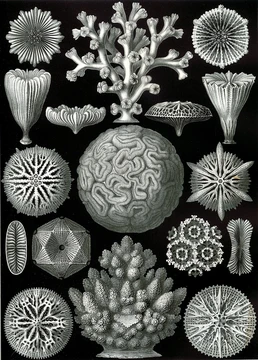
Merulinidae
Colonial reef-building corals with highly fused skeletons.

Merulinidae are a family of stony corals that build reefs. Every genus in this family forms colonies. Their skeletons resemble those of the Faviidae family, but the structures are more heavily fused and lack paliform lobes.
Quick Facts
- Taxon
- Merulinidae
Facts from the source article.
Lore & Background
Merulinidae is a family of reef-building stony corals. All the genera in this family are colonial, reef-building corals. Their skeletal structures are similar to those of Faviidae but are highly fused, without paliform lobes. The valleys are superficial or may be indistinct because of fan-like spreading or contortions in the ridges. Faviidae and Trachyphylliidae are the most closely related families.
Reader's Guide
The family Merulinidae is significant as a group of colonial, reef-building stony corals. Its skeletal structures, while similar to those of Faviidae, are distinguished by being highly fused and lacking paliform lobes. The valleys of the corallum are superficial or may be indistinct due to fan-like spreading or contortions in the ridges. The family's closest relatives are Faviidae and Trachyphylliidae. The World Register of Marine Species includes 27 genera in the family, with some marked as extinct. This family contributes to reef ecosystems through its colonial growth forms and skeletal fusion, which are key characteristics for identification and classification within stony corals.
Did You Know?
- All genera in Merulinidae are colonial, reef-building corals.
- Merulinidae skeletons are highly fused and lack paliform lobes.
- The World Register of Marine Species lists 27 genera in Merulinidae, including extinct ones.
Frequently Asked Questions
What are Merulinidae?
Merulinidae is a family of reef-building stony corals found in tropical marine environments. Every genus within the family grows as a colony rather than as a single solitary polyp.
How do Merulinidae differ from the closely related Faviidae?
Although their skeletons look broadly similar to Faviidae, Merulinidae skeletal elements are noticeably more heavily fused together. They also completely lack the paliform lobes that characterize Faviidae.
Do all Merulinidae form colonies?
Yes, colonial growth is universal across the family—there is no solitary genus among them. This makes them consistent contributors to reef framework construction.
How many genera are recognized in Merulinidae?
The family comprises 27 genera when you include both extant and extinct lineages. This makes it a moderately diverse family within the Scleractinia.
What is the single most distinctive skeletal trait of Merulinidae?
The heavy fusion of skeletal elements is the hallmark that separates them from visually similar families like Faviidae. Coupled with the absence of paliform lobes, this fused architecture is the key diagnostic feature used to identify the family.
More in Stony Corals 1-24
Spotted an error? Know more?
Reader corrections go straight into our review queue. Suggest an edit · How this site is sourced