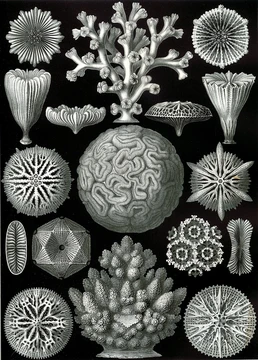
Lobophylliidae
Family of Indo-Pacific large polyp stony corals.

Lobophylliidae is a family of stony corals with large polyps. It was established in 2009 following a reclassification of the "robust" coral families Faviidae, Merulinidae, Mussidae, and Pectiniidae, which molecular studies had revealed to be polyphyletic. The new family grouped together Indo-Pacific species originally placed in Mussidae with certain species formerly belonging to Pectiniidae; the remaining Pectiniidae species were absorbed into Merulinidae. The genus *Lobophyllia* serves as the type genus for the family.
In terms of taxonomy, the traditional classification of these robust families relied on physical traits, but recent genetic analysis demonstrated that the similarities among species arose through convergent evolution, making the groups polyphyletic. For instance, traditional genera like *Favia* and *Scolymia* were also found to be polyphyletic, with Atlantic faviids and scolymids more closely related to each other than to their Indo-Pacific counterparts. A revised classification proposed in 2012 placed Pacific mussid species into Lobophylliidae, while retaining the name Mussidae for Atlantic species. As part of this revision, the genera *Echinomorpha*, *Echinophyllia*, and *Oxypora* were moved from Pectiniidae to Lobophylliidae, and *Moseleya* was transferred from another group.
According to the World Register of Marine Species, the family includes these genera: *Acanthastrea*, *Acanthophyllia*, *Australophyllia*, *Cynarina*, *Echinomorpha*, *Echinophyllia*, *Homophyllia*, *Lobophyllia*, *Micromussa*, *Moseleya*, *Oxypora*, *Paraechinophyllia*, and *Sclerophyllia*.
Quick Facts
- Taxon
- Lobophylliidae
Facts from the source article.
Lore & Background
The family Lobophylliidae was established in 2009 following a revision of the 'robust' stony coral families Faviidae, Merulinidae, Mussidae and Pectiniidae, which molecular analysis had shown to be polyphyletic. The similarities among these groups were found to have arisen through convergent evolution rather than common ancestry. The new family was composed of Indo-Pacific species previously placed in Mussidae, along with some species from Pectiniidae. A further revised classification proposed in 2012 placed the Pacific species of Mussidae in Lobophylliidae, while retaining the taxon Mussidae for Atlantic species. In that revision, the genera Echinomorpha, Echinophyllia and Oxypora were transferred to Lobophylliidae from Pectiniidae, and the genus Moseleya was moved from elsewhere.
Reader's Guide
Lobophylliidae is significant as a reclassification that resolved polyphyly in traditional stony coral families. The family was created in 2009 after molecular analysis revealed that the 'robust' families Faviidae, Merulinidae, Mussidae and Pectiniidae were not monophyletic, with convergent evolution masking true relationships. The revision placed Indo-Pacific species formerly in Mussidae into Lobophylliidae, while Atlantic mussids retained the name Mussidae. This taxonomic split reflects a deeper biogeographic and evolutionary divide. The family also absorbed some genera from Pectiniidae, such as Echinomorpha, Echinophyllia and Oxypora, and the genus Moseleya from elsewhere. The type genus is Lobophyllia. The World Register of Marine Species lists thirteen genera in the family, including Acanthastrea, Cynarina, and Homophyllia. Lobophylliidae thus represents a modern, molecularly informed classification that clarifies the evolutionary history of these corals.
Did You Know?
- Lobophylliidae was created in 2009 after a revision of the polyphyletic families Faviidae, Merulinidae, Mussidae and Pectiniidae.
- The family was formed from Indo-Pacific species traditionally included in Mussidae and some species from Pectiniidae.
- A revised classification proposed in 2012 placed Pacific Mussidae in Lobophylliidae and retained Mussidae for Atlantic species.
Frequently Asked Questions
What is Lobophylliidae?
Lobophylliidae is a family of robust, massive stony corals recognized for their notably large polyps, native to the Indo-Pacific region. The family encompasses 13 genera and sits within the broader group of so-called 'robust' corals.
When and why was Lobophylliidae established?
The family was formally erected in 2009 after molecular phylogenetic analyses demonstrated that the older coral families Faviidae, Merulinidae, Mussidae, and Pectiniidae were polyphyletic rather than a single natural assemblage. Taxonomists therefore carved out Lobophylliidae to unite the Indo-Pacific lineages that genuinely cluster together genetically.
What is the type genus of Lobophylliidae?
The genus Lobophyllia serves as the type genus, giving the family its name and anchoring its defining characteristics. It exemplifies the large-polyp, massive coral morphology that the family was built around.
How did Lobophylliidae absorb species from the old Mussidae and Pectiniidae?
Indo-Pacific species previously filed under Mussidae were folded into the new family, along with a subset of species once placed in Pectiniidae. The remaining Pectiniidae species were reassigned to Merulinidae, effectively dissolving the old family boundaries.
Has the Lobophylliidae classification been updated since 2009?
Yes, a revised classification was proposed in 2012 that further refined the family's internal structure and boundaries. The family is now recognized as containing 13 genera of large-polyp, robust corals.
More in Stony Corals 1-24
Spotted an error? Know more?
Reader corrections go straight into our review queue. Suggest an edit · How this site is sourced