Diploria
Monotypic genus of massive reef-building stony coral.

Diploria is a genus of stony coral that builds massive reefs, belonging to the family Mussidae. It contains only one species: *Diploria labyrinthiformis*, better known as grooved brain coral. This coral lives in the western Atlantic Ocean and the Caribbean Sea, and its surface has a well-known, maze-like pattern.
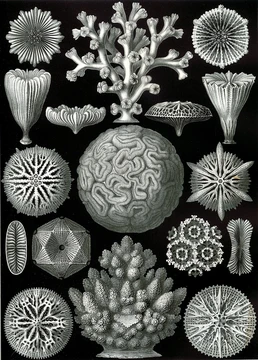
The coral grows in a hemispherical, brain-like shape and can be brown, yellow, or grey. Its surface is marked by deep, connected double-valleys, each separated by grooved ridges called ambulacral ridges. The valleys and grooves sometimes differ in color. *Diploria labyrinthiformis* grows upward at about 3.5 millimeters per year and can reach up to 2 meters (6.6 feet) across. During its larval stage, it can move through the water, but after settling, it becomes permanently attached to the seafloor.
This species feeds by suspension, mainly on zooplankton and bacteria. Its polyps capture prey by extending mesenterial filaments and tentacles, using nematocysts to immobilize it. Mucus and cilia then move the prey to the mouth. The coral is hermaphroditic and reproduces through broadcast spawning, releasing eggs and sperm into the water for fertilization and larval development at the surface. Unlike most other Caribbean broadcast spawners, it spawns over several months, from late spring into mid-autumn.
*Diploria labyrinthiformis* is found in tropical parts of the western Atlantic Ocean, the Gulf of Mexico, the Caribbean Sea, the southern tip of Florida, the Bahamas, Bermuda, and the coasts of Central America. It lives offshore at depths from 1 to 30 meters (3.3 to 98.4 feet). The coral is important for studying past ocean temperatures, as scientists can examine layers in its skeleton.
For years, the IUCN Red List classified this species as Least Concern. However, the 2021 assessment uplisted it due to a predicted decline, partly because it is vulnerable to stony coral tissue loss disease.
The coral hosts *Zooxanthella*, a symbiotic dinoflagellate alga. The alga gains a protected, elevated home, while the coral receives nutrients from the alga’s photosynthesis, which aids its growth and calcification. It also benefits from the long-spined urchin *Diadema antillarum*, whose grazing reduces shading and prevents macroalgae from overgrowing.
Quick Facts
- Taxon
- Diploria labyrinthiformis
Facts from the source article.
Lore & Background
Diploria labyrinthiformis has a hemispherical, brain-like shape with a brown, yellow, or grey colour. It is characterized by deep, interconnected double-valleys separated by grooved ambulacral ridges, with possible colour differences between valleys and grooves. The coral grows upward at about 3.5 millimeters per year, reaching up to 2 metres in diameter. During its planktonic larval stage it has locomotion, after which it becomes permanently sessile.
This species is a suspension feeder, surviving mainly on zooplankton and bacteria captured by polyps using extruded mesenterial filaments and tentacles. Polyps have nematocysts that immobilize prey, which is then transported to the mouth with mucus and cilia. Diploria labyrinthiformis is hermaphroditic and reproduces through broadcast spawning, releasing eggs and sperm over multiple months from late spring to mid-autumn, unlike most other Caribbean broadcast spawners.
It is found in tropical parts of the west Atlantic Ocean, the Gulf of Mexico, the Caribbean Sea, the southern tip of Florida, the Bahamas, Bermuda, and the coasts of Central America, at depths from 1 to 30 metres. The coral hosts Zooxanthella, a symbiotic dinoflagellate alga, and has a relationship with Diadema antillarum, the long-spined urchin, whose grazing reduces shading and macroalgae overgrowth.
Reader's Guide
Diploria labyrinthiformis is notable as the sole species in its genus and as a reef-building coral with a distinctive brain-like appearance. Its growth layers help researchers study historical ocean temperature changes. The species was listed as Least Concern for years on the IUCN Red List, but the most recent assessment in 2021 resulted in a sudden uplisting due to predicted decline, partly from susceptibility to stony coral tissue loss disease. It faces predation from gastropods, polychaetes, sea urchins, starfishes, sea spiders, parrotfish, and other fishes. It is also host to the parasite Corallovexia brevibrachium, which is both an ectoparasite and endoparasite. The coral's symbiotic relationship with Zooxanthella provides nutrients for growth and calcification. Images of Diploria labyrinthiformis appear on three postage stamps: a 75 cent Belizean stamp, a 15 cent United States stamp issued 1980-08-26, and a 54 Euro cent stamp from Mayotte.
More in Stony Corals 1-24
Spotted an error? Know more?
Reader corrections go straight into our review queue. Suggest an edit · How this site is sourced