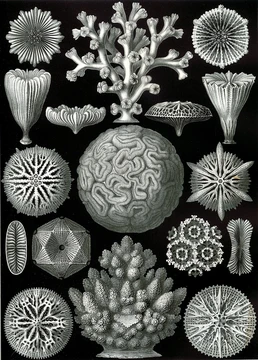
Dichocoenia
A monotypic stony coral with irregular corallites and variable form.

Dichocoenia is a monotypic genus of stony coral in the family Meandrinidae, represented solely by the species Dichocoenia stokesii. It is notable for its variable form—either a massive hemispherical hump or a flat platform—and its irregular, often elongated corallites, which give it a distinctive appearance.
Quick Facts
- Taxon
- Dichocoenia stokesi
Facts from the source article.
Lore & Background
Dichocoenia stokesii forms massive colonial structures, either rounded humps up to 40 cm in diameter or thick plates. Its corallites are notably irregular—oval, elongated (up to 5 cm long and 0.5 cm wide), circular, or Y-shaped—with raised rims and a fragile, spongy columella. The polyps are large, about 4 mm in diameter, and well-separated. Color varies widely, including white, cream, orange, yellowish-brown, green, olive, or brown, with white septo-costae ridges. Occasionally, two individuals grow side by side without fusing, each retaining its original color.
This coral is found in the western Atlantic Ocean and Caribbean Sea, from Bermuda and southern Florida through the Gulf of Mexico to Venezuela. It prefers fore reefs and back reefs but avoids reef crests, with a depth range of 2 to 72 m, though it is commonest at 30 m or less. Corallites are larger and more prominent in deeper individuals. The fossil record indicates its presence in the Caribbean since the Oligocene Era (34 to 23 million years ago).
Dichocoenia stokesii is zooxanthellate, hosting symbiotic green algae. Its polyps retract during the day and emerge at night to feed on plankton. It is preyed upon by some bivalve molluscs and occasionally overgrown by sponges. The species has separate sexes and undergoes two mass spawning events per year, one in late August and another in October. Free-swimming planula larvae settle to form new colonies.
Reader's Guide
Dichocoenia stokesii is significant as the sole representative of its genus, with a distinctive morphology that sets it apart from other meandrinid corals. Its irregular, elongated corallites and variable colony shape—from rounded humps to flat plates—make it a recognizable species in Caribbean and western Atlantic reefs. The article notes its susceptibility to bleaching, though it is more tolerant of thermal stress than many stony corals. However, it is highly vulnerable to white plague disease, especially at high water temperatures. A 1995 epizootic of white plague type II in the Florida Keys killed 75% of its colonies, and due to its slow growth rate and low recruitment, the population has not recovered, leaving reef numbers permanently diminished. It is also affected by black band disease, ciliate infection, and dark-spot syndrome. Despite these threats, its fossil record extending back to the Oligocene underscores its long-term presence in the region. The species' biology—including zooxanthellate symbiosis, nocturnal feeding, and separate sexes with biannual spawning—provides context for its ecological role. Its legacy is one of a relatively uncommon coral that has faced severe disease outbreaks, highlighting the fragility of slow-growing, low-recruitment species in changing marine environments.
Did You Know?
- Dichocoenia stokesii is the only species in the genus Dichocoenia.
- Its corallites can be up to 5 cm long and only 0.5 cm wide.
- In the Florida Keys in 1995, 75% of Dichocoenia stokesii colonies were killed by white plague type II.
More in Stony Corals 1-24
Spotted an error? Know more?
Reader corrections go straight into our review queue. Suggest an edit · How this site is sourced