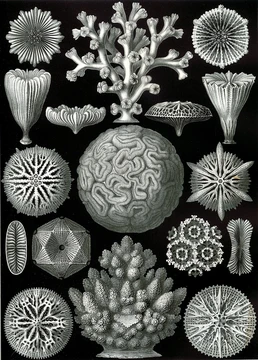
Dendrophyllia
A genus of deep-sea azooxanthellate stony cup corals.

Dendrophyllia is a genus of stony cup corals belonging to the family Dendrophylliidae. These corals live in deep water, reaching depths of up to about 900 meters (3,000 feet). Unlike many other coral species, they are azooxanthellate, meaning they lack the symbiotic photosynthetic dinoflagellates that provide energy to shallow-water corals.
The following species are recognized by the World Register of Marine Species (WoRMS): Dendrophyllia aculeata, D. alcocki, D. alternata, D. arbuscula, D. boschmai, D. californica, D. carleenae, D. cecilliana, D. cladonia, D. compressa, D. cornigera, D. cribrosa, D. dilatata, D. florulenta, D. futojiku, D. granosa, D. ijimai, D. incisa, D. indica, D. johnsoni, D. laboreli, D. minima, D. minuscula, D. oldroydae, D. paragracilis, D. radians, D. ramea, D. robusta, D. suprarbuscula, and D. velata.
Quick Facts
- Taxon
- Dendrophyllia
Facts from the source article.
Lore & Background
Dendrophyllia is a genus of stony cup corals within the family Dendrophylliidae. Unlike many shallow-water corals, they are azooxanthellate, meaning they lack symbiotic photosynthetic dinoflagellates and thus do not rely on sunlight for energy. This allows them to inhabit depths down to about 900 metres (3,000 ft).
The World Register of Marine Species lists 30 species in the genus, including Dendrophyllia aculeata, Dendrophyllia alcocki, Dendrophyllia alternata, and Dendrophyllia arbuscula, among others. The species were described by various authors such as Latypov, Wells, Pourtalès, van der Horst, and many others, spanning from the 19th century to the early 2000s.
Notable species include Dendrophyllia cornigera, described by Lamarck in 1816, and Dendrophyllia ramea, described by Linnaeus in 1758. The genus includes both shallow and deep-water forms, all sharing the characteristic of lacking symbiotic algae.
Reader's Guide
Dendrophyllia is significant as a genus of azooxanthellate stony corals that thrive in deep waters, down to about 900 metres. Their lack of symbiotic photosynthetic dinoflagellates distinguishes them from many reef-building corals and allows them to occupy habitats where light is absent. The genus includes 30 recognized species according to the World Register of Marine Species, with descriptions dating from the 18th century (e.g., Dendrophyllia ramea by Linnaeus) to the early 2000s (e.g., Dendrophyllia futojiku by Ogawa & Takahashi). These corals are cup corals, forming part of the family Dendrophylliidae. Their deep-sea distribution and azooxanthellate nature make them important for understanding coral diversity beyond sunlit reefs. The species list includes contributions from many researchers, reflecting a long history of taxonomic study. The genus serves as an example of how corals can adapt to extreme environments without relying on photosynthesis.
Did You Know?
- Members of this genus are found at depths down to about 900 metres (3,000 ft).
- Dendrophyllia ramea was described by Linnaeus in 1758.
More in Stony Corals 1-24
Spotted an error? Know more?
Reader corrections go straight into our review queue. Suggest an edit · How this site is sourced