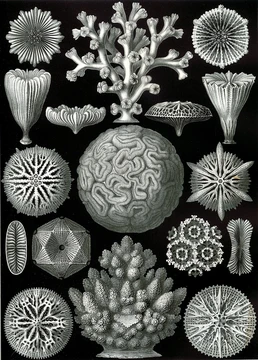
Ctenella
Monotypic stony coral endemic to the Chagos Archipelago.

Ctenella is a monotypic genus of stony coral in the family Euphylliidae, represented solely by the species Ctenella chagius. It is notable for its massive, hemispherical, brain-like appearance and its endemic distribution to the Chagos Archipelago in the Indian Ocean.
Quick Facts
- Taxon
- Ctenella chagius
Facts from the source article.
Lore & Background
Ctenella chagius forms solid, smooth hemispherical domes that can grow up to a meter in diameter. Its surface is fissured with a brain-like appearance, featuring meandering valleys between the calyces. The valleys are about 1 cm deep and 1.5 cm wide, with solid, non-porous ridges. The fine septa radiating from the corallites are closely packed and evenly spaced, some continuing over the ridges. The coral is a pale brown color and is zooxanthellate, hosting symbiotic unicellular dinoflagellate algae within its tissues.
Reader's Guide
Ctenella chagius is listed as critically endangered on the IUCN Red List. Its population size is unknown, but the reefs it inhabits are degrading faster than the coral can establish new colonies. The species is highly susceptible to coral bleaching and coral diseases, both of which are increasing with rising sea temperatures. Human activities also pose threats, though the Chagos Islands are now part of the Chagos Marine Protected Area, which may offer some protection. The coral is found in lagoons and on reef slopes at depths up to 45 meters around the Chagos Archipelago. Its restricted range and vulnerability to environmental stressors make its conservation status particularly concerning.
Did You Know?
- Ctenella is a monotypic genus, containing only the species Ctenella chagius.
- The coral can grow to a meter in diameter and forms solid, smooth hemispherical domes.
More in Stony Corals 1-24
Spotted an error? Know more?
Reader corrections go straight into our review queue. Suggest an edit · How this site is sourced