Colpophyllia
Monotypic genus of boulder brain coral, a Caribbean reef builder.

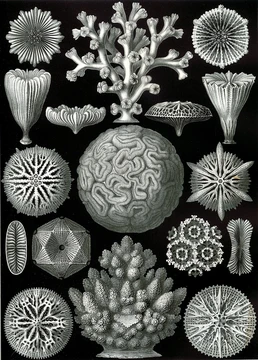
Colpophyllia is a genus of stony coral belonging to the family Mussidae. It contains just one species, *Colpophyllia natans*, which goes by the common names boulder brain coral or large-grooved brain coral. This coral lives on the slopes and tops of reefs, reaching depths of up to 50 metres. Its colonies are large and dome-shaped, sometimes growing as wide as 2 metres across. The surface is covered in a winding pattern of ridges and valleys. The ridges are typically brown and have a single groove running along the top, while the valleys are tan, green, or white and are all about 2 centimetres wide. The polyps only extend their tentacles at night.
Colonies are usually broadly domed, and the curve becomes more pronounced as the colony gets larger and older. Younger colonies may be flat-topped discs. The skeleton’s surface looks like a maze of curving valleys and ridges, similar to the folds of a brain. The ridge tops have a thin groove. The width of the ridges and valleys—up to 2 centimetres—helps tell this coral apart from the similar-looking *Diploria*, which has narrower features. Because of its robust size and slow growth, boulder brain coral can survive conditions that kill smaller, more fragile corals, like the plate-like lettuce coral (*Agaricia agaricites*). Along with the boulder star coral (*Montastraea annularis*), it is less likely to be smothered by algal blooms and survived Hurricane Allen off Jamaica in 1980. Caribbean corals are vulnerable to bleaching from high water temperatures and sunlight. A 2005 study compared bleaching mortality in *C. natans* and the finger-like *Porites porites*. Though both species bleached to a similar degree, 56% of the *P. porites* colonies died, compared to just 8% of the *C. natans* colonies. However, bleaching triggered widespread White Plague Type II, which caused 42% mortality in *C. natans* over nine months—nearly as high as the death rate for *P. porites*.
Boulder brain corals are found on reefs in the Caribbean Sea and Gulf of Mexico, most often off Belize, the eastern Yucatán Peninsula, southern Florida, Puerto Rico, the Virgin Islands, and Cuba. They appear in the fossil record from at least the early Pliocene. *C. natans* is a major reef-building coral in the Caribbean and is common on shallow reef ledges and slopes. It can live as deep as 50 metres but is usually found closer to the surface.
*C.
Quick Facts
- Taxon
- Colpophyllia natans
Facts from the source article.
Lore & Background
Colpophyllia natans forms large, broadly domed colonies up to 2 metres across, with curvature increasing with age. The surface is a network of winding ridges and valleys, the ridges being brown with a single groove, and the valleys tan, green, or white, uniform in width. Polyps extend tentacles only at night. The species is long-lived, with specimens capable of living more than two hundred years. It is a hermaphroditic broadcast spawner, releasing gametes synchronously; after fertilization, the planula larva settles on suitable substrate to form a new colony, though this process has a high failure rate. The species is susceptible to more coral diseases than most others in its habitat, including black band disease, yellow-band disease, white plague types I, II, and III, dark spot, and skeletal anomalies. An unidentified pathogen killed about half the corals at Bird Key Reef between 2001 and 2002.
Reader's Guide
Colpophyllia natans is considered one of the dominant reef-building corals of the Caribbean region, inhabiting reef slopes and tops down to 50 metres. Its robust shape and slow growth allow it to survive conditions that kill smaller, more fragile corals, such as the plate-like lettuce coral. It weathered Hurricane Allen off Jamaica in 1980 and is less likely to be smothered by algal bloom than some species. A 2005 nine-month study found that while bleaching severity was similar to that of Porites porites, only 8% of bleach-affected C. natans colonies died, compared to 56% of P. porites. However, bleaching induced widespread White Plague Type II, causing 42% mortality in C. natans over the same period. The species is identifiable in fossil records since the early Pliocene. Its first description was by Maarten Houttuyn in 1772 as Madrepora natans, later moved to Colpophyllia by Henri Milne-Edwards and Jules Haime in 1848. A synonym is Meandrina gyrosa, and there is dispute over whether Colpophyllia breviserialis is the same species.
Did You Know?
- Colpophyllia is monotypic, containing only the species Colpophyllia natans.
- The species is also known as boulder brain coral or large-grooved brain coral.
- It is one of only twenty-two coral species worldwide known to be afflicted by more than three diseases.
- A nine-month study found 8% mortality from bleaching in C. natans, compared to 56% in Porites porites.
More in Stony Corals 1-24
Spotted an error? Know more?
Reader corrections go straight into our review queue. Suggest an edit · How this site is sourced