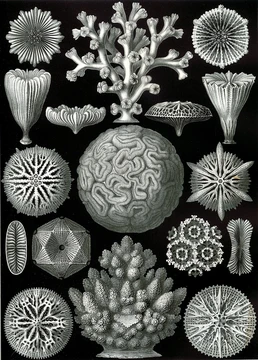
Balanophyllia
A genus of solitary stony corals with two subgenera.

Balanophyllia is a genus of corals that live alone, not in colonies, and belong to the group known as stony corals. Within this genus, there are two subgroups, or subgenera: Balanophyllia (Balanophyllia) and Balanophyllia (Eupsammia).
Quick Facts
- Taxon
- Balanophyllia
Facts from the source article.
Lore & Background
The genus Balanophyllia was established by Wood in 1844. It is divided into two subgenera: Balanophyllia (Balanophyllia) and Balanophyllia (Eupsammia). The subgenus Balanophyllia (Balanophyllia) contains numerous species described by various authors including Milne Edwards & Haime, Cairns, van der Horst, Verrill, Durham, Duncan, Squires, Alcock, Moseley, Zibrowius, Vaughan, Tenison Woods, Harrison & Poole, Dennant, Semper, Pourtalès, Klunzinger, Abe, Wright, Gardiner, Gosse, Dana, Bourne, Crossland, and others. Some species are noted as extinct, indicated by a dagger symbol (†), such as Balanophyllia javaensis, Balanophyllia pittieri, and Balanophyllia ukrainensis.
Reader's Guide
The genus Balanophyllia is notable as a group of solitary stony corals, distinct from colonial forms. Its division into two subgenera—Balanophyllia (Balanophyllia) and Balanophyllia (Eupsammia)—reflects taxonomic organization within the genus. The extensive list of species under Balanophyllia (Balanophyllia) demonstrates a wide geographic and temporal distribution, with species described from locations such as the Cape of Good Hope (bonaespei, capensis), California (cedrosensis), Florida (floridana), the Galapagos (galapagensis), Japan (iwayamaensis, japonica), Hawaii (kalakauai, laysanensis), and the Mediterranean (europaea). The inclusion of extinct species (javaensis, pittieri, ukrainensis) indicates a fossil record. The subgenus Balanophyllia (Eupsammia) includes species like Balanophyllia caribbeana from the Caribbean and Balanophyllia imperialis. The genus's significance lies in its contribution to the diversity of stony corals and its representation in both modern and fossil coral faunas.
Did You Know?
- Balanophyllia is a genus of solitary corals in the order of stony corals.
- The genus includes two subgenera: Balanophyllia (Balanophyllia) and Balanophyllia (Eupsammia).
- Some species in the genus are extinct, such as Balanophyllia javaensis, Balanophyllia pittieri, and Balanophyllia ukrainensis.
- Species in the genus have been described by authors including Milne Edwards & Haime, Cairns, Verrill, and Pourtalès.
More in Stony Corals 1-24
Spotted an error? Know more?
Reader corrections go straight into our review queue. Suggest an edit · How this site is sourced