Astroides
Monotypic cup coral endemic to the western Mediterranean Sea.

Astroides is a genus within the stony cup coral family Dendrophylliidae. It is monotypic, with its sole member being *Astroides calycularis*, a species found only in the western Mediterranean. German naturalist Peter Simon Pallas provided the first scientific description of this coral in 1766.
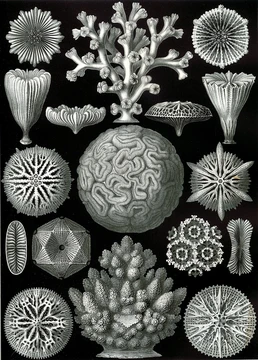
Colonies of *Astroides calycularis* are formed by multiple polyps, each housed in its own stony cup, or calyx. These colonies typically measure 25 to 30 cm across and reach about 10 cm in height, with individual polyps spanning 1 to 2 cm in diameter. The polyps are yellow or orange and feature a fringe of roughly thirty very short tentacles around a slit-shaped mouth. Growth occurs through asexual budding, where new polyps emerge from existing ones and secrete their own calices. In deeper waters, colonies take on a bushy shape with circular calices, and budding happens at various points along the calyx walls. In shallower areas, colonies tend to be ellipsoid, the calyces are polygonal, and budding occurs both at the colony’s center and around its edges.
During the Pleistocene, *Astroides calycularis* occupied a broader range across the entire western Mediterranean. It later vanished from the northern part of that area due to lower sea temperatures linked to glaciation. Today, it is native to the western Mediterranean south of Sardinia and also appears in the Atlantic Ocean near the Strait of Gibraltar. Until 1989, it was confined to waters west of Sicily, but that year it was first recorded in the Adriatic Sea. This expansion coincided with a shift in eastern Mediterranean circulation, which may have allowed its short-lived pelagic larvae to survive long enough to settle along the Croatian coast. The coral lives on rocks, walls, under overhangs, and in submarine caves down to depths of about 70 m. In favorable spots, colonies can cover up to 90% of the available surface. In one Italian cave, it was more common in well-lit areas than the solitary sunset cup coral (*Leptopsammia pruvoti*), and it was especially abundant where sulphurous spring water entered the cave.
*Astroides calycularis* is nocturnal, with polyps staying retracted into their calices during the day. At night, they extend to feed on zooplankton, small fish, and possibly bacteria. This coral is azooxanthellate, meaning it lacks the symbiotic dinoflagellates found in many other corals.
Quick Facts
- Taxon
- Astroides calycularis
Facts from the source article.
Lore & Background
Astroides calycularis is a colonial coral, each polyp sitting in a stony cup called a calyx. Colonies grow by asexual reproduction, with new polyps budding off existing ones. Deep-water colonies are bush-shaped with circular calices, while shallow-water colonies tend to be ellipsoid with polygonal calyces. During the Pleistocene, the species had a wider distribution across the western Mediterranean but disappeared from northern areas due to lower sea temperatures from glaciation. It is now native to the western Mediterranean south of Sardinia and also occurs in the Atlantic near the Strait of Gibraltar. In 1989, it appeared in the Adriatic Sea for the first time, possibly due to a change in circulation that allowed its pelagic larvae to reach the Croatian coast. It inhabits rocks, walls, overhangs, and submarine caves down to about 70 m depth, and in suitable locations colonies can cover 90% of the substrate.
Reader's Guide
Astroides calycularis is notable as the sole species in its genus and for its restricted modern distribution, which contrasts with its wider Pleistocene range. Its appearance in the Adriatic Sea in 1989, linked to a shift in Mediterranean circulation, highlights how oceanographic changes can influence species dispersal. The coral is azooxanthellate, lacking symbiotic dinoflagellates, and is nocturnal, feeding on zooplankton and small fish. Its reproductive strategy is gonochoristic, with colonies being single-sex; males release sperm, fertilization occurs in the female's coelenteron, and embryos are brooded before release as planula larvae. In a cave in Italy, it was more common in better-lit areas and near sulphurous spring water than the solitary sunset cup coral. These ecological and reproductive traits underscore its adaptation to specific Mediterranean habitats and its value as a subject for studying biogeography and climate-driven range shifts.
Did You Know?
- Astroides calycularis was first described in 1766 by German naturalist Peter Simon Pallas.
- Colonies can cover up to 90% of available substrate in suitable locations.
- It is azooxanthellate, meaning it lacks symbiotic dinoflagellates in its tissues.
More in Stony Corals 1-24
Spotted an error? Know more?
Reader corrections go straight into our review queue. Suggest an edit · How this site is sourced