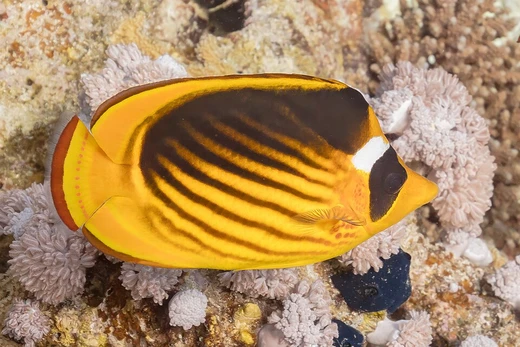
Pseudotropheus saulosi
Electric-blue males and golden-yellow females guard every rock in Lake Malawi's Mouth region.

Pseudotropheus saulosi, commonly known as the Saulosi cichlid or Blue Saulosi, is a small mbuna (rock-dwelling) cichlid endemic to the rocky littoral zones of Lake Malawi in East Africa. Described by Tavares Ribeiro in 1995 from the Mouth region of the lake, it belongs to the haplochromine radiation that makes Lake Malawi one of the most species-rich freshwater systems on Earth. The species is instantly recognizable in the hobby for its bold sexual dimorphism: adult males display a vivid electric-blue coloration, while females are a contrasting golden-yellow, making it one of the most visually striking mbuna pairs available to aquarists.
In the aquarium trade, P. saulosi occupies a niche as a mid-sized, highly territorial rock-dweller that rewards keepers who provide ample rocky terrain and compatible tankmates. It is a livebearing mouthbrooder—females incubate fertilized eggs and early-stage fry in the oral cavity—giving it a reproductive strategy shared across much of the Malawi haplochromine fauna. Its popularity stems from the dramatic color contrast between sexes and its manageable size relative to larger mbuna species.
- Common name
- Saulosi cichlid / Blue Saulosi
- Family
- Cichlidae (subfamily Haplochrominae)
- Origin
- Lake Malawi, Africa – Mouth region (rocky littoral)
- Habitat type
- Freshwater, rocky shallows
- Reproduction
- Female mouthbrooding (livebearing)
- Sexual dimorphism
- Males electric-blue; females golden-yellow
- Typical adult length
- Approximately 8–10 cm (3–4 in)
Lore & Background
Pseudotropheus saulosi was formally described in 1995 by the Portuguese malacologist and ichthyologist Tavares Ribeiro, drawing on material collected from the rocky, shallow bays of the Mouth region in the northern part of Lake Malawi. The Mouth area is characterized by exposed granite and gneiss outcrops that rise steeply from the waterline, creating the kind of crevice-rich, algae-covered microhabitat that defines the mbuna ecological guild. P. saulosi occupies this niche as a mid-level rock grazer, picking at diatoms, filamentous algae, and small attached invertebrates from the stone surfaces.
In the wild, social structure is dominated by male territoriality. A single blue male will claim a cluster of rocks and defend it aggressively against conspecific males and, to a lesser degree, against other mid-sized mbuna species. Females, less conspicuous in their yellow coloration, forage in the periphery and enter the male's territory only to spawn. After the female collects the fertilized eggs, she retreats to a sheltered crevice to complete incubation, a behavior typical of haplochromine mouthbrooders. This reproductive strategy buffers the species against predation on free-swimming larvae, a critical advantage in a lake teeming with piscivorous haplochromines.
Within the broader Lake Malawi radiation, P. saulosi is one of hundreds of closely related mbuna species that have diversified in response to competition for rock-dwelling niches. Its vivid blue-and-yellow sexual dichromatism is thought to function in mate recognition and territorial signaling, with the blue male coloration intensifying during breeding and aggressive displays. The species remains relatively abundant in its native range but, like many Lake Malawi endemics, is sensitive to habitat degradation from shoreline development and changes in water chemistry.
Reader's Guide
TERRAIN & TANK SETUP: Provide a densely packed rocky landscape with multiple caves, overhangs, and crevices. A minimum of 150 L (≈40 US gal) is the widely cited lower bound for a single male plus a small group of females; experienced keepers recommend 200 L+ for a stable community. Source: published mbuna husbandry literature (e.g., Balazs, 1999; Tavares Ribeiro & Van der Werff, 1997) and long-standing keeper consensus on mbuna stocking.
WATER PARAMETERS: Maintain a pH of approximately 7.5–8.5 and a temperature of 24–28 °C (75–82 °F). Lake Malawi water is hard and alkaline, so a carbonate-hardness substrate (crushed coral or aragonite) is standard practice. Source: published aquaculture literature on haplochromine husbandry.
DIET: Offer a varied diet of high-quality flake or pellet base supplemented with blanched vegetables (zucchini, spinach) and occasional frozen brine shrimp or daphnia. P. saulosi is omnivorous with a strong algal component in the wild. Source: dietary observations in field literature and keeper consensus.
COMPATIBILITY & BEHAVIOR: Keep with other mbuna species of similar size and energy level. Avoid pairing with very small or slow-moving species that will be outcompeted for food. A common mistake is under-stocking: a single male with only one or two females leads to chronic harassment of the females. Aim for a ratio of 1 male to 3–5 females minimum. Source: experienced keeper consensus and published community-keeping guidelines.
COMMON MISTAKES: (1) Placing P. saulosi in a smooth-sand-only tank without rockwork, which removes their primary foraging and shelter structure. (2) Overfeeding, which degrades water quality and increases aggression. (3) Introducing them to a tank with incompatible, highly aggressive large mbuna or predatory haplochromines. Source: keeper consensus and published troubleshooting literature.
More in Aquarium Keeping
Elsewhere in Diagonal butterflyfish
Spotted an error? Know more?
Reader corrections go straight into our review queue. Suggest an edit · How this site is sourced