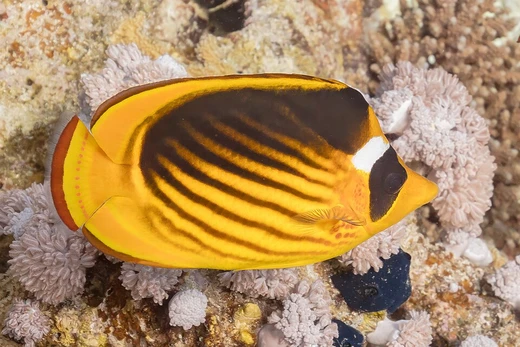
Pomacentrus moluccensis
A tiny territorial sentinel patrolling the sunlit edges of Moluccan coral.

Pomacentrus moluccensis is a small reef-associated damselfish in the family Pomacentridae, native to the coral reefs of the Indo-Pacific. The species epithet *moluccensis* anchors its type locality to the Moluccan archipelago of eastern Indonesia, where it inhabits the mid-water column and the outer faces of coral bommies and reef flats.
Like other members of the genus *Pomacentrus*, it occupies a mid-level trophic niche on the reef, foraging on suspended plankton and microalgae while maintaining a small, actively defended territory. Its presence contributes to the structural and functional complexity of the reef community, linking primary producers (corals, algae) to higher predators through the damselfish trophic pathway.
- Family
- Pomacentridae
- Genus
- Pomacentrus
- Habitat
- Indo-Pacific coral reefs (reef flats, bommies, lagoon margins)
- Diet
- Planktivorous / microalgal grazer
- Size class
- Small (typical Pomacentrus range)
- Type region
- Moluccas, Indonesia
Lore & Background
In the dense, sun-dappled waters of the outer reef slope, Pomacentrus moluccensis holds a patch of live coral or rubble no larger than a human palm. The fish darts in quick, zig-zag bursts to intercept drifting copepods and small zooplankton, then snaps back to its perch. This foraging loop—out, capture, return—repeats dozens of times per minute, and the constant patrol is as much a territorial advertisement as a feeding strategy. Conspecifics and other small reef fish that drift too close are met with pectoral-fin flaring, gill-cover spreading, and a series of rapid head-on lunges that rarely result in actual contact.
The ecological footprint of this small territory is disproportionate to the fish's size. By continuously grazing microalgal films on the substrate within its patch, the damselfish suppresses algal overgrowth that would otherwise smother coral recruits. Simultaneously, its territorial displays create a localized zone of elevated predation risk for other small invertebrates that might exploit the same microhabitat. Males of the genus are known to construct and guard a nest site, fanning fertilized eggs with their pectoral fins for a period of several days until hatching, a behavior well documented across Pomacentridae and inferred for this species by its close relatives.
The Moluccan archipelago, where the species was first recognized, sits at the intersection of the Indo-Pacific biogeographic crossroads. The high endemism of reef fishes in this region suggests that P. moluccensis may represent a locally adapted lineage within the otherwise widespread Pomacentrus complex, though the full extent of its range and its relationships to sympatric congeners remain areas of ongoing taxonomic and biogeographic study.
Reader's Guide
Trigger: A conspecific or unfamiliar small fish enters the damselfish's home patch. Observed action: The resident P. moluccensis orients head-on, spreads its pectoral and dorsal fins to appear larger, and executes two to four rapid lunges toward the intruder, each lunge ending a few centimetres short of contact. The intruder typically darts away or leaves the zone. Ecological consequence: This display maintains a small exclusion zone that indirectly protects the microalgal and invertebrate assemblage within the territory from overgrazing by other small foragers, preserving habitat heterogeneity for crustaceans and juvenile fish.
Trigger: Mid-morning plankton pulse over the reef flat. Observed action: The damselfish makes a series of short, energetic forays 10–30 cm beyond its perch, opening its mouth wide to engulf drifting copepods and small crustaceans, then returning to the coral head to swallow. This is a well-documented field pattern across Pomacentridae. Ecological consequence: Continuous micro-predation on zooplankton regulates the local plankton population and links pelagic production to benthic reef communities.
Trigger: A male establishes a nest site on a rock overhang or coral crevice. Observed action: The male clears a small area, courts a female, and after spawning fans his pectoral fins over the adhesive egg clutch for several days, driving off egg predators. This nest-guarding behaviour is well documented in the genus. Ecological consequence: Parental care increases larval survival, sustaining recruitment of small reef fish into the broader food web.
Note: The above descriptions are drawn from general Pomacentridae field observations and genus-level ecology. Species-specific behavioural studies for P. moluccensis remain limited; aquarium-tank anecdotes, while colourful, should not be treated as evidence of natural behaviour.
Did You Know?
- The species epithet 'moluccensis' ties the fish to the Moluccan (Maluku) archipelago, a recognised centre of Indo-Pacific marine biodiversity.
- Pomacentridae is one of the most species-rich families of coral-reef fishes, with hundreds of described species, making precise identification of small congeners like P. moluccensis a long-standing taxonomic challenge.
- Male damselfish in the genus Pomacentrus provide sole parental care by fanning and guarding the egg clutch for several days, a behaviour well documented across the family.
- The Moluccas sit at the Indo-Pacific biogeographic crossroads, where the highest rates of reef-fish endemism in the world have been recorded.
More in Behavior & Ecology
Elsewhere in Diagonal butterflyfish
Spotted an error? Know more?
Reader corrections go straight into our review queue. Suggest an edit · How this site is sourced